
BMN 673 (Synonyms: Talazoparib) |
| رقم الكتالوجGC15932 |
BMN 673 is a novel and highly potent poly (ADP-ribose) polymerase1 and 2 (PARP1/2) inhibitor with Ki = 1.2 nM and Ki = 0.87nM, respectively.
Products are for research use only. Not for human use. We do not sell to patients.
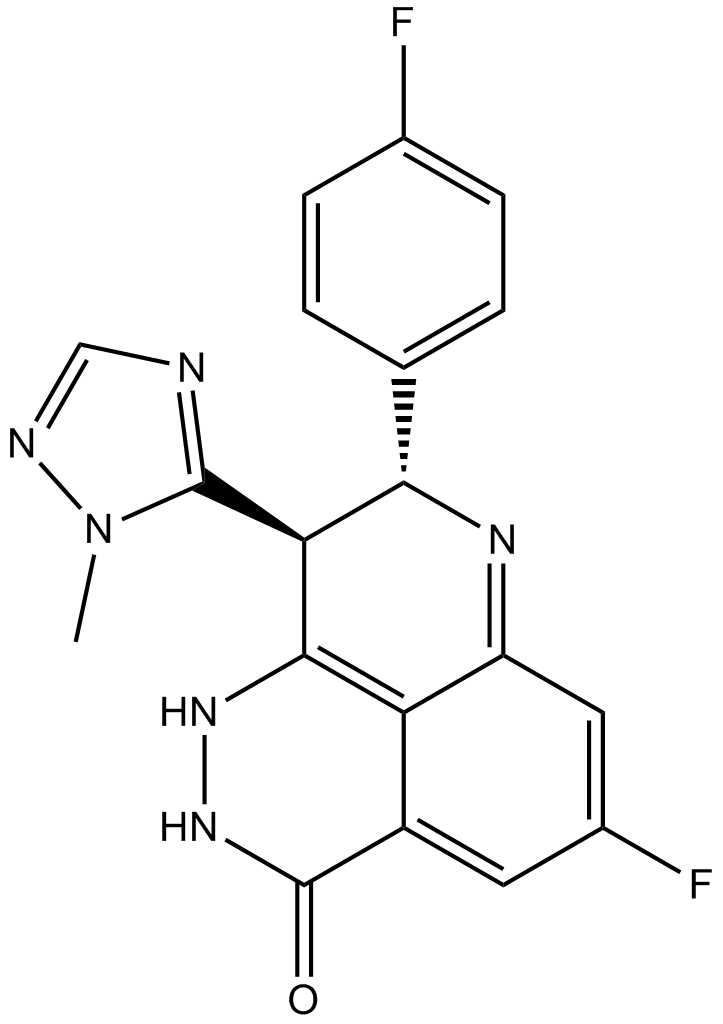
Cas No.: 1207456-01-6
Sample solution is provided at 25 µL, 10mM.
BMN 673 is a novel and highly potent poly (ADP-ribose) polymerase1 and 2 (PARP1/2) inhibitor with Ki = 1.2 nM and Ki = 0.87nM, respectively[1]. BMN 673 interferes the DNA single-strand breaks repair function of PARP1/2 and emerges as an anticancer agents[2].
In vitro, BMN 673 (1nM-10μM) treatment on wild-type avian B-lymphoblast DT40 cells for 72h produced PARP-mediated cytotoxicity with IC90 value of 30nM but shows no cytotoxic effect on PARP1−/− DT40[3]. BMN 673 (0.01, 0.05, 0.1, 0.5, 1, 5, and 10nM) incubated wild‐type triple negative breast cancer MDA‐MB‐231 cells for 6 to 12 days and exerted inhibitory effects on cells by inducing apoptosis, multicaspase activity, G2/M arrest, and altering the expression levels of apoptosis‐related genes[4].
In vivo, BMN 673 (1mg/kg) was administered via i.p. injection every other day for a total of five doses into Brca−/− murine ovarian carcinoma cells engrafted FVB mice. BMN 673 significantly increased the number of peritoneal CD8+ T cells and NK cells as well as their production of IFN-γ and TNF-α, and finally increased mice survival rate[5]. Oral administration of BMN 673 for 28 days (0.1mg/kg/day or 0.33mg/kg/day) into nude mice bearing subcutaneous human embryonic lung fibroblast cells tumor significantly inhibited tumor progression with no animal lethality or significant weight loss[6]. BMN 673 (0.33mg/kg) was administered by oral gavage once daily into pancreatic ductal adenocarcinoma (PDAC) xenografted mice models for four weeks. BMN 673 resulted in significant tumor growth inhibition and reduced induced apoptosis by increasing cleaved caspase-3[7].
References:
[1] Wang B, Chu D, Feng Y, et al. Discovery and Characterization of (8S,9R)-5-Fluoro-8-(4-fluorophenyl)-9-(1-methyl-1H-1,2,4-triazol-5-yl)-2,7,8,9-tetrahydro-3H-pyrido[4,3,2-de]phthalazin-3-one (BMN 673, Talazoparib), a Novel, Highly Potent, and Orally Efficacious Poly(ADP-ribose) Polymerase-1/2 Inhibitor, as an Anticancer Agent. J Med Chem. 2016 Jan 14;59(1):335-57.
[2] De Bono JS, Mina LA, Gonzalez M, et al. First-in-human trial of novel oral PARP inhibitor BMN 673 in patients with solid tumors. J Clin Oncol. 2013; 31(suppl):abstr 2580.
[3] Murai J, Huang S N, Renaud A, et al. Stereospecific PARP trapping by BMN 673 and comparison with olaparib and rucaparib. Mol Cancer Ther. 2014 Feb;13(2):433-43.
[4] Eskiler G G, Cecener G, Egeli U, Tunca B. BMN 673 (talazoparib): A potent PARP inhibitor for triple negative breast cancer with different genetic profile. J Biochem Mol Toxicol. 2019 May;33(5):e22286.
[5] Huang H, Wang L, Cong Z Y, et al. The PARP1 inhibitor BMN 673 exhibits immunoregulatory effects in a Brca1(-/-) murine model of ovarian cancer. Biochem Biophys Res Commun. 2015 Aug 7;463(4):551-6.
[6] Shen Y Q, Rehman F L, Feng Y, et al. BMN 673, a novel and highly potent PARP1/2 inhibitor for the treatment of human cancers with DNA repair deficiency.Clin Cancer Res. 2013 Sep 15;19(18):5003-15.
[7] Andrei A Z, Hall A, Smith A L, et al. Increased in vitro and in vivo sensitivity of BRCA2-associated pancreatic cancer to the poly(ADP-ribose) polymerase-1/2 inhibitor BMN 673. Cancer Lett. 2015 Aug 1;364(1):8-16.
| Cell experiment [1]: | |
Cell lines | Wild‐type triple negative breast cancer MDA‐MB‐231 cells |
Preparation Method | MDA-MB-231 cells were seeded into in a 96-well culture plates due to differences in the growth rate. After a 24h incubation, these cell were treated with different concentrations (0.01, 0.05, 0.1, 0.5, 1, 5, and 10nM) of BMN 673 and incubated for 6 to12 days. |
Reaction Conditions | 0.01, 0.05, 0.1, 0.5, 1, 5, and 10nM; 6 to 12 days |
Applications | BMN 673 exerted inhibitory effects on cells by inducing apoptosis, multicaspase activity, G2/M arrest, and altering the expression levels of apoptosis‐related genes. |
| Animal experiment [2]: | |
Animal models | Female SCID/Beige mice |
Preparation Method | Patient-derived pancreatic ductal adenocarcinoma (PDAC) were implanted subcutaneously on both flanks of two 5-week old female SCID/Beige mice. BMN 673 (0.33mg/kg, 0.05cc) and the vehicle (0.05cc of 10% dimethylacetamide, 6% Solutol in PBS) were administered by oral gavage once daily into mice models for four weeks. |
Dosage form | 0.33mg/kg; oral gavage; daily for 4 weeks |
Applications | BMN 673 resulted in significant tumor growth inhibition and reduced induced apoptosis by increasing cleaved caspase-3. |
References: | |
| Cas No. | 1207456-01-6 | SDF | |
| المرادفات | Talazoparib | ||
| Chemical Name | (8R,9S)-5-fluoro-8-(4-fluorophenyl)-9-(1-methyl-1H-1,2,4-triazol-5-yl)-8,9-dihydro-1H-pyrido[4,3,2-de]phthalazin-3(2H)-one | ||
| Canonical SMILES | FC1=CC2=N[C@@H](C(C=C3)=CC=C3F)[C@H](C4=NC=NN4C)C(NNC5=O)=C2C5=C1 | ||
| Formula | C19H14F2N6O | M.Wt | 380.35 |
| الذوبان | ≥ 19.0 mg/mL in DMSO, ≥ 14.2 mg/mL in EtOH with ultrasonic and warming | Storage | Store at -20°C |
| General tips | Please select the appropriate solvent to prepare the stock solution according to the
solubility of the product in different solvents; once the solution is prepared, please store it in
separate packages to avoid product failure caused by repeated freezing and thawing.Storage method
and period of the stock solution: When stored at -80°C, please use it within 6 months; when stored
at -20°C, please use it within 1 month. To increase solubility, heat the tube to 37°C and then oscillate in an ultrasonic bath for some time. |
||
| Shipping Condition | Evaluation sample solution: shipped with blue ice. All other sizes available: with RT, or with Blue Ice upon request. | ||
| Prepare stock solution | |||
|
1 mg | 5 mg | 10 mg |
| 1 mM | 2.6292 mL | 13.1458 mL | 26.2916 mL |
| 5 mM | 525.8 μL | 2.6292 mL | 5.2583 mL |
| 10 mM | 262.9 μL | 1.3146 mL | 2.6292 mL |
Step 1: Enter information below (Recommended: An additional animal making an allowance for loss during the experiment)
Step 2: Enter the in vivo formulation (This is only the calculator, not formulation. Please contact us first if there is no in vivo formulation at the solubility Section.)
Calculation results:
Working concentration: mg/ml;
Method for preparing DMSO master liquid: mg drug pre-dissolved in μL DMSO ( Master liquid concentration mg/mL, Please contact us first if the concentration exceeds the DMSO solubility of the batch of drug. )
Method for preparing in vivo formulation: Take μL DMSO master liquid, next addμL PEG300, mix and clarify, next addμL Tween 80, mix and clarify, next add μL ddH2O, mix and clarify.
Method for preparing in vivo formulation: Take μL DMSO master liquid, next add μL Corn oil, mix and clarify.
Note: 1. Please make sure the liquid is clear before adding the next solvent.
2. Be sure to add the solvent(s) in order. You must ensure that the solution obtained, in the previous addition, is a clear solution before proceeding to add the next solvent. Physical methods such as vortex, ultrasound or hot water bath can be used to aid dissolving.
3. All of the above co-solvents are available for purchase on the GlpBio website.
Quality Control & SDS
- View current batch:
- Purity: >98.50%
- COA (Certificate Of Analysis)
- SDS (Safety Data Sheet)
- Datasheet
Average Rating: 5 (Based on Reviews and 30 reference(s) in Google Scholar.)
GLPBIO products are for RESEARCH USE ONLY. Please make sure your review or question is research based.
Required fields are marked with *


