

Digoxin (Synonyms: NSC 95100) |
رقم الكتالوجGC13108
 One-Click Copy Product Info
|

مثبط مضخة Na+/K+ ATPase
Products are for research use only. Not for human use. We do not sell to patients.
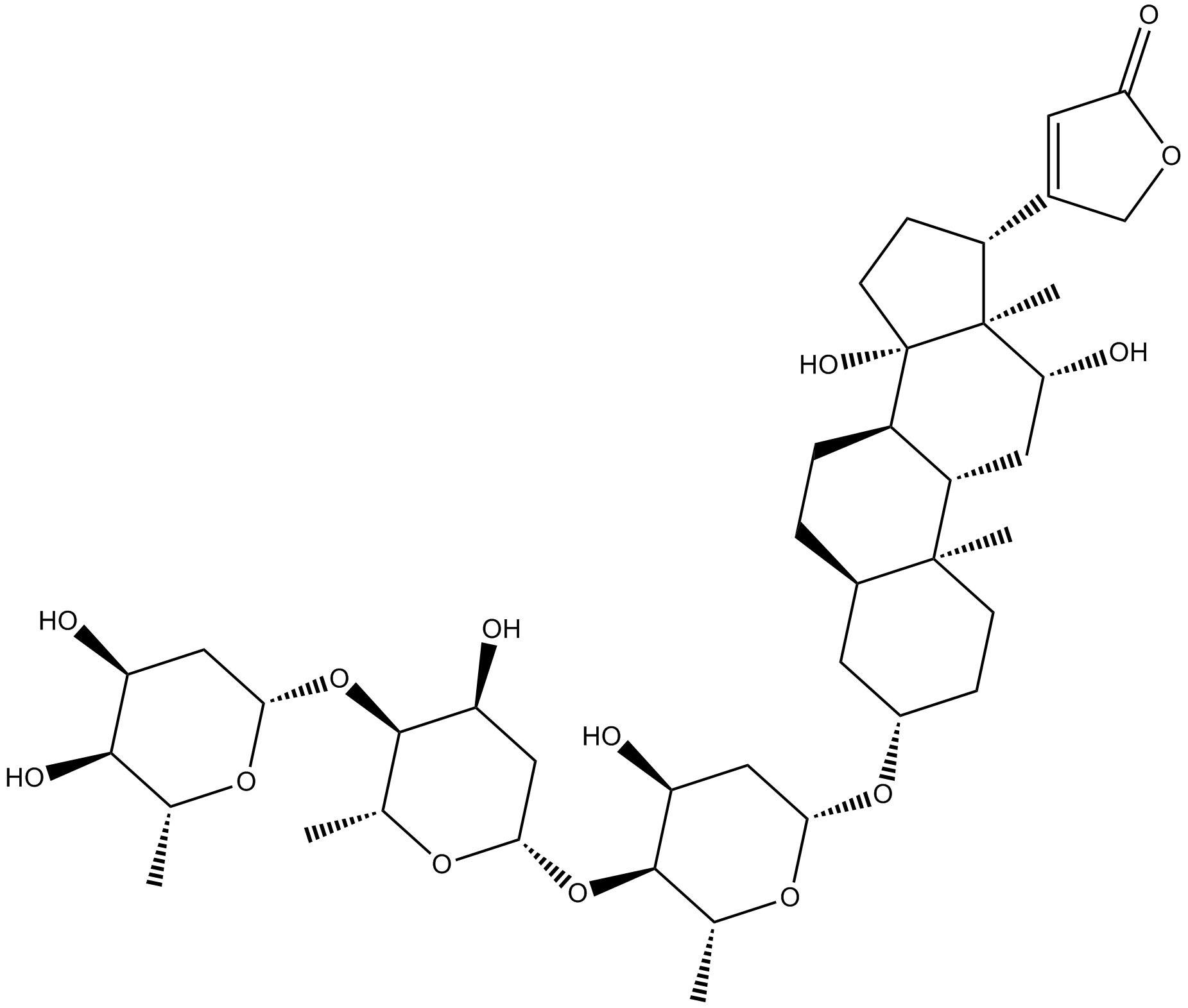
Cas No.: 20830-75-5
Sample solution is provided at 25 µL, 10mM.
Digoxin is a potent Na+/K+-ATPase inhibitor clinically used to treat arrhythmias and heart failure[1]. Digoxin belongs to the class of digitalis glycosides, which are used to increase cardiac strength and efficiency, or to control heart rate and rhythm[2]. Digoxin is a specific inhibitor of the transcriptional activity of the retinoic acid receptor-related orphan nuclear receptor RORγt[3].
In vitro, treatment of A549 and H1299 cells with Digoxin (0-1µM) for 24 or 48h inhibited the proliferation of A549 and H1299 cells in a dose-dependent manner, with IC50 values of 0.10 and 0.12μM, respectively, and also induced DNA damage and increased ROS production[4]. Digoxin (1µM) treatment of T84 epithelial cells for 72h effectively induced P-glycoprotein MDR1 transcription level (92-fold), total protein (7-fold), apical MDR1 protein (4.7-fold) and functional activity (1.75-fold)[5].
In vivo, Digoxin (2mg/kg) treated by intraperitoneal injection for 20 days in mice transplanted with Raji cells inhibited 66.2% of tumor volume, had no obvious toxic effects on mice, reduced the distribution of Raji cells in tumor tissues, and reduced the expression of Ki-67 and c-myc proteins [6]. Digoxin (1, 2mg/kg) treated by intraperitoneal injection for 14 days in mice with experimental autoimmune uveitis (EAU) inhibited the development of EAU and the cellular immune response to inter-photoreceptor retinoid acid binding protein (IRBP), but caused severe damage to the retina[7].
References:
[1] Ashbrook A W, Lentscher A J, Zamora P F, et al. Antagonism of the sodium-potassium ATPase impairs chikungunya virus infection[J]. MBio, 2016, 7(3): 10.1128/mbio. 00693-16.
[2] Ibrahim N A M. An up-to-date review of digoxin toxicity and its management[J]. Int. J. Res. Pharm. Pharm. Sci, 2019, 4: 59-64.
[3] Huh J R, Leung M W L, Huang P, et al. Digoxin and its derivatives suppress TH17 cell differentiation by antagonizing RORγt activity[J]. Nature, 2011, 472(7344): 486-490.
[4] Wang Y, Ma Q, Zhang S, et al. Digoxin enhances the anticancer effect on non-small cell lung cancer while reducing the cardiotoxicity of adriamycin[J]. Frontiers in pharmacology, 2020, 11: 186.
[5] Haslam I S, Jones K, Coleman T, et al. Rifampin and digoxin induction of MDR1 expression and function in human intestinal (T84) epithelial cells[J]. British journal of pharmacology, 2008, 154(1): 246-255.
[6] Wang T, Xu P, Wang F, et al. Effects of digoxin on cell cycle, apoptosis and NF-κ B pathway in Burkitt’s lymphoma cells and animal model[J]. Leukemia & Lymphoma, 2017, 58(7): 1673-1685.
[7] Hinshaw S J H, Ogbeifun O, Wandu W S, et al. Digoxin inhibits induction of experimental autoimmune uveitis in mice, but causes severe retinal degeneration[J]. Investigative ophthalmology & visual science, 2016, 57(3): 1441-1447.
| Cell experiment [1]: | |
|
Cell lines |
A549 and H1299 cells |
|
Preparation Method |
Cells (3×10⁴ cells/mL) were cultured in a 96-well plate treated with various concentrations of digoxin(0-1µM) for 24h or 48h. After addition of MTT (5mg/mL) to each well, the cells were further incubated for 4h. |
|
Reaction Conditions |
0-1µM; 24 or 48h |
|
Applications |
Digoxin inhibited proliferation of A549 and H1299 cells in a dose-dependent manner, with IC50 values of 0.10 and 0.12µM for A549 and H1299 cells, respectively. |
| Animal experiment [2]: | |
|
Animal models |
Male BALB/c nude mice |
|
Preparation Method |
2×10⁶ Raji cells (100μL 1640 medium and matrigel mixture) were injected subcutaneously into the right flank of four-week-old male BALB/c nude mice, two days after mice were injected intraperitoneally with cyclophosphamide (75mg/kg) to suppress xenograft rejection. When the tumor volume reached 50mm3, the animals were randomized into control and treatment groups. Within three weeks, the animals were injected intraperitoneally with digoxin (2mg/kg/day) or vehicle. The tumor volume and body weight of the mice were monitored twice a week. Mice were killed after 20 days of treatment. Tumors were collected and fixed with 4% paraformaldehyde for hematoxylin-eosin and immunohistochemistry (IHC). |
|
Dosage form |
2mg/kg; i.p. |
|
Applications |
Digoxin inhibited the tumor volume by 66.2% with no obvious toxicity to mice and no change in body weight. Digoxin reduced the distribution of Raji cells in tumor tissues. Digoxin reduced the expression of Ki-67 and c-myc proteins. |
|
References: |
|
| Cas No. | 20830-75-5 | SDF | |
| المرادفات | NSC 95100 | ||
| Canonical SMILES | O[C@]1([C@]([C@@H](C2=CC(OC2)=O)CC1)(C)[C@@H]3O)[C@H]4[C@H](C3)[C@](CC[C@@H]5O[C@@H](C[C@@H]6O)O[C@H](C)[C@H]6O[C@@H](C[C@@H]7O)O[C@H](C)[C@H]7O[C@@H](C[C@@H]8O)O[C@H](C)[C@H]8O)(C)[C@@H](C5)CC4 | ||
| Formula | C41H64O14 | M.Wt | 780.94 |
| الذوبان | ≥ 33.25mg/mL in DMSO | Storage | Store at -20°C,protect from light |
| General tips | Please select the appropriate solvent to prepare the stock solution according to the
solubility of the product in different solvents; once the solution is prepared, please store it in
separate packages to avoid product failure caused by repeated freezing and thawing.Storage method
and period of the stock solution: When stored at -80°C, please use it within 6 months; when stored
at -20°C, please use it within 1 month. To increase solubility, heat the tube to 37°C and then oscillate in an ultrasonic bath for some time. |
||
| Shipping Condition | Evaluation sample solution: shipped with blue ice. All other sizes available: with RT, or with Blue Ice upon request. | ||
| Prepare stock solution | |||

|
1 mg | 5 mg | 10 mg |
| 1 mM | 1.2805 mL | 6.4025 mL | 12.8051 mL |
| 5 mM | 256.1 μL | 1.2805 mL | 2.561 mL |
| 10 mM | 128.1 μL | 640.3 μL | 1.2805 mL |
Step 1: Enter information below (Recommended: An additional animal making an allowance for loss during the experiment)
 g
μL
g
μL
Step 2: Enter the in vivo formulation (This is only the calculator, not formulation. Please contact us first if there is no in vivo formulation at the solubility Section.)
Calculation results:
Working concentration: mg/ml;
Method for preparing DMSO master liquid: mg drug pre-dissolved in μL DMSO ( Master liquid concentration mg/mL, Please contact us first if the concentration exceeds the DMSO solubility of the batch of drug. )
Method for preparing in vivo formulation: Take μL DMSO master liquid, next addμL PEG300, mix and clarify, next addμL Tween 80, mix and clarify, next add μL saline, mix and clarify.
Method for preparing in vivo formulation: Take μL DMSO master liquid, next add μL Corn oil, mix and clarify.
Note: 1. Please make sure the liquid is clear before adding the next solvent.
2. Be sure to add the solvent(s) in order. You must ensure that the solution obtained, in the previous addition, is a clear solution before proceeding to add the next solvent. Physical methods such as vortex, ultrasound or hot water bath can be used to aid dissolving.
3. All of the above co-solvents are available for purchase on the GlpBio website.
Quality Control & SDS
- View current batch:
- Purity: >98.00% Appearance: A solid
- COA (Certificate of Analysis)
- SDS (Safety Data Sheet)
- Datasheet

Average Rating: 5 (Based on Reviews and 16 reference(s) in Google Scholar.)