

Entinostat (MS-275,SNDX-275) (Synonyms: Entinostat, SNDX 275) |
رقم الكتالوجGC11625
 One-Click Copy Product Info
|

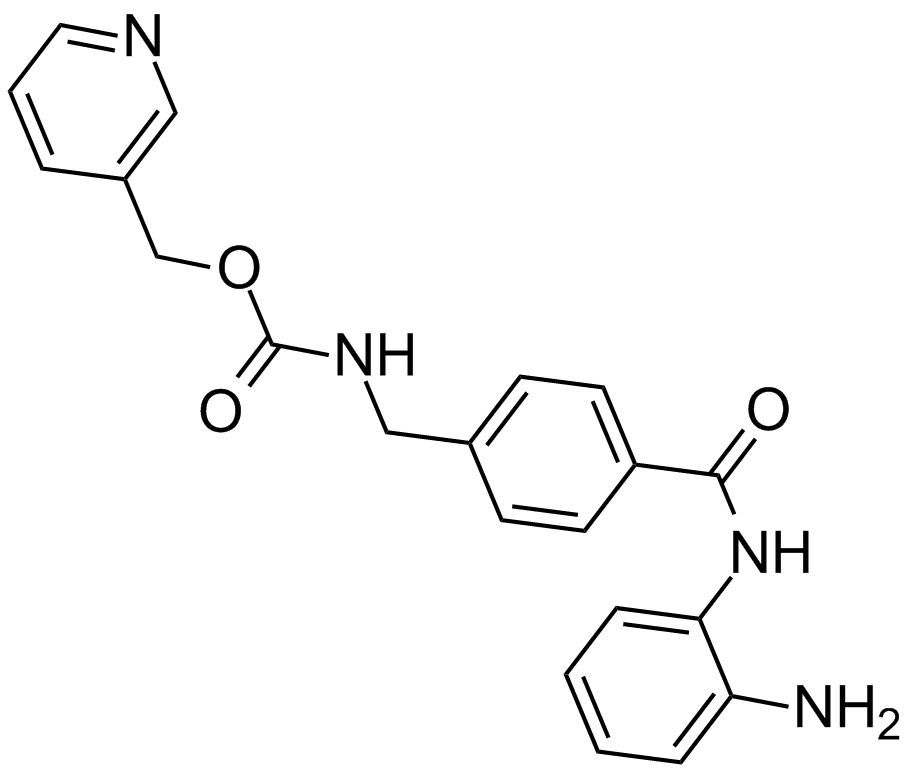
Entinostat (MS-275,SNDX-275) is a potent, orally available inhibitor of histone deacetylases (HDACs), with IC₅₀ values of 0.368µM for HDAC1 and 0.501µM for HDAC3, but exhibits relatively weak inhibition of HDAC8.
Products are for research use only. Not for human use. We do not sell to patients.
Cas No.: 209783-80-2
Sample solution is provided at 25 µL, 10mM.
_1-3.$$$39978408@51.jpg');)
_1-9.$$$38538795@65.jpg');)
_1-9.$$$39112701@51.jpg');)
_1-7.$$$37316672@70.jpg');)
_366-372.$$$36198801@70.jpg');)
.$$$38565142@65.jpg');)
_1867-1883.$$$33248023@67.jpg');)
_eads6055.$$$39977546@45.jpg');)
_eadm9805.$$$40080571@45.jpg');)
_eadj3020.$$$39666821@45.jpg');)
_1-20.$$$39757301@28.jpg');)
_1-24.$$$38898113@28.jpg');)
_273-287.$$$36806353@46.jpg');)
_1-16.$$$37156877@44.jpg');)
_1-19.$$$37460805@44.jpg');)
_1291-1307.$$$34518654@46.jpg');)
Entinostat (MS-275,SNDX-275) is a potent, orally available inhibitor of histone deacetylases (HDACs), with IC₅₀ values of 0.368µM for HDAC1 and 0.501µM for HDAC3, but exhibits relatively weak inhibition of HDAC8[1]. HDACs are associate with a number of well characterized cellular oncogenes and tumor suppressor genes. Entinostat exhibits anti-proliferative activity in vitro in many different human cancer cell lines including breast, colon, lung, myeloma, ovary, pancreas, prostate and leukemia in vivo antitumor activity and also demonstrates antitumor activity in vivo in animal models[1]. Entinostat has been used in preclinical studies for cancer treatment[2].
In vitro, Entinostat (0.1-100µM; 24-72h) inhibited the proliferation of human Y79 and Weri-Rb1 cells in a dose- and time-dependent manner, with GI₅₀ values of 1.34 and 0.98µM for Y79 and Weri-Rb1 cells, respectively, at 72h[3].
In vivo, Entinostat (20mg/kg; i.p.) administered every other day for 21 days reduced ocular tumor burden by 76% in LHh-Tag mice[3]. Entinostat (20mg/kg; i.p.) administered every other day for 13 days reduced ocular tumor burden by 63% in the rat ocular xenograft model[3]. Entinostat (3.5mg/kg; i.p.) administered for 5 days greatly reduced the severity and duration of experimental autoimmune neuritis (EAN), attenuated the local accumulation of macrophages, T cells, and B cells, as well as demyelination of the sciatic nerves, in rats with EAN induced by the neuritogenic synthetic P2 peptide[4].
References:
[1] Hess-Stumpp, Holger et al. “MS-275, a potent orally available inhibitor of histone deacetylases--the development of an anticancer agent.” The international journal of biochemistry & cell biology vol. 39,7-8 (2007): 1388-405.
[2] Pili, R et al. “Phase I study of the histone deacetylase inhibitor entinostat in combination with 13-cis retinoic acid in patients with solid tumours.” British journal of cancer vol. 106,1 (2012): 77-84.
[3] Dalgard, Clifton Lee et al. “Evaluation of the in vitro and in vivo antitumor activity of histone deacetylase inhibitors for the therapy of retinoblastoma.” Clinical cancer research : an official journal of the American Association for Cancer Research vol. 14,10 (2008): 3113-23.
[4] Zhang, Z Y et al. “MS-275, an histone deacetylase inhibitor, reduces the inflammatory reaction in rat experimental autoimmune neuritis.” Neuroscience vol. 169,1 (2010): 370-7.
| Cell experiment [1]: | |
Cell lines | Human Y79 and Weri-Rb1 cells |
Preparation Method | For colorimetric analysis, cells were exposed to WST-8 Cell Proliferation Reagent, and absorbance was quantified after 2h using a SpectraMax microplate reader |
Reaction Conditions | 0.1-100µM; 24-72h |
Applications | Entinostat inhibited the proliferation of human Y79 and Weri-Rb1 cells in a dose- and time-dependent manner. |
| Animal experiment [1]: | |
Animal models | LHh-Tag mice |
Preparation Method | LHh-Tag mice were treated every other day for 21d with 20mg/kg Entinostat or DMSO vehicle only (i.p.). Mice were monitored daily and weighed thrice weekly. Animals were sacrificed on day 23, and eyes were enucleated, fixed, and processed to obtain sections from five levels throughout each eye. Tumor burden per mouse was expressed as the mean tumor area per level in both eyes. |
Dosage form | 20mg/kg; every other day for 21d; i.p. |
Applications | Throughout the treatment period, mean body weight of MS-275-treated and control animals did not differ significantly. At treatment end point, Entinostat–treated animals showed a significant, 76% reduction in ocular tumor burden relative to controls. |
References: | |
| Cas No. | 209783-80-2 | SDF | |
| المرادفات | Entinostat, SNDX 275 | ||
| Chemical Name | pyridin-3-ylmethyl N-[[4-[(2-aminophenyl)carbamoyl]phenyl]methyl]carbamate | ||
| Canonical SMILES | C1=CC=C(C(=C1)N)NC(=O)C2=CC=C(C=C2)CNC(=O)OCC3=CN=CC=C3 | ||
| Formula | C21H20N4O3 | M.Wt | 376.4 |
| الذوبان | ≥ 18.8mg/mL in DMSO, ≥ 7.4 mg/mL in EtOH with ultrasonic | Storage | Store at -20°C |
| General tips | Please select the appropriate solvent to prepare the stock solution according to the
solubility of the product in different solvents; once the solution is prepared, please store it in
separate packages to avoid product failure caused by repeated freezing and thawing.Storage method
and period of the stock solution: When stored at -80°C, please use it within 6 months; when stored
at -20°C, please use it within 1 month. To increase solubility, heat the tube to 37°C and then oscillate in an ultrasonic bath for some time. |
||
| Shipping Condition | Evaluation sample solution: shipped with blue ice. All other sizes available: with RT, or with Blue Ice upon request. | ||
| Prepare stock solution | |||

|
1 mg | 5 mg | 10 mg |
| 1 mM | 2.6567 mL | 13.2837 mL | 26.5675 mL |
| 5 mM | 531.3 μL | 2.6567 mL | 5.3135 mL |
| 10 mM | 265.7 μL | 1.3284 mL | 2.6567 mL |
Step 1: Enter information below (Recommended: An additional animal making an allowance for loss during the experiment)
 g
μL
g
μL
Step 2: Enter the in vivo formulation (This is only the calculator, not formulation. Please contact us first if there is no in vivo formulation at the solubility Section.)
Calculation results:
Working concentration: mg/ml;
Method for preparing DMSO master liquid: mg drug pre-dissolved in μL DMSO ( Master liquid concentration mg/mL, Please contact us first if the concentration exceeds the DMSO solubility of the batch of drug. )
Method for preparing in vivo formulation: Take μL DMSO master liquid, next addμL PEG300, mix and clarify, next addμL Tween 80, mix and clarify, next add μL saline, mix and clarify.
Method for preparing in vivo formulation: Take μL DMSO master liquid, next add μL Corn oil, mix and clarify.
Note: 1. Please make sure the liquid is clear before adding the next solvent.
2. Be sure to add the solvent(s) in order. You must ensure that the solution obtained, in the previous addition, is a clear solution before proceeding to add the next solvent. Physical methods such as vortex, ultrasound or hot water bath can be used to aid dissolving.
3. All of the above co-solvents are available for purchase on the GlpBio website.
Quality Control & SDS
- View current batch:
- Purity: >98.00% Appearance: A solid
- COA (Certificate of Analysis)
- SDS (Safety Data Sheet)
- Datasheet
Average Rating: 5 (Based on Reviews and 30 reference(s) in Google Scholar.)