

PHYSALIEN (Synonyms: Physalien) |
رقم الكتالوجGC19245
 One-Click Copy Product Info
|

PHYSALIEN (Physalien) عبارة عن كاروتينويد مشتق من التوت البري ، وله تأثيرات إجهاد مضادة للالتهابات ومضادة للأكسدة.
Products are for research use only. Not for human use. We do not sell to patients.
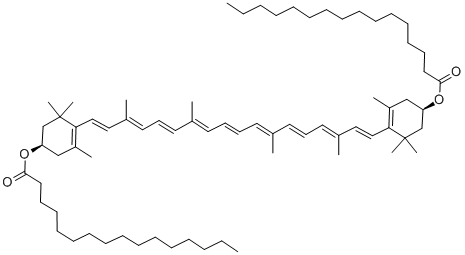
Cas No.: 144-67-2
Sample solution is provided at 25 µL, 10mM.
_1-3.$$$39978408@51.jpg');)
_1-9.$$$38538795@65.jpg');)
_1-9.$$$39112701@51.jpg');)
_1-7.$$$37316672@70.jpg');)
_366-372.$$$36198801@70.jpg');)
.$$$38565142@65.jpg');)
_1867-1883.$$$33248023@67.jpg');)
_eads6055.$$$39977546@45.jpg');)
_eadm9805.$$$40080571@45.jpg');)
_eadj3020.$$$39666821@45.jpg');)
_1-20.$$$39757301@28.jpg');)
_1-24.$$$38898113@28.jpg');)
_273-287.$$$36806353@46.jpg');)
_1-16.$$$37156877@44.jpg');)
_1-19.$$$37460805@44.jpg');)
_1291-1307.$$$34518654@46.jpg');)
PHYSALIEN is a lipophilic carotenoid compound[1-2]. PHYSALIEN exhibits antioxidant and anti-inflammatory properties, which contribute to its hepatoprotective effects by mitigating oxidative stress and alleviating hepatic fibrosis. PHYSALIEN is utilized in research related to liver diseases and ocular disorders[3-4].
In vitro, BRL-3A rat normal hepatocytes were pretreated with PHYSALIEN (1µM) for 2 hours before co-incubation with ethanol for 24 hours. The treatment restored the ethanol-suppressed expression of key autophagy-related proteins (Atg5, Beclin-1, and LC3A/B) and reduced the accumulation of the autophagy substrate p62. The pretreatment with PHYSALIEN targeted the cell membrane receptors P2X7 and AdipoR1, thereby modulating the AMPK/FoxO3a and PI3K/Akt signaling pathways, which restored ethanol-inhibited mitophagy and attenuated the activation of the NLRP3 inflammasome[5].
In vivo, in a murine model of alcoholic fatty liver disease (AFLD) using male C57BL/6 mice, oral administration of PHYSALIEN (25mg/kg/day) from weeks 5 to 10 of the experiment. PHYSALIEN significantly alleviated typical AFLD symptoms induced by ethanol consumption. This included amelioration of liver histopathology (reduced lipid droplet deposition and inflammatory foci), lowered serum alanine aminotransferase (ALT) levels, and mitigation of hepatic oxidative stress and inflammation. The hepatoprotective effect was mediated through the regulation of the CYP2E1, NF-κB, and MAPK (p38 and ERK) signaling pathways[6]. In N-methyl-N-nitrosourea (MNU)-induced photoreceptor degeneration in adult male C57BL/6J mice, daily oral administration of PHYSALIEN (approximately 0.27mg/kg), starting one week before injury and continuing for a total of two weeks. PHYSALIEN significantly improved photoreceptor survival, enhanced retinal electrophysiological responses to light, and increased visual acuity in the injured mice[7].
References:
[1] Long JT, Fan HX, Zhou ZQ, et al. The major zeaxanthin dipalmitate derivatives from wolfberry. J Asian Nat Prod Res. 2020 Aug;22(8):746-753.
[2] Liu F, Liu X, Zhou Y, et al. Wolfberry-derived zeaxanthin dipalmitate delays retinal degeneration in a mouse model of retinitis pigmentosa through modulating STAT3, CCL2 and MAPK pathways. J Neurochem. 2021 Sep;158(5):1131-1150.
[3] Kan X, Zhou W, Xu W, et al. Zeaxanthin Dipalmitate-Enriched Emulsion Stabilized with Whey Protein Isolate-Gum Arabic Maillard Conjugate Improves Gut Microbiota and Inflammation of Colitis Mice. Foods. 2022 Nov 16;11(22):3670.
[4] Bahaji Azami NL, Sun M. Zeaxanthin Dipalmitate in the Treatment of Liver Disease. Evid Based Complement Alternat Med. 2019 Aug 21;2019:1475163.
[5] Gao H, Lv Y, Liu Y, et al. Wolfberry-Derived Zeaxanthin Dipalmitate Attenuates Ethanol-Induced Hepatic Damage. Mol Nutr Food Res. 2019 Jun;63(11):e1801339.
[6] Xiao J, Wang J, Xing F, et al. Zeaxanthin dipalmitate therapeutically improves hepatic functions in an alcoholic fatty liver disease model through modulating MAPK pathway. PLoS One. 2014 Apr 16;9(4):e95214.
[7] Chen X, Zhang S, Yang L, et al. Zeaxanthin dipalmitate-enriched wolfberry extract improves vision in a mouse model of photoreceptor degeneration. PLoS One. 2024 May 20;19(5):e0302742.
| Cell experiment [1]: | |
Cell lines | Rat normal hepatocyte BRL-3A cell line |
Preparation Method | BRL-3A cells were cultured in DMEM with 10%(v/v) fetal bovine serum at 37°C with 5% CO₂. Cells were pretreated with PHYSALIEN (1μM) for 2 hours prior to the addition of 250mM ethanol for 24 hours. |
Reaction Conditions | 1μM; 2-hour pretreatment. |
Applications | PHYSALIEN significantly counteracted ethanol-induced downregulation of key autophagy proteins (Atg5, beclin-1, LC3A/B) and upregulation of the autophagy substrate p62 in BRL-3A cells. PHYSALIEN also partially reversed ethanol-suppressed mitophagy, as evidenced by restored mitochondrial morphology (reduced swelling and disrupted cristae) and an increased percentage of intact mitochondria. Furthermore, PHYSALIEN attenuated ethanol-evoked NLRP3 inflammasome activation, reducing the expression levels of cleaved caspase-1 and secretion of IL-1β and IL-18. |
| Animal experiment [2]: | |
Animal models | Female Sprague-Dawley rats (Alcoholic fatty liver disease model) |
Preparation Method | Rats were intragastrically administered ethanol (4.0g/kg) for 10 weeks. PHYSALIEN was orally administered (25mg/kg/day) from the 5th week to the 10th week. Rats were sacrificed 8 hours after the last administration. |
Dosage form | 25mg/kg/day; Oral gavage; Daily administration for 5 weeks. |
Applications | PHYSALIEN treatment significantly alleviated alcoholic fatty liver disease (AFLD) symptoms, including reduced body weight loss, hepatic fat droplet deposition, and inflammatory cell infiltration. PHYSALIEN improved liver function by lowering serum ALT levels and triglycerides (TG). PHYSALIEN also attenuated hepatic oxidative stress (reducing CYP2E1 expression, MDA, and 8-isoprostane; restoring CAT and SOD1), diminished inflammation (reducing TNF-α, IL-1β, IL-6, MCP-1), and reduced hepatic apoptosis. |
References: | |
| Cas No. | 144-67-2 | SDF | |
| المرادفات | Physalien | ||
| Formula | C72H116O4 | M.Wt | 1045.69 |
| الذوبان | Ethanol : 1 mg/mL (0.96 mM; Need ultrasonic and warming) | Storage | Store at -20°C,protect from light |
| General tips | Please select the appropriate solvent to prepare the stock solution according to the
solubility of the product in different solvents; once the solution is prepared, please store it in
separate packages to avoid product failure caused by repeated freezing and thawing.Storage method
and period of the stock solution: When stored at -80°C, please use it within 6 months; when stored
at -20°C, please use it within 1 month. To increase solubility, heat the tube to 37°C and then oscillate in an ultrasonic bath for some time. |
||
| Shipping Condition | Evaluation sample solution: shipped with blue ice. All other sizes available: with RT, or with Blue Ice upon request. | ||
| Prepare stock solution | |||

|
1 mg | 5 mg | 10 mg |
| 1 mM | 956.3 μL | 4.7815 mL | 9.5631 mL |
| 5 mM | 191.3 μL | 956.3 μL | 1.9126 mL |
| 10 mM | 95.6 μL | 478.2 μL | 956.3 μL |
Step 1: Enter information below (Recommended: An additional animal making an allowance for loss during the experiment)
 g
μL
g
μL
Step 2: Enter the in vivo formulation (This is only the calculator, not formulation. Please contact us first if there is no in vivo formulation at the solubility Section.)
Calculation results:
Working concentration: mg/ml;
Method for preparing DMSO master liquid: mg drug pre-dissolved in μL DMSO ( Master liquid concentration mg/mL, Please contact us first if the concentration exceeds the DMSO solubility of the batch of drug. )
Method for preparing in vivo formulation: Take μL DMSO master liquid, next addμL PEG300, mix and clarify, next addμL Tween 80, mix and clarify, next add μL saline, mix and clarify.
Method for preparing in vivo formulation: Take μL DMSO master liquid, next add μL Corn oil, mix and clarify.
Note: 1. Please make sure the liquid is clear before adding the next solvent.
2. Be sure to add the solvent(s) in order. You must ensure that the solution obtained, in the previous addition, is a clear solution before proceeding to add the next solvent. Physical methods such as vortex, ultrasound or hot water bath can be used to aid dissolving.
3. All of the above co-solvents are available for purchase on the GlpBio website.
Quality Control & SDS
- View current batch:
- Purity: >95.00% Appearance: A solid
- COA (Certificate of Analysis)
- SDS (Safety Data Sheet)
- Datasheet
Average Rating: 5 (Based on Reviews and 30 reference(s) in Google Scholar.)