

Sumatriptan |
رقم الكتالوجGC16634
 One-Click Copy Product Info
|

سوماتريبتان (القاعدة الحرة GR 43175) هو ناهض لمستقبلات 5-HT1 النشط عن طريق الفم مع Kis من 17 نانومتر و 27 نانومتر و 100 نانومتر لمستقبلات 5-HT1D و 5-HT1B و 5-HT1A ، على التوالي
Products are for research use only. Not for human use. We do not sell to patients.
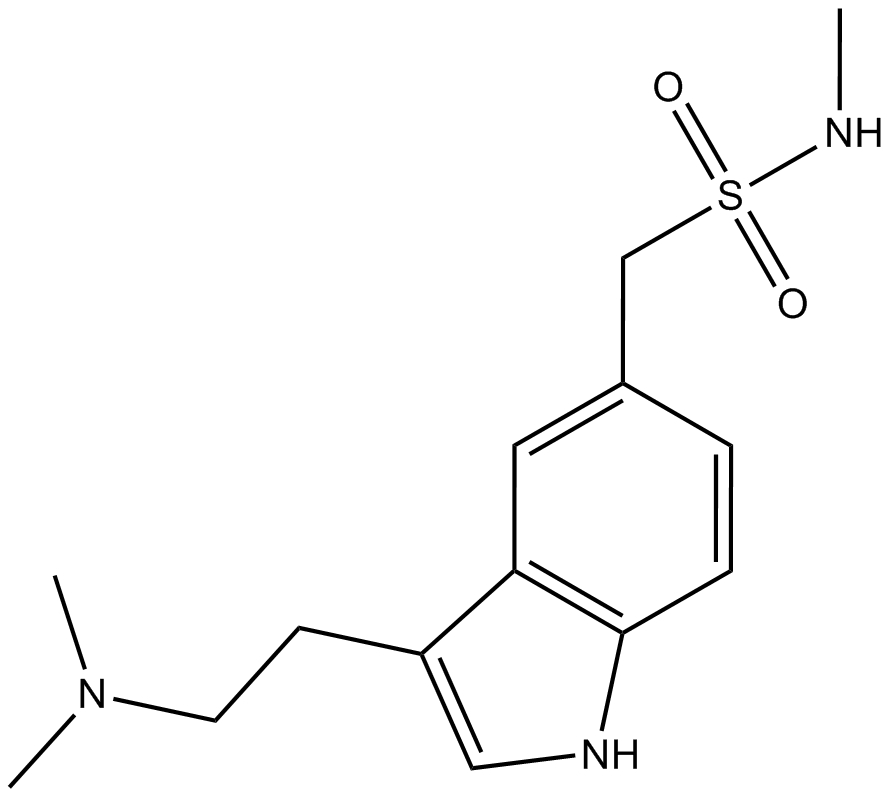
Cas No.: 103628-46-2
Sample solution is provided at 25 µL, 10mM.
_1-3.$$$39978408@51.jpg');)
_1-9.$$$38538795@65.jpg');)
_1-9.$$$39112701@51.jpg');)
_1-7.$$$37316672@70.jpg');)
_366-372.$$$36198801@70.jpg');)
.$$$38565142@65.jpg');)
_1867-1883.$$$33248023@67.jpg');)
_eads6055.$$$39977546@45.jpg');)
_eadm9805.$$$40080571@45.jpg');)
_eadj3020.$$$39666821@45.jpg');)
_1-20.$$$39757301@28.jpg');)
_1-24.$$$38898113@28.jpg');)
_273-287.$$$36806353@46.jpg');)
_1-16.$$$37156877@44.jpg');)
_1-19.$$$37460805@44.jpg');)
_1291-1307.$$$34518654@46.jpg');)
Sumatriptan is an orally active 5-HT1 receptor agonist with IC50 values of 7.3nM, 9.3nM and 17.8nM for 5-HT1D, 5-HT1B and 5-HT1F receptors, respectively[1]. 5-HT1 receptor is a G-protein-coupled receptor subfamily that inhibits adenylyl cyclase and modulates serotonin-mediated neurotransmission[2]. Sumatriptan is usually used for migraine headache research[3].
In vitro, Sumatriptan(10pM-10μM; 20min) displaced [³H]-5-HT with an IC50 of 5.0nM and fully stimulated [35S]-GTPγS binding with an EC50 of 16nM in CHO cells stably expressing human 5-HT1D receptors[4]. Sumatriptan(10pM-10μM; 20min) inhibited forskolin-stimulated cAMP accumulation in HEK-293 cells expressing h5-HT1B receptors (IC50=20nM) and in C6-glioma cells expressing h5-HT1D receptors (IC50=2.6nM)[5].
In vivo, Sumatriptan (600μg/kg; i.p.) reversed nitroglycerin (NTG)-induced thermal and mechanical allodynia in male C57BL/6 mice, and restored withdrawal latencies and thresholds to baseline within 60min[6]. Sumatriptan (0.3mg/kg/day; i.p.; 28 days) reversed T9-10 clip-compression–induced mechanical and thermal allodynia, reduced spinal TNF-α, IL-1β and CGRP, and improved BBB locomotor scores in adult male Sprague-Dawley rats[7].
References:
[1] Peroutka SJ, McCarthy BG. Sumatriptan (GR 43175) interacts selectively with 5-HT1B and 5-HT1D binding sites. Eur J Pharmacol. 1989;163(1):133-136.
[2] Polter AM, Li X. 5-HT1A receptor-regulated signal transduction pathways in brain. Cell Signal. 2010;22(10):1406-1412.
[3] Dechant KL, Clissold SP. Sumatriptan. A review of its pharmacodynamic and pharmacokinetic properties, and therapeutic efficacy in the acute treatment of migraine and cluster headache. Drugs. 1992;43(5):776-798.
[4] Castro JL, Street LJ, Guiblin AR, et al. 3-[2-(Pyrrolidin-1-yl)ethyl]indoles and 3-[3-(piperidin-1-yl)propyl]indoles: agonists for the h5-HT1D receptor with high selectivity over the h5-HT1B subtype. J Med Chem. 1997;40(22):3497-3500.
[5] Lesage AS, Wouters R, Van Gompel P, et al. Agonistic properties of alniditan, sumatriptan and dihydroergotamine on human 5-HT1B and 5-HT1D receptors expressed in various mammalian cell lines. Br J Pharmacol. 1998;123(8):1655-1665.
[6] Bates EA, Nikai T, Brennan KC, et al. Sumatriptan alleviates nitroglycerin-induced mechanical and thermal allodynia in mice. Cephalalgia. 2010;30(2):170-178.
[7] Afshari K, Dehdashtian A, Haddad NS, et al. Sumatriptan improves the locomotor activity and neuropathic pain by modulating neuroinflammation in rat model of spinal cord injury. Neurol Res. 2021;43(1):29-39.
| Cell experiment [1]: | |
Cell lines | HEK 293 cells |
Preparation Method | HEK 293, a human transformed embryonic kidney cell line, was grown in Dulbecco's modi®ed Eagle's medium containing 1mM sodium pyruvate, 2mM L-glutamine, antibiotics and 10% foetal calf serum. The selection and culture medium for HEK 293 cells expressing the 5-HT 1B receptor contained an extra 800μg/ml geneticin. Geneticin was left out at least 2 days before assay. Cells were grown at 37℃ in humidi®ed air with 5% CO2. Cells were plated in Multi-well 24 plates. The next day, cells were washed and incubated for 20min in the presence of 10pM-10μM Sumatriptan with controlled salt solution (composition in mM : NaCl=120, KCl=5, MgCl2=0.8, CaCl2=1.8, glucose=15 and phenol red=0.04 in 25mM Tris-HCl, pH 7.4) containing either 100μM forskolin or solvent. The incubation was stopped with ice-cold HClO4. The extract was neutralized to pH 7.5 with K3PO4/KOH solution. After precipitation of KClO4 at 4℃, plates were centrifuged, and the supernatant was assayed for cyclic AMP content with a commercial [ 125 I]-cyclic AMP radioimmunoassay kit according to the procedure recommended by the manufacturer. The cyclic AMP levels were expressed as percentage of forskolin-stimulated cyclic AMP production (set at 100%), and plotted against the drug concentration on a logarithmic scale. Sigmoidal curves of best ®t were calculated by non linear regression analysis. The pIC50 value referred to the concentration of a compound producing half the maximum reduction in cyclic AMP seen with 5-HT. |
Reaction Conditions | 10pM-10μM; 20min |
Applications | Sumatriptan inhibited forskolin-stimulated cAMP accumulation in HEK-293 cells expressing h5-HT1B receptors (IC50=20nM). |
| Animal experiment [2]: | |
Animal models | C57BL6 male mice |
Preparation Method | All experiments were conducted on C57BL6 male mice weighing 20-30g. Animals were housed in a 12-h light–dark cycle. Experiments were conducted between 09.00 and 14.00h at a temperature of 22°C. A stock of 5.0mg/ml NTG dissolved in 30% alcohol, 30% propylene glycol, and water was freshly diluted each day in 0.9% saline in a polypropylene tube. Doses of 0.5, 1, 5 or 10mg/kg were administered intraperitoneally. Control mice received an intraperitoneal injection of 0.9% saline. Five minutes after the administration of 10mg/kg NTG, each animal was treated with i.p. Sumatriptan(600μg/kg) or saline. Alternatively, an identical set of NTG-injected mice was treated with a single injection of intrathecal Sumatriptan (0.06μg in 5μl) or saline at 5min after NTG administration. Animals were habituated to the testing apparatus for 60min on the day prior to and again immediately before determination of baseline nociceptive thresholds. Each group of animals underwent one of two different tests before and following NTG injection. Hargreaves assay was used to determine thermal nociceptive thresholds. Mechanical nociceptive thresholds were determined with von Frey monofilaments. |
Dosage form | 600μg/kg; i.p. |
Applications | Sumatriptan reversed nitroglycerin (NTG)-induced thermal and mechanical allodynia in male C57BL/6 mice. |
References: | |
| Cas No. | 103628-46-2 | SDF | |
| Chemical Name | 1-(3-(2-(dimethylamino)ethyl)-1H-indol-5-yl)-N-methylmethanesulfonamide | ||
| Canonical SMILES | CNS(CC1=CC(C(CCN(C)C)=CN2)=C2C=C1)(=O)=O | ||
| Formula | C14H21N3O2S | M.Wt | 295.4 |
| الذوبان | ≥ 14.77mg/mL in DMSO | Storage | Store at -20°C |
| General tips | Please select the appropriate solvent to prepare the stock solution according to the
solubility of the product in different solvents; once the solution is prepared, please store it in
separate packages to avoid product failure caused by repeated freezing and thawing.Storage method
and period of the stock solution: When stored at -80°C, please use it within 6 months; when stored
at -20°C, please use it within 1 month. To increase solubility, heat the tube to 37°C and then oscillate in an ultrasonic bath for some time. |
||
| Shipping Condition | Evaluation sample solution: shipped with blue ice. All other sizes available: with RT, or with Blue Ice upon request. | ||
| Prepare stock solution | |||

|
1 mg | 5 mg | 10 mg |
| 1 mM | 3.3852 mL | 16.9262 mL | 33.8524 mL |
| 5 mM | 677 μL | 3.3852 mL | 6.7705 mL |
| 10 mM | 338.5 μL | 1.6926 mL | 3.3852 mL |
Step 1: Enter information below (Recommended: An additional animal making an allowance for loss during the experiment)
 g
μL
g
μL
Step 2: Enter the in vivo formulation (This is only the calculator, not formulation. Please contact us first if there is no in vivo formulation at the solubility Section.)
Calculation results:
Working concentration: mg/ml;
Method for preparing DMSO master liquid: mg drug pre-dissolved in μL DMSO ( Master liquid concentration mg/mL, Please contact us first if the concentration exceeds the DMSO solubility of the batch of drug. )
Method for preparing in vivo formulation: Take μL DMSO master liquid, next addμL PEG300, mix and clarify, next addμL Tween 80, mix and clarify, next add μL saline, mix and clarify.
Method for preparing in vivo formulation: Take μL DMSO master liquid, next add μL Corn oil, mix and clarify.
Note: 1. Please make sure the liquid is clear before adding the next solvent.
2. Be sure to add the solvent(s) in order. You must ensure that the solution obtained, in the previous addition, is a clear solution before proceeding to add the next solvent. Physical methods such as vortex, ultrasound or hot water bath can be used to aid dissolving.
3. All of the above co-solvents are available for purchase on the GlpBio website.
Quality Control & SDS
- View current batch:
- Purity: >98.00% Appearance: A solid
- COA (Certificate of Analysis)
- SDS (Safety Data Sheet)
- Datasheet
Average Rating: 5 (Based on Reviews and 10 reference(s) in Google Scholar.)