

A-740003 |
Catalog No.GC11842
 One-Click Copy Product Info
|

A-740003 est un antagoniste du récepteur P2X7 actif par voie orale (IC50=40nM).
Products are for research use only. Not for human use. We do not sell to patients.
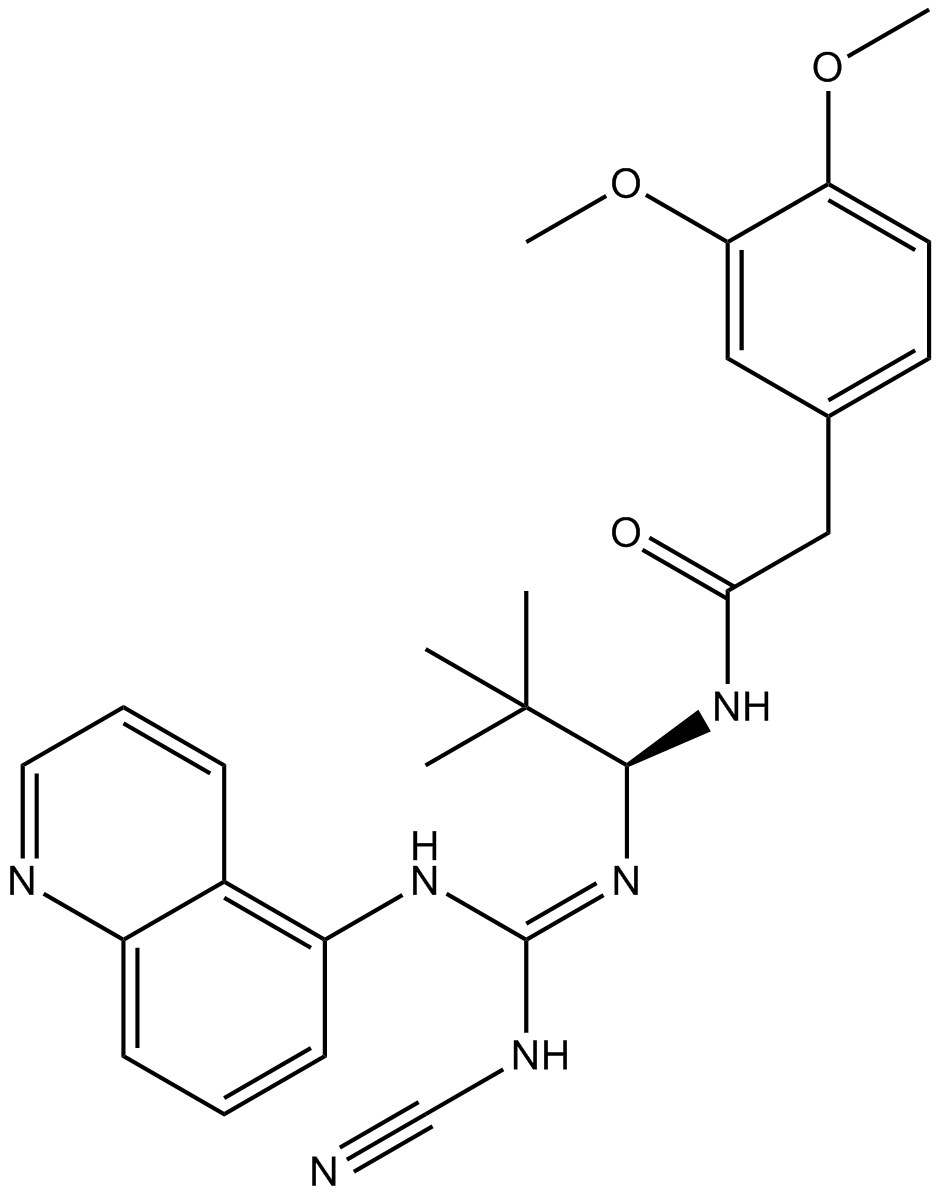
Cas No.: 861393-28-4
Sample solution is provided at 25 µL, 10mM.
A-740003 est un antagoniste du récepteur P2X7 actif par voie orale (IC50=40nM). A-740003 réduit la libération d'IL-1β et la formation de pores dans la membrane de cellule en empêchant ATP de se lier au récepteur PX27. Il soulage aussi la douleur neuropathique et les réponses inflammatoires en bloquant l'activation de ce récepteur. A-740003 peut être utilisé à rechercher la douleur neuropathique, la douleur inflammatoire et le neuroblastome[1-4].
Les cellules MC3T3-E1 ont été in vitro co-cultivées avec A-740003 (10μM), Wnt3a (20ng/ml), et BzATP (300μM) pendant 24h. A-740003 a fortement inhibé la potentialisation de la voie qui transmet les signaux Wnt3a induite par BzATP[5]. Les cellules MC3T3-E1 ou UMR-106 ont été incubées avec A-740003 (10μM), et l'efflux de protons a été mesuré immédiatement. A-740003 n'a pas eu d'effet significatif sur l'efflux basal de protons, mais a bien bloqué la phase soutenue de la réponse induite par BzATP dans les deux types de cellules[6].
In vivo, A-740003 (10μM; 0.5μl/h) a été perfusé par voie intracérébroventriculaire pendant 2 semaines chez les rats atteints d'un status epilepticus (SE) induit par la pilocarpine. A-740003 a augmenté le nombre de neurones positifs à Fluoro-Jade B (FJB) dans la région CA3 de l'hippocampe[7]. A-740003 (100nmol; 0.3μl; en une seule fois) a été injecté par voie intracérébroventriculaire (dans vlPAG). A-740003 a antagonisé l'effet analgésique du tramadol[8].
References:
[1] Janssen B, Vugts DJ, Funke U, et al. Synthesis and initial preclinical evaluation of the P2X7 receptor antagonist [¹¹C]A-740003 as a novel tracer of neuroinflammation. J Labelled Comp Radiopharm. 2014 Jun 30;57(8):509-16.
[2] Honore P, Donnelly-Roberts D, Namovic MT, et al. A-740003 [N-(1-{[(cyanoimino)(5-quinolinylamino) methyl]amino}-2,2-dimethylpropyl)-2-(3,4-dimethoxyphenyl)acetamide], a novel and selective P2X7 receptor antagonist, dose-dependently reduces neuropathic pain in the rat. J Pharmacol Exp Ther. 2006 Dec;319(3):1376-85.
[3] Zhang B, Zhang P, Li T, et al. P2X7 Receptor in Microglia Contributes to Propofol-induced Unconsciousness by Regulating Synaptic Plasticity in Mice. Neuroscience. 2023 Jul 15;523:157-172.
[4] Liu Y, Liu Q, Xu Z, et al. P2X7 Receptor acts as a novel target for ameliorating Sepsis-induced skeletal muscle atrophy in mice model. Shock. 2025 Sep 5.
[5] Grol MW, Zelner I, Dixon SJ. P2X₇-mediated calcium influx triggers a sustained, PI3K-dependent increase in metabolic acid production by osteoblast-like cells. Am J Physiol Endocrinol Metab. 2012 Mar 1;302(5):E561-75.
[6] Grol MW, Brooks PJ, Pereverzev A, et al. P2X7 nucleotide receptor signaling potentiates the Wnt/β-catenin pathway in cells of the osteoblast lineage. Purinergic Signal. 2016 Sep;12(3):509-20.
[7] Kim JE, Ryu HJ, Kang TC. P2X7 receptor activation ameliorates CA3 neuronal damage via a tumor necrosis factor-α-mediated pathway in the rat hippocampus following status epilepticus. J Neuroinflammation. 2011 Jun 2;8:62.
[8] Li P, Zhang Q, Xiao Z, et al. Activation of the P2X7 receptor in midbrain periaqueductal gray participates in the analgesic effect of tramadol in bone cancer pain rats. Mol Pain. 2018 Jan-Dec;14:1744806918803039.
| Expériences cellulaires [1]: | |
Lignées cellulaires | Cellules MC3T3-E1 de type ostéoblaste |
Méthode de préparation | Les cellules MC3T3-E1 ont été transfectées avec un rapporteur luciférase de β-caténine, placées dans un milieu sans sérum, incubées toute la nuit. Le lendemain, les cellules ont été traitées avec Wnt3a (20ng/ml) ou son véhicule, et BzATP (300μM) ou son véhicule, en présence ou en absence de A-740003 (10μM). |
Conditions de réaction | 10μM; 24h |
Domaines d'application | A-740003 a inhibé la potentialisation de la voie qui transmet les signaux Wnt3a induite par BzATP dans les cellules MC3T3-E1. |
| Expériences animales [2]: | |
Modèles animaux | Rats Sprague-Dawley |
Méthode de préparation | Les rats ont reçu une perfusion intracérébronventriculaire de A-740003 (10μM; 0.5μl/h) avant l'induction d'un status epilepticus (SE) par la pilocarpine. Les animaux ont été sacrifiés pour l'analyse de l'hippocampe. |
Forme de dosage | 10μM; perfusion intracérébroventriculaire; 0,5µL/h pendant 2 semaines |
Domaines d'application | La perfusion d' A-740003 a augmenté la mort neuronale induite par SE dans la région CA3, comme l'indique l'augmentation des neurones positifs à Fluoro-Jade B. |
References: | |
| Cas No. | 861393-28-4 | SDF | |
| Chemical Name | N-[1-[(E)-[(cyanoamino)-(quinolin-5-ylamino)methylidene]amino]-2,2-dimethylpropyl]-2-(3,4-dimethoxyphenyl)acetamide | ||
| Canonical SMILES | CC(C)(C)C(NC(=O)CC1=CC(=C(C=C1)OC)OC)N=C(NC#N)NC2=CC=CC3=C2C=CC=N3 | ||
| Formula | C26H30N6O3 | M.Wt | 474.57 |
| Solubility | ≥ 23.7 mg/mL in DMSO, ≥ 2.48 mg/mL in EtOH with ultrasonic and warming | Storage | Store at -20°C |
| General tips | Please select the appropriate solvent to prepare the stock solution according to the
solubility of the product in different solvents; once the solution is prepared, please store it in
separate packages to avoid product failure caused by repeated freezing and thawing.Storage method
and period of the stock solution: When stored at -80°C, please use it within 6 months; when stored
at -20°C, please use it within 1 month. To increase solubility, heat the tube to 37°C and then oscillate in an ultrasonic bath for some time. |
||
| Shipping Condition | Evaluation sample solution: shipped with blue ice. All other sizes available: with RT, or with Blue Ice upon request. | ||
| Prepare stock solution | |||

|
1 mg | 5 mg | 10 mg |
| 1 mM | 2.1072 mL | 10.5359 mL | 21.0717 mL |
| 5 mM | 421.4 μL | 2.1072 mL | 4.2143 mL |
| 10 mM | 210.7 μL | 1.0536 mL | 2.1072 mL |
Step 1: Enter information below (Recommended: An additional animal making an allowance for loss during the experiment)
 g
μL
g
μL
Step 2: Enter the in vivo formulation (This is only the calculator, not formulation. Please contact us first if there is no in vivo formulation at the solubility Section.)
Calculation results:
Working concentration: mg/ml;
Method for preparing DMSO master liquid: mg drug pre-dissolved in μL DMSO ( Master liquid concentration mg/mL, Please contact us first if the concentration exceeds the DMSO solubility of the batch of drug. )
Method for preparing in vivo formulation: Take μL DMSO master liquid, next addμL PEG300, mix and clarify, next addμL Tween 80, mix and clarify, next add μL saline, mix and clarify.
Method for preparing in vivo formulation: Take μL DMSO master liquid, next add μL Corn oil, mix and clarify.
Note: 1. Please make sure the liquid is clear before adding the next solvent.
2. Be sure to add the solvent(s) in order. You must ensure that the solution obtained, in the previous addition, is a clear solution before proceeding to add the next solvent. Physical methods such as vortex, ultrasound or hot water bath can be used to aid dissolving.
3. All of the above co-solvents are available for purchase on the GlpBio website.
Quality Control & SDS
- View current batch:
- Purity: >98.00% Appearance: A solid
- COA (Certificate of Analysis)
- SDS (Safety Data Sheet)
- Datasheet
Average Rating: 5 (Based on Reviews and 30 reference(s) in Google Scholar.)