

Compound 401 |
Catalog No.GC10812
 One-Click Copy Product Info
|

Le composé 401 est un inhibiteur synthétique de l'ADN-PK (IC50 = 0,28 μM) qui cible également mTOR mais pas PI3K in vitro.
Products are for research use only. Not for human use. We do not sell to patients.
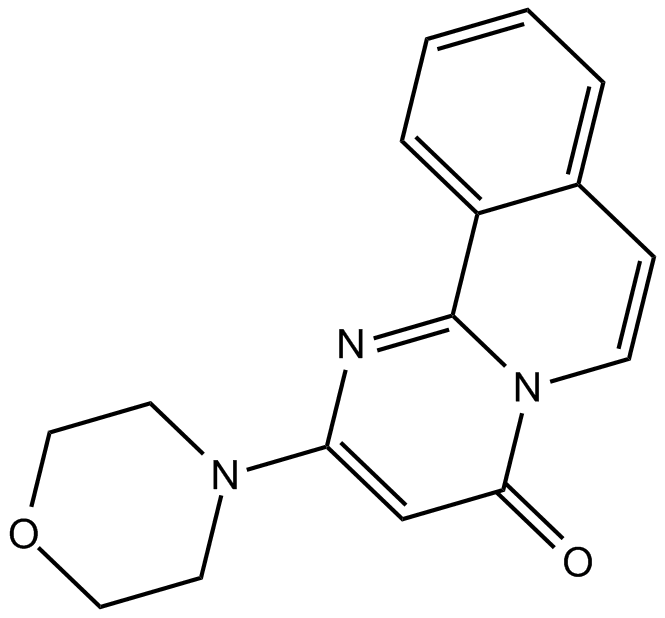
Cas No.: 168425-64-7
Sample solution is provided at 25 µL, 10mM.
_1-3.$$$39978408@51.jpg');)
_1-9.$$$38538795@65.jpg');)
_1-9.$$$39112701@51.jpg');)
_1-7.$$$37316672@70.jpg');)
_366-372.$$$36198801@70.jpg');)
.$$$38565142@65.jpg');)
_1867-1883.$$$33248023@67.jpg');)
_eads6055.$$$39977546@45.jpg');)
_eadm9805.$$$40080571@45.jpg');)
_eadj3020.$$$39666821@45.jpg');)
_1-20.$$$39757301@28.jpg');)
_1-24.$$$38898113@28.jpg');)
_273-287.$$$36806353@46.jpg');)
_1-16.$$$37156877@44.jpg');)
_1-19.$$$37460805@44.jpg');)
_1291-1307.$$$34518654@46.jpg');)
Compound 401 is a synthetic inhibitor of DNA-PK (IC50 = 0.28 μM) that also targets mTOR but not PI3K in vitro.
Compound 401 is a potent inhibitor of DNA-PK (IC50=0.28 μM). Compound 401 is reported to be a poor inhibitor of PI3K, ATM, and ATR in vitro, but it is active against mTOR. Compound 401 shows activity against mTOR (IC50=5.3 μM) but not p110α/p85α PI3K (IC50>100 μM). Treatment of cells with Compound 401 blocks the phosphorylation of sites modified by mTOR-Raptor and mTOR-Rictor complexes (ribosomal protein S6 kinase 1 Thr389 and Akt Ser473, respectively). By contrast, there is no direct inhibition of Akt Thr308 phosphorylation, which is dependent on PI3K. Similar effects are also observed in cells that lack DNA-PK. Compound 401 inhibits immunoprecipitated epitope-tagged mTOR or endogenous mTOR in Raptor immunoprecipitates. In both cases, inhibition of 67% or 78% is obtained at 5 μM or 10 μM Compound 401, respectively. By contrast, dose response curves show that the p110α/p85α or p110β/p85α PI3K complexes are poorly inhibited by Compound 401 at these concentrations. The proliferation of TSC1-/- fibroblasts is inhibited in the presence of Compound 401, but TSC1+/+ cells are resistant[1].
References:
[1]. Ballou LM, et al. Inhibition of mammalian target of rapamycin signaling by 2-(morpholin-1-yl)pyrimido[2,1-alpha]isoquinolin-4-one. J Biol Chem. 2007 Aug 17;282(33):24463-70.
Kinase experiment: | FreeStyle 293-F cells are transfected with cDNA for AU1-mTOR using 293fectin. Two days later, the cells are lysed and mTOR immunoprecipitates are prepared using AU1 antibody. Alternatively, the mTORC1 complex is immunoprecipitated from untransfected cells using Raptor antibody. Kinase activity in the immunoprecipitates is assayed in the presence of vehicle (DMSO) or Compound 401 (1, 5 and 10 μM) using bacterially expressed glutathione S-transferase (GST)-4E-BP1 as a substrate. Kinase reactions are stopped by boiling in SDS sample buffer and the samples are subjected to SDS-PAGE. Phosphorylated 4E-BP1 is detected by autoradiography. Radioactivity in the bands is quantified by scintillation counting[1]. |
References: [1]. Ballou LM, et al. Inhibition of mammalian target of rapamycin signaling by 2-(morpholin-1-yl)pyrimido[2,1-alpha]isoquinolin-4-one. J Biol Chem. 2007 Aug 17;282(33):24463-70. | |
| Cas No. | 168425-64-7 | SDF | |
| Chemical Name | 2-morpholino-4H-pyrimido[2,1-a]isoquinolin-4-one | ||
| Canonical SMILES | O=C1N2C(C3=CC=CC=C3C=C2)=NC(N4CCOCC4)=C1 | ||
| Formula | C16H15N3O2 | M.Wt | 281.31 |
| Solubility | DMF: 1 mg/ml,DMSO: 1 mg/ml,Ethanol: 0.5 mg/ml | Storage | Store at RT |
| General tips | Please select the appropriate solvent to prepare the stock solution according to the
solubility of the product in different solvents; once the solution is prepared, please store it in
separate packages to avoid product failure caused by repeated freezing and thawing.Storage method
and period of the stock solution: When stored at -80°C, please use it within 6 months; when stored
at -20°C, please use it within 1 month. To increase solubility, heat the tube to 37°C and then oscillate in an ultrasonic bath for some time. |
||
| Shipping Condition | Evaluation sample solution: shipped with blue ice. All other sizes available: with RT, or with Blue Ice upon request. | ||
| Prepare stock solution | |||

|
1 mg | 5 mg | 10 mg |
| 1 mM | 3.5548 mL | 17.774 mL | 35.548 mL |
| 5 mM | 711 μL | 3.5548 mL | 7.1096 mL |
| 10 mM | 355.5 μL | 1.7774 mL | 3.5548 mL |
Step 1: Enter information below (Recommended: An additional animal making an allowance for loss during the experiment)
 g
μL
g
μL
Step 2: Enter the in vivo formulation (This is only the calculator, not formulation. Please contact us first if there is no in vivo formulation at the solubility Section.)
Calculation results:
Working concentration: mg/ml;
Method for preparing DMSO master liquid: mg drug pre-dissolved in μL DMSO ( Master liquid concentration mg/mL, Please contact us first if the concentration exceeds the DMSO solubility of the batch of drug. )
Method for preparing in vivo formulation: Take μL DMSO master liquid, next addμL PEG300, mix and clarify, next addμL Tween 80, mix and clarify, next add μL saline, mix and clarify.
Method for preparing in vivo formulation: Take μL DMSO master liquid, next add μL Corn oil, mix and clarify.
Note: 1. Please make sure the liquid is clear before adding the next solvent.
2. Be sure to add the solvent(s) in order. You must ensure that the solution obtained, in the previous addition, is a clear solution before proceeding to add the next solvent. Physical methods such as vortex, ultrasound or hot water bath can be used to aid dissolving.
3. All of the above co-solvents are available for purchase on the GlpBio website.
Quality Control & SDS
- View current batch:
- Purity: >99.50% Appearance: A solid
- COA (Certificate of Analysis)
- SDS (Safety Data Sheet)
- Datasheet
Average Rating: 5 (Based on Reviews and 25 reference(s) in Google Scholar.)