

Eicosapentaenoic Acid (Synonyms: Single-Use EPA (peroxide free), Single-Use Timnodonic Acid (peroxide free)) |
Catalog No.GC11344
 One-Click Copy Product Info
|

Eicosapentaenoic Acid (EPA) est un acide gras polyinsaturé à longue-chaîne oméga-3 (ω-3) actif par voie orale (PUFA) et est un précurseur des eicosanoïdes prostaglandine-3, thromboxane-3 et leucotriène-5.
Products are for research use only. Not for human use. We do not sell to patients.
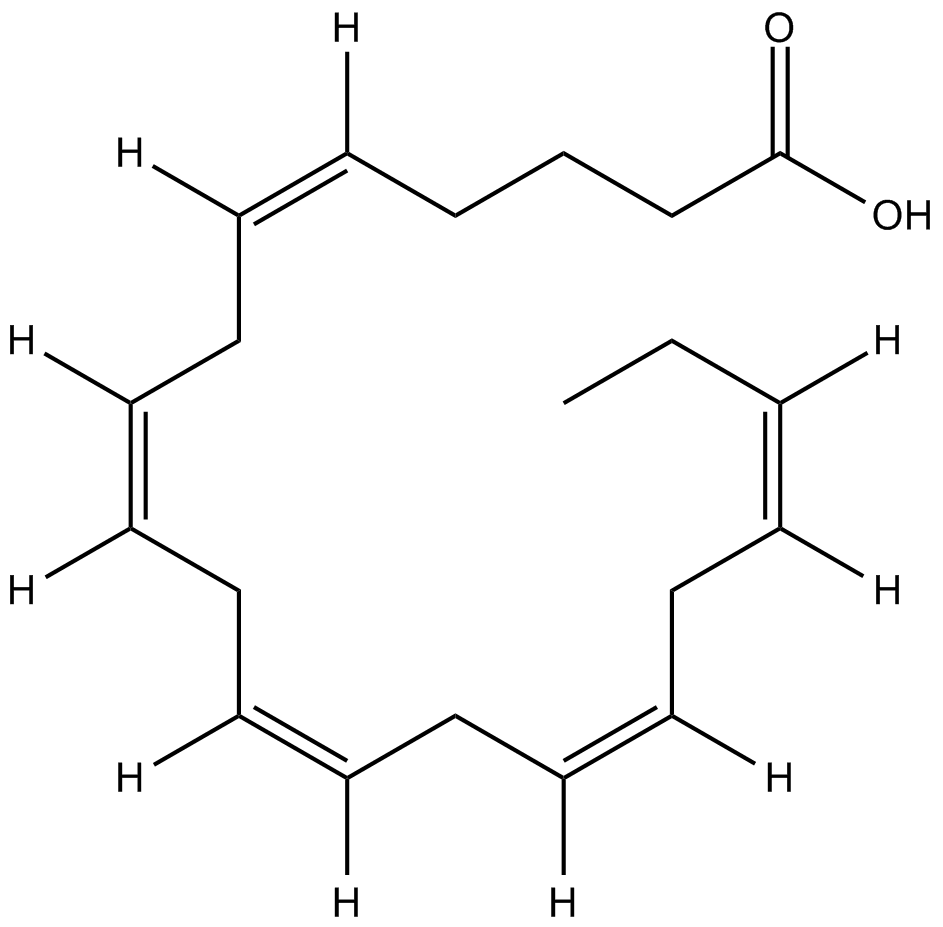
Cas No.: 10417-94-4
Sample solution is provided at 25 µL, 10mM.
Eicosapentaenoic Acid (EPA) est un acide gras polyinsaturé à longue-chaîne oméga-3 (ω-3) actif par voie orale (PUFA) et est un précurseur des eicosanoïdes prostaglandine-3, thromboxane-3 et leucotriène-5[1]. Eicosapentaenoic Acid possède les effets anti-inflammatoires, anti-maladies cardiovasculaires et anti-diabétiques. C'est présent en grandes quantités dans les organismes marins[2, 3].
In vitro, Eicosapentaenoic Acid (100 µM) a significativement réduit le niveau de la cytokines inflammatoires IL-8 dans les cellules cancéreuses du sein MDA-MB-231 et MCF-7 après 48 heures de traitement[4]. Eicosapentaenoic Acid (0.1 μM, 1 μM, 10 μM) induit de manière dose-dépendante l'apoptose et active les enzymes caspase -3, -7, -9, et PARP dans les cellules cancéreuses de l'oesophage TE11 et KYSE180 après 24 heures de traitement[5]. Eicosapentaenoic Acid (25 μM) inhibe considérablment la prolifération des cellules cancéreuses du côlon HT-29 et réduit la régulation de la voie de signalisation PI-3K/Akt/mTOR après 24 heures de traitement [6].
In vivo, Eicosapentaenoic Acid (500 mg/kg) qui est administré par voie orale aux rats Goto-Kakizaki diabétiques de type 2 pendant 4 semaines réduit significativement le niveau d'insuline circulante de 48% et augmente le contenu en mRNA de GLUT4 dans le muscle squelettique et le tissu adipeux[7].
References:
[1] Mason R P, Libby P, Bhatt D L. Emerging mechanisms of cardiovascular protection for the omega-3 fatty acid eicosapentaenoic acid[J]. Arteriosclerosis, thrombosis, and vascular biology, 2020, 40(5): 1135-1147.
[2] Šimat V, Elabed N, Kulawik P, et al. Recent advances in marine-based nutraceuticals and their health benefits[J]. Marine drugs, 2020, 18(12): 627.
[3] Nobre M E P, Correia A O, de Brito Borges M, et al. Eicosapentaenoic acid and docosahexaenoic acid exert anti-inflammatory and antinociceptive effects in rodents at low doses[J]. Nutrition research, 2013, 33(5): 422-433.
[4] Rasha F, Kahathuduwa C, Ramalingam L, et al. Combined effects of eicosapentaenoic acid and adipocyte renin–angiotensin system inhibition on breast cancer cell inflammation and migration[J]. Cancers, 2020, 12(1): 220.
[5] Mizoguchi K, Ishiguro H, Kimura M, et al. Induction of apoptosis by eicosapentaenoic acid in esophageal squamous cell carcinoma[J]. Anticancer research, 2014, 34(12): 7145-7149.
[6] Tang F Y, Cho H J, Pai M H, et al. Concomitant supplementation of lycopene and eicosapentaenoic acid inhibits the proliferation of human colon cancer cells[J]. The Journal of nutritional biochemistry, 2009, 20(6): 426-434.
[7] Figueras M, Olivan M, Busquets S, et al. Effects of eicosapentaenoic acid (EPA) treatment on insulin sensitivity in an animal model of diabetes: improvement of the inflammatory status[J]. Obesity, 2011, 19(2): 362-369.
| Expériences cellulaires [1]: | |
Lignées cellulaires | Cellules MDA-MB-231、MCF-7 |
Méthode de préparation | Les cellules MDA-MB-231 et MCF-7 ont été traitées par 100 µM Eicosapentaenoic Acid pendant 48 h. |
Conditions de réaction | 100 µM; 48h |
Domaines d'application | Le traitement de Eicosapentaenoic Acid a significativement réduit le niveau d'IL-8 dans les cellules. |
| Expériences animales [2]: | |
Modèles animaux | Rats mâles Goto-Kakizaki âgés de 3 semaines |
Méthode de préparation | Les rats mâles Goto-Kakizaki âgés de 3 semaines ont été utilisés. Il s'agit d'un modèle de rat atteint de diabète de type 2 spontané. Les animaux ont été maintenus sous un cycle lumière-obscurité régulier à une température ambiante et avaient un accès libre à la nourriture et à l'eau. Les rats ont été divisés en l'un des trois groupes : témoin, Eicosapentaenoic Acid (EPA) et acide linoléique (LINO), respectivement. Groupe EPA : des animaux nourris de la même manière que le groupe de témoin, mais supplémentés quotidiennement avec 500mg/kg de poids corporel d' EPA mélangé à carboxyméthylcellulose à 1% administré par sonde unique. Le traitement a duré 4 semaines avant que les animaux ne soient euthanasiés. |
Forme de dosage | 500mg/kg; p.o. |
Domaines d'application | L'administration de Eicosapentaenoic Acid a entraîné une réduction significative de l'insuline circulante (48%), ce qui n'a pas été observé dans le groupe LINO. Eicosapentaenoic Acid a entraîné une augmentation du contenu en mRNA de GLUT4 dans le muscle squelettique et le tissu adipeux. |
References: | |
| Cas No. | 10417-94-4 | SDF | |
| Synonymes | Single-Use EPA (peroxide free), Single-Use Timnodonic Acid (peroxide free) | ||
| Chemical Name | (5Z,8Z,11Z,14Z,17Z)-icosa-5,8,11,14,17-pentaenoic acid | ||
| Canonical SMILES | CC/C([H])=C([H])\C/C([H])=C([H])\C/C([H])=C([H])\C/C([H])=C([H])\C/C([H])=C([H])\CCCC(O)=O | ||
| Formula | C20H30O2 | M.Wt | 302.45 |
| Solubility | ≥ 116.8mg/mL in DMSO | Storage | Store at -20°C, protect from light, stored under nitrogen |
| General tips | Please select the appropriate solvent to prepare the stock solution according to the
solubility of the product in different solvents; once the solution is prepared, please store it in
separate packages to avoid product failure caused by repeated freezing and thawing.Storage method
and period of the stock solution: When stored at -80°C, please use it within 6 months; when stored
at -20°C, please use it within 1 month. To increase solubility, heat the tube to 37°C and then oscillate in an ultrasonic bath for some time. |
||
| Shipping Condition | Evaluation sample solution: shipped with blue ice. All other sizes available: with RT, or with Blue Ice upon request. | ||
| Prepare stock solution | |||

|
1 mg | 5 mg | 10 mg |
| 1 mM | 3.3063 mL | 16.5317 mL | 33.0633 mL |
| 5 mM | 661.3 μL | 3.3063 mL | 6.6127 mL |
| 10 mM | 330.6 μL | 1.6532 mL | 3.3063 mL |
Step 1: Enter information below (Recommended: An additional animal making an allowance for loss during the experiment)
 g
μL
g
μL
Step 2: Enter the in vivo formulation (This is only the calculator, not formulation. Please contact us first if there is no in vivo formulation at the solubility Section.)
Calculation results:
Working concentration: mg/ml;
Method for preparing DMSO master liquid: mg drug pre-dissolved in μL DMSO ( Master liquid concentration mg/mL, Please contact us first if the concentration exceeds the DMSO solubility of the batch of drug. )
Method for preparing in vivo formulation: Take μL DMSO master liquid, next addμL PEG300, mix and clarify, next addμL Tween 80, mix and clarify, next add μL saline, mix and clarify.
Method for preparing in vivo formulation: Take μL DMSO master liquid, next add μL Corn oil, mix and clarify.
Note: 1. Please make sure the liquid is clear before adding the next solvent.
2. Be sure to add the solvent(s) in order. You must ensure that the solution obtained, in the previous addition, is a clear solution before proceeding to add the next solvent. Physical methods such as vortex, ultrasound or hot water bath can be used to aid dissolving.
3. All of the above co-solvents are available for purchase on the GlpBio website.
Quality Control & SDS
- View current batch:
- Purity: >97.00% Appearance: A solid
- COA (Certificate of Analysis)
- SDS (Safety Data Sheet)
- Datasheet
Average Rating: 5 (Based on Reviews and 40 reference(s) in Google Scholar.)