

Enrofloxacin (Synonyms: BAY-Vp 2674, ENR, PD 160788) |
Catalog No.GC10487
 One-Click Copy Product Info
|

Enrofloxacin est un antibiotique de la famille des fluoroquinolones avec un large spectre antibactérien et une forte activité bactéricide contre les principales bactéries pathogènes.
Products are for research use only. Not for human use. We do not sell to patients.
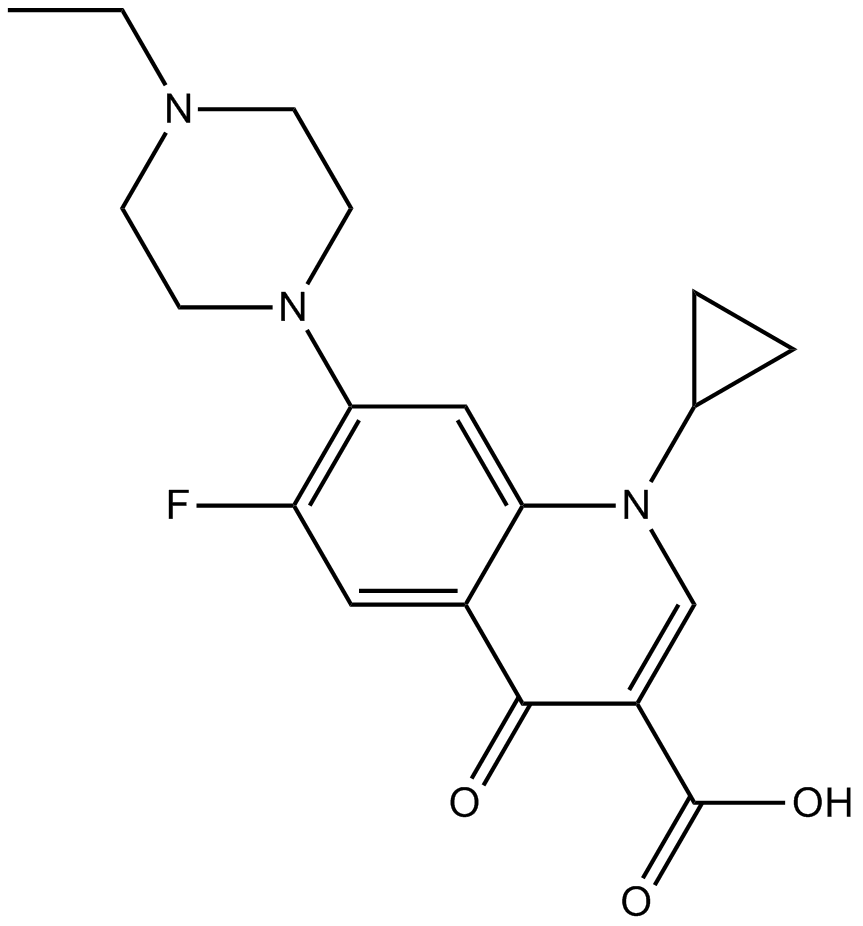
Cas No.: 93106-60-6
Sample solution is provided at 25 µL, 10mM.
_1-3.$$$39978408@51.jpg');)
_1-9.$$$38538795@65.jpg');)
_1-9.$$$39112701@51.jpg');)
_1-7.$$$37316672@70.jpg');)
_366-372.$$$36198801@70.jpg');)
.$$$38565142@65.jpg');)
_1867-1883.$$$33248023@67.jpg');)
_eads6055.$$$39977546@45.jpg');)
_eadm9805.$$$40080571@45.jpg');)
_eadj3020.$$$39666821@45.jpg');)
_1-20.$$$39757301@28.jpg');)
_1-24.$$$38898113@28.jpg');)
_273-287.$$$36806353@46.jpg');)
_1-16.$$$37156877@44.jpg');)
_1-19.$$$37460805@44.jpg');)
_1291-1307.$$$34518654@46.jpg');)
Enrofloxacin est un antibiotique de la famille des fluoroquinolones avec un large spectre antibactérien et une forte activité bactéricide contre les principales bactéries pathogènes[1]. Enrofloxacin se lie au complexe ADN-topoisomérase au niveau du site de clivage-ligation, modifie la conformation de l'enzyme, bloque la réplication de DNA en empêchant une ligation efficace[2]. Enrofloxacin est utilisé à traiter les infections bactériennes de la mamelle, des voies respiratoires et du tube digestif chez les bovins[3].
Le traitement in vitro avec Enrofloxacin (40µg/ml) pendant 72h a significativement augmenté le niveau γH2Ax dans les cellules Abrams, a réduit fortement leur viabilité[4]. Le traitement avec 200µg/ml de Enrofloxacin pendant 4 jours a induit une fragmentation caractéristique de DNA et une condensation des noyaux apoptotiques dans les cellules de tendon et les chondrocytes canins[5]. Le traitement avec 200µg/ml de Enrofloxacin pendant 24h a induit la libération de lactate déshydrogénase (LDH) et une hausse des espèces réactives de l'oxygène (ERO) dans les cellules L8824, perturbé le potentiel membranaire mitochondrial, favorisé la mort de cellule[6].
Le traitement in vivo avec Enrofloxacin via l'administration orale à une dose de 10mg/kg toutes les 12 heures pendant 7 jours a réduit l'inflammation pulmonaire chez les rats ayant subi une occlusion de l'artère cérébrale moyenne (OACM), amélioré leur durée de vie, évité la perte de poids[7]. L'administration orale de l'eau contenant 0.27mg/ml de Enrofloxacin quotidiennement pendant 2 semaines a considérablement atténué les symptômes de sensibilité au contact (SC) chez les rats, modifié la composition de la flore intestinale, stimulé les réponses anti-inflammatoires[8].
References:
[1] Lopez-Cadenas C, Sierra-Vega M, Garcia-Vieitez J J, et al. Enrofloxacin: pharmacokinetics and metabolism in domestic animal species[J]. Current Drug Metabolism, 2013, 14(10): 1042-1058.
[2] Grabowski Ł, Gaffke L, Pierzynowska K, et al. Enrofloxacin—the ruthless killer of eukaryotic cells or the last hope in the fight against bacterial infections?[J]. International journal of molecular sciences, 2022, 23(7): 3648.
[3] Mitchell M A. Enrofloxacin[J]. Journal of Exotic Pet Medicine, 2006, 15(1): 66-69.
[4] York D, Withers S S, Watson K D, et al. Enrofloxacin enhances the effects of chemotherapy in canine osteosarcoma cells with mutant and wild‐type p53[J]. Veterinary and comparative oncology, 2017, 15(3): 1087-1100.
[5] Lim S, Hossain M A, Park J, et al. The effects of enrofloxacin on canine tendon cells and chondrocytes proliferation in vitro[J]. Veterinary research communications, 2008, 32(3): 243-253.
[6] Liu B, Cui Y, Brown P B, et al. Cytotoxic effects and apoptosis induction of enrofloxacin in hepatic cell line of grass carp (Ctenopharyngodon idellus)[J]. Fish & Shellfish Immunology, 2015, 47(2): 639-644.
[7] Hetze S, Engel O, Römer C, et al. Superiority of preventive antibiotic treatment compared with standard treatment of poststroke pneumonia in experimental stroke: a bed to bench approach[J]. Journal of Cerebral Blood Flow & Metabolism, 2013, 33(6): 846-854.
[8] Strzępa A, Majewska-Szczepanik M, Lobo F M, et al. Broad spectrum antibiotic enrofloxacin modulates contact sensitivity through gut microbiota in a murine model[J]. Journal of Allergy and Clinical Immunology, 2017, 140(1): 121-133. e3.
| Expériences cellulaires [1]: | |
Lignées cellulaires | Cellules de tendon canines |
Méthode de préparation | Les cellules de tendon canines ont été ensemencées dans les plaques de microculture à fond plat de 96 puits, à une densité de 1×10⁴ cellules/puits dans 200µl de milieu DMEM. Les cellules ont été laissées adhérer aux plaques, puis traitées avec différentes concentrations de Enrofloxacin (10, 50, 100, et 200μg/ml) pendant 4 jours, après quoi le prolifération cellulaire a été mesurée. |
Conditions de réaction | 10, 50, 100, et 200μg/ml; 4 jours |
Domaines d'application | Le traitement avec Enrofloxacin a significativement augmenté la prolifération des cellules de tendon canines de manière dose-dépendante. |
| Expériences animales [2]: | |
Modèles animaux | Rats mâles C57Bl6/J |
Méthode de préparation | Les rats mâles C57Bl6/J (âgés de 11 semaines) ont été hébergés dans une pièce à température contrôlée (21-23°C), humidité (55-60%), et éclairage (cycle lumière/obscurité de 12h/12h), avec accès à l'eau. Après induction de l'anesthésie avec de l'isoflurane dans un mélange 1:2 d'oxygène/protoxyde d'azote, une incision médiane cervicale ventrale a été pratiquée, et un filament de nylon de 12mm enduit de silicone a été introduit au niveau de l'artère carotide commune, puis avancé dans l'artère carotide interne pour occlure l'origine de l'artère cérébrale moyenne. Après 60 minutes d'ischémie, le filament a été retiré pour permettre la reperfusion. La température corporelle a été contrôlée tout au long de l'intervention. Les rats ont reçu Enrofloxacin (10mg/kg; p.o.) à l'aide d'un aiguille à gavage toutes les 12 heures, environ une heure après le réveil de l'anesthésie de reperfusion, pendant 7 jours. La charge bactérienne pulmonaire et la durée de vie ont été mesurées. |
Forme de dosage | 10mg/kg; toutes les 12 heures pendant 7 jours; p.o. |
Domaines d'application | Le traitement avec Enrofloxacin a réduit la charge bactérienne pulmonaire, amélioré la durée de vie des rats ayant subi une occlusion de l'artère cérébrale moyenne (OACM). |
References: | |
| Cas No. | 93106-60-6 | SDF | |
| Synonymes | BAY-Vp 2674, ENR, PD 160788 | ||
| Chemical Name | 1-cyclopropyl-7-(4-ethylpiperazin-1-yl)-6-fluoro-4-oxoquinoline-3-carboxylic acid | ||
| Canonical SMILES | CCN1CCN(CC1)C2=C(C=C3C(=C2)N(C=C(C3=O)C(=O)O)C4CC4)F | ||
| Formula | C19H22FN3O3 | M.Wt | 359.39 |
| Solubility | ≥ 15mg/mL in DMSO with gentle warming | Storage | Store at -20°C |
| General tips | Please select the appropriate solvent to prepare the stock solution according to the
solubility of the product in different solvents; once the solution is prepared, please store it in
separate packages to avoid product failure caused by repeated freezing and thawing.Storage method
and period of the stock solution: When stored at -80°C, please use it within 6 months; when stored
at -20°C, please use it within 1 month. To increase solubility, heat the tube to 37°C and then oscillate in an ultrasonic bath for some time. |
||
| Shipping Condition | Evaluation sample solution: shipped with blue ice. All other sizes available: with RT, or with Blue Ice upon request. | ||
| Prepare stock solution | |||

|
1 mg | 5 mg | 10 mg |
| 1 mM | 2.7825 mL | 13.9125 mL | 27.8249 mL |
| 5 mM | 556.5 μL | 2.7825 mL | 5.565 mL |
| 10 mM | 278.2 μL | 1.3912 mL | 2.7825 mL |
Step 1: Enter information below (Recommended: An additional animal making an allowance for loss during the experiment)
 g
μL
g
μL
Step 2: Enter the in vivo formulation (This is only the calculator, not formulation. Please contact us first if there is no in vivo formulation at the solubility Section.)
Calculation results:
Working concentration: mg/ml;
Method for preparing DMSO master liquid: mg drug pre-dissolved in μL DMSO ( Master liquid concentration mg/mL, Please contact us first if the concentration exceeds the DMSO solubility of the batch of drug. )
Method for preparing in vivo formulation: Take μL DMSO master liquid, next addμL PEG300, mix and clarify, next addμL Tween 80, mix and clarify, next add μL saline, mix and clarify.
Method for preparing in vivo formulation: Take μL DMSO master liquid, next add μL Corn oil, mix and clarify.
Note: 1. Please make sure the liquid is clear before adding the next solvent.
2. Be sure to add the solvent(s) in order. You must ensure that the solution obtained, in the previous addition, is a clear solution before proceeding to add the next solvent. Physical methods such as vortex, ultrasound or hot water bath can be used to aid dissolving.
3. All of the above co-solvents are available for purchase on the GlpBio website.
Quality Control & SDS
- View current batch:
- Purity: >99.50% Appearance: A solid
- COA (Certificate of Analysis)
- SDS (Safety Data Sheet)
- Datasheet
Average Rating: 5 (Based on Reviews and 3 reference(s) in Google Scholar.)