

Etoricoxib (Synonyms: L-791,456, MK-0663) |
Catalog No.GC10429
 One-Click Copy Product Info
|

Etoricoxib is a selective cyclooxygenase-2 (COX-2) inhibitor. Etoricoxib inhibits the activity of COX-2 (IC50=1.1μM) and COX-1 (IC50=116μM).
Products are for research use only. Not for human use. We do not sell to patients.
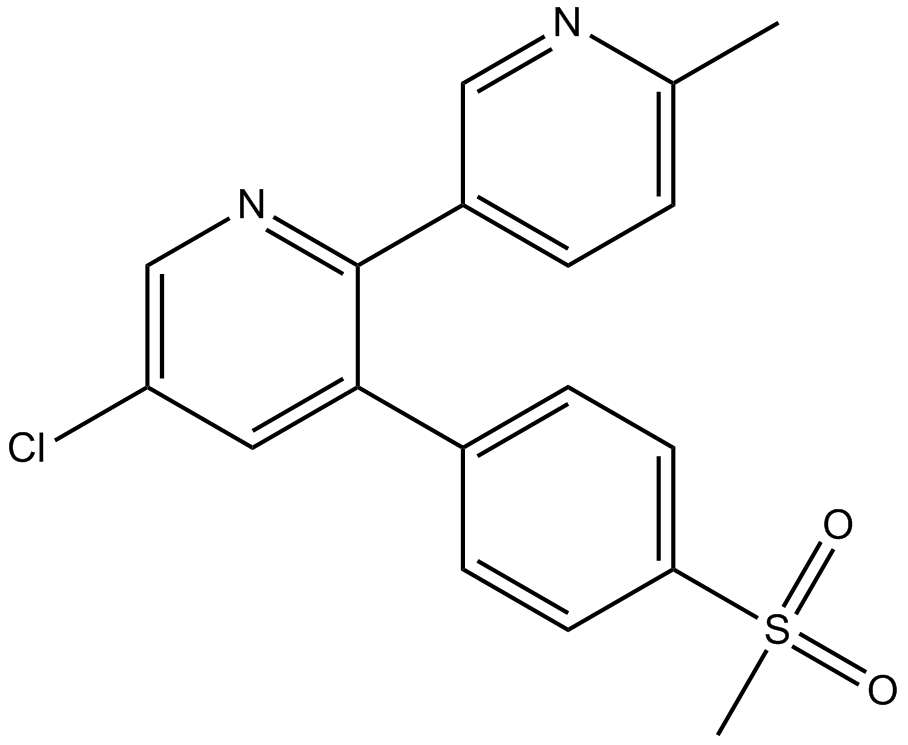
Cas No.: 202409-33-4
Sample solution is provided at 25 µL, 10mM.
Etoricoxib is a selective cyclooxygenase-2 (COX-2) inhibitor. Etoricoxib inhibits the activity of COX-2 (IC50=1.1μM) and COX-1 (IC50=116μM). Etoricoxib inhibits COX-2-mediated arachidonic acid conversion to reduce the synthesis of pro-inflammatory prostaglandins such as prostaglandin E2. Etoricoxib can be used for research on osteoarthritis, rheumatoid arthritis, acute gouty arthritis, ankylosing spondylitis, and chronic pain[1-4].
In vitro, Caco-2 cells were treated with 0.2-20μg/mL Etoricoxib for 24-48 hours. Etoricoxib did not affect ACE2 mRNA and protein expression. Etoricoxib did not affect soluble and membrane-bound ACE2 activity[5]. N13 cells were pretreated with 6-12µM Etoricoxib for 1 hour, then stimulated with 10µg/mL lipopolysaccharide for 24-48 hours, resulting in reduced COX-2 protein expression, NF-kB phosphorylation, and NO production[6]. Mouse bone-derived cells were treated with 10-20µM etoricoxib for 7 days, resulting in inhibited alkaline phosphatase activity[7].
In vivo, C57BL/6 mice received intraperitoneal injections of 5-20mg/kg Etoricoxib 3 times a week for 4 weeks starting from day 2 after destabilization of the medial meniscus surgery, resulting ininhibited osteophyte formation, reduced bone volume fraction and trabecular thickness, reduced subchondral bone elastic modulus, increased subchondral bone microfractures and pores, increased the empty/total osteocyte ratio. Etoricoxib did not significantly improve articular cartilage destruction or synovial inflammation[8]. Pentylenetetrazol-induced seizure model albino mice were orally administered 6mg/kg or 10mg/kg Etoricoxib, resulting in delayed the onset of clonic seizures, shortened clonic seizure duration, enhanced diazepam protection, reduced mortality, increased free plasma diazepam levels[9]. BALB/c mice were orally administered 10.5-21mg/kg/day Etoricoxib for 28 days. Etoricoxib (10.5mg/kg/day) caused mild centrilobular vein and sinusoid dilation and congestion, portal area enlargement, and occasional hepatocyte vacuolation. Etoricoxib (21mg/kg/day) caused hepatocyte ballooning, pyknosis, inflammatory cell infiltration, hepatocyte necrosis, and hepatic lobule structure destruction[10].
References:
[1] Cochrane DJ, Jarvis B, Keating GM. Etoricoxib. Drugs. 2002;62(18):2637-51; discussion 2652-3.
[2] Malviya R, Sharma PK, Dubey SK. Efficiency of self-assembled etoricoxib containing polyelectrolyte complex stabilized cubic nanoparticles against human cancer cells. Precis Med Sci. 2020;9:9-22.
[3] Md S, Alhakamy NA, Alharbi WS, et al. Development and Evaluation of Repurposed Etoricoxib Loaded Nanoemulsion for Improving Anticancer Activities against Lung Cancer Cells. Int J Mol Sci. 2021;22:13284.
[4] Arunkumar P, Indulekha S, Vijayalakshmi S, et al. Poly(caprolactone) microparticles and chitosan thermogels based injectable formulation of etoricoxib for the potential treatment of osteoarthritis. Mater Sci Eng C. 2016;62:710-722.
[5] de Bruin N, Schneider A-K, Reus P, et al. Ibuprofen, Flurbiprofen, Etoricoxib or Paracetamol Do Not Influence ACE2 Expression and Activity In Vitro or in Mice and Do Not Exacerbate In-Vitro SARS-CoV-2 Infection. Int J Mol Sci. 2022;23:1049.
[6] Calvello R, Panaro MA, Carbone ML, et al. Novel selective COX-1 inhibitors suppress neuroinflammatory mediators in LPS-stimulated N13 microglial cells. Pharmacol Res. 2012;65(1):137-148.
[7] Choi JS, Kim JY, Ahn M, et al. Celecoxib is the only nonsteroidal anti-inflammatory drug to inhibit bone progression in spondyloarthritis. BMB Rep. 2025;58(3):140-145.
[8] Liu B, Jia C, Shao Y, et al. Etoricoxib decreases subchondral bone mass and attenuates biomechanical properties at the early stage of osteoarthritis in a mouse model. Biomed Pharmacother. 2020;127:110144.
[9] Jayaraman R, Manisenthil KT, Anita T, et al. Influence of etoricoxib on anticonvulsant activity of phenytoin and diazepam in experimental seizure models in mice. J Pharm Pharmacol. 2010;62(5):610-614.
[10] Jamous YF, Alghamdi BS, Jarrar Y, et al. Hepatic Effects of Etoricoxib in Mice: Integrated Histopathological and Gene Expression Analysis. Pharmaceuticals. 2026;19:414.
| Cell experiment [1]: | |
|
Cell lines |
mouse N13 microglial cells |
|
Preparation Method |
N13 microglial cells were maintained in RPMI 1640 medium with 10% FBS at 37°C, 5% CO2. N13 microglial cells were pretreated with Etoricoxib at 6µM or 12µM for 1 hour, then stimulated with LPS (10µg/mL) for 24h or 48h, followed by detection of COX-2, p-IkBα, NO and iNOS. |
|
Reaction Conditions |
6-12µM; pretreatment 1h then LPS 24h or 48h |
|
Applications |
Etoricoxib reduced COX-2 protein expression, reduced NF-kB activation by lowering p-IkBα levels, and reduced NO production and iNOS expression in LPS-stimulated N13 microglial cells. |
| Animal experiment [2]: | |
|
Animal models |
C57BL/6 mice |
|
Preparation Method |
C57BL/6 mice underwent destabilization of the medial meniscus (DMM) surgery; 2 days after surgery, mice were intraperitoneally injected with Etoricoxib 5-20mg/kg, 3 times a week for 4 weeks, then knee joints were evaluated by micro-CT, AFM, SEM and histology. |
|
Dosage form |
5-20mg/kg; i.p.; 3 times a week for 4 weeks |
|
Applications |
Etoricoxib inhibited osteophyte formation in subchondral bone, reduced bone volume fraction and trabecular thickness, lowered elastic modulus of subchondral bone, increased microfractures and pore density, increased empty/total osteocyte ratio, and did not significantly improve articular cartilage destruction or synovial inflammation in early OA mice. |
References: [1] Calvello R, Panaro MA, Carbone ML, et al. Novel selective COX-1 inhibitors suppress neuroinflammatory mediators in LPS-stimulated N13 microglial cells. Pharmacol Res. 2012;65(1):137-148. [2] Liu B, Jia C, Shao Y, et al. Etoricoxib decreases subchondral bone mass and attenuates biomechanical properties at the early stage of osteoarthritis in a mouse model. Biomed Pharmacother. 2020;127:110144. | |
| Cas No. | 202409-33-4 | SDF | |
| Synonymes | L-791,456, MK-0663 | ||
| Chemical Name | 5-chloro-2-(6-methylpyridin-3-yl)-3-(4-methylsulfonylphenyl)pyridine | ||
| Canonical SMILES | CC1=NC=C(C=C1)C2=NC=C(C=C2C3=CC=C(C=C3)S(=O)(=O)C)Cl | ||
| Formula | C18H15ClN2O2S | M.Wt | 358.84 |
| Solubility | ≥ 10.85 mg/mL in DMSO, ≥ 49.4 mg/mL in EtOH with gentle warming | Storage | Store at -20°C |
| General tips | Please select the appropriate solvent to prepare the stock solution according to the
solubility of the product in different solvents; once the solution is prepared, please store it in
separate packages to avoid product failure caused by repeated freezing and thawing.Storage method
and period of the stock solution: When stored at -80°C, please use it within 6 months; when stored
at -20°C, please use it within 1 month. To increase solubility, heat the tube to 37°C and then oscillate in an ultrasonic bath for some time. |
||
| Shipping Condition | Evaluation sample solution: shipped with blue ice. All other sizes available: with RT, or with Blue Ice upon request. | ||
| Prepare stock solution | |||

|
1 mg | 5 mg | 10 mg |
| 1 mM | 2.7868 mL | 13.9338 mL | 27.8676 mL |
| 5 mM | 557.4 μL | 2.7868 mL | 5.5735 mL |
| 10 mM | 278.7 μL | 1.3934 mL | 2.7868 mL |
Step 1: Enter information below (Recommended: An additional animal making an allowance for loss during the experiment)
 g
μL
g
μL
Step 2: Enter the in vivo formulation (This is only the calculator, not formulation. Please contact us first if there is no in vivo formulation at the solubility Section.)
Calculation results:
Working concentration: mg/ml;
Method for preparing DMSO master liquid: mg drug pre-dissolved in μL DMSO ( Master liquid concentration mg/mL, Please contact us first if the concentration exceeds the DMSO solubility of the batch of drug. )
Method for preparing in vivo formulation: Take μL DMSO master liquid, next addμL PEG300, mix and clarify, next addμL Tween 80, mix and clarify, next add μL saline, mix and clarify.
Method for preparing in vivo formulation: Take μL DMSO master liquid, next add μL Corn oil, mix and clarify.
Note: 1. Please make sure the liquid is clear before adding the next solvent.
2. Be sure to add the solvent(s) in order. You must ensure that the solution obtained, in the previous addition, is a clear solution before proceeding to add the next solvent. Physical methods such as vortex, ultrasound or hot water bath can be used to aid dissolving.
3. All of the above co-solvents are available for purchase on the GlpBio website.
Quality Control & SDS
- View current batch:
- Purity: >99.00% Appearance: A solid
- COA (Certificate of Analysis)
- SDS (Safety Data Sheet)
- Datasheet
Average Rating: 5 (Based on Reviews and 30 reference(s) in Google Scholar.)