
Pyrogallol (Synonyms: Antioxidant PY, Benzene-1,2,3-triol, C.I. 76515, Fouramine Brown AP, NSC 5035, 2,3-dihydroxy Phenol, 1,2,3-Trihydroxybenzene) |
| Catalog No.GC32391 |
Le pyrogallol est un composé polyphénolique, qui possède des propriétés antifongiques et anti-psoriasiques.
Products are for research use only. Not for human use. We do not sell to patients.
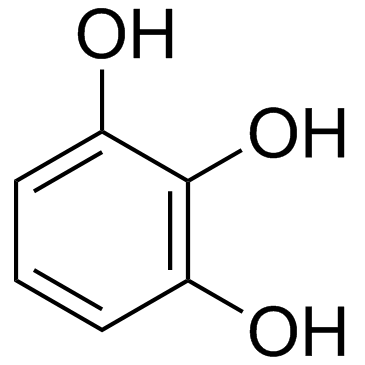
Cas No.: 87-66-1
Sample solution is provided at 25 µL, 10mM.
Pyrogallol is a polyphenol compound, which has anti-fungal and anti-psoriatic properties. Pyrogallol is a reductant that is able to generate free radicals, in particular superoxide anions.
Pyrogallol (PG) is a reductant that is able to generate free radicals, in particular superoxide anions (O2•-), so has frequently been used as a photographic developing agent and in the hair dying industry. Pyrogallol inhibits Calu-6 and A549 lung cancer cell growth via apoptosis and depletion of glutathione (GSH). Pyrogallol (PG) induces apoptosis in lung cancer cells via the overproduction of O2•- and affects mitogen activated protein kinases (MAPKs) in these cells[1]. The effect of Pyrogallol on human pulmonary fibroblast (HPF) cell viability and necrotic cell death is examined. For these experiments, 0, 50 or 100 µM Pyrogallol is used to differentiate the levels of cell viability inhibition or death with or without a given MAPK inhibitor. Treatment with 50 and 100 µM Pyrogallol decreases HPF viability by ~40 and 65% at 24 h, respectively. Treatment with an MEK inhibitor slightly enhances the inhibition of cell viability in 50 µM Pyrogallol-treated HPF cells, whereas treatment with a p38 inhibitor mildly attenuates the inhibition of viability. In 100 µM Pyrogallol-treated HPF cells, all the MAPK inhibitors increase the inhibition of viability to a certain extent, with treatment with the p38 inhibitor alone augmenting HPF control cell viability. Necrotic cell death is determined by measuring lactate dehydrogenase (LDH) release from cells. While treatment with 50 µM Pyrogallol does not affect LDH release from HPF cells, 100 µM Pyrogallol significantly increases LDH release[1].
[1]. Han BR, et al. MAPK inhibitors enhance cell death in pyrogallol-treated human pulmonary fibroblast cells via increasing O2•- levels. Oncol Lett. 2017 Jul;14(1):1179-1185.

|
Cell experiment: |
Briefly, 5×10³ HPF cells per well in 96-well microtiter plates are exposed to 0, 50 or 100 µM Pyrogallol with or without each MAPK inhibitor at 37°C for 24 h. Changes in cell viability induced by Pyrogallol and/or a given MAPK inhibitor are determined by measuring the MTT; dye absorbance[1]. |
|
References: [1]. Han BR, et al. MAPK inhibitors enhance cell death in pyrogallol-treated human pulmonary fibroblast cells via increasing O2•- levels. Oncol Lett. 2017 Jul;14(1):1179-1185. |
|
| Cas No. | 87-66-1 | SDF | |
| Synonymes | Antioxidant PY, Benzene-1,2,3-triol, C.I. 76515, Fouramine Brown AP, NSC 5035, 2,3-dihydroxy Phenol, 1,2,3-Trihydroxybenzene | ||
| Canonical SMILES | OC1=CC=CC(O)=C1O | ||
| Formula | C6H6O3 | M.Wt | 126.11 |
| Solubility | DMSO : ≥ 100 mg/mL (792.96 mM);Water : 50 mg/mL (396.48 mM) | Storage | Store at RT |
| General tips | Please select the appropriate solvent to prepare the stock solution according to the
solubility of the product in different solvents; once the solution is prepared, please store it in
separate packages to avoid product failure caused by repeated freezing and thawing.Storage method
and period of the stock solution: When stored at -80°C, please use it within 6 months; when stored
at -20°C, please use it within 1 month. To increase solubility, heat the tube to 37°C and then oscillate in an ultrasonic bath for some time. |
||
| Shipping Condition | Evaluation sample solution: shipped with blue ice. All other sizes available: with RT, or with Blue Ice upon request. | ||
| Prepare stock solution | |||
|
1 mg | 5 mg | 10 mg |
| 1 mM | 7.9296 mL | 39.6479 mL | 79.2959 mL |
| 5 mM | 1.5859 mL | 7.9296 mL | 15.8592 mL |
| 10 mM | 793 μL | 3.9648 mL | 7.9296 mL |
Step 1: Enter information below (Recommended: An additional animal making an allowance for loss during the experiment)
Step 2: Enter the in vivo formulation (This is only the calculator, not formulation. Please contact us first if there is no in vivo formulation at the solubility Section.)
Calculation results:
Working concentration: mg/ml;
Method for preparing DMSO master liquid: mg drug pre-dissolved in μL DMSO ( Master liquid concentration mg/mL, Please contact us first if the concentration exceeds the DMSO solubility of the batch of drug. )
Method for preparing in vivo formulation: Take μL DMSO master liquid, next addμL PEG300, mix and clarify, next addμL Tween 80, mix and clarify, next add μL ddH2O, mix and clarify.
Method for preparing in vivo formulation: Take μL DMSO master liquid, next add μL Corn oil, mix and clarify.
Note: 1. Please make sure the liquid is clear before adding the next solvent.
2. Be sure to add the solvent(s) in order. You must ensure that the solution obtained, in the previous addition, is a clear solution before proceeding to add the next solvent. Physical methods such as vortex, ultrasound or hot water bath can be used to aid dissolving.
3. All of the above co-solvents are available for purchase on the GlpBio website.
Quality Control & SDS
- View current batch:
- Purity: >99.50%
- COA (Certificate Of Analysis)
- SDS (Safety Data Sheet)
- Datasheet
Average Rating: 5 (Based on Reviews and 21 reference(s) in Google Scholar.)
GLPBIO products are for RESEARCH USE ONLY. Please make sure your review or question is research based.
Required fields are marked with *


