

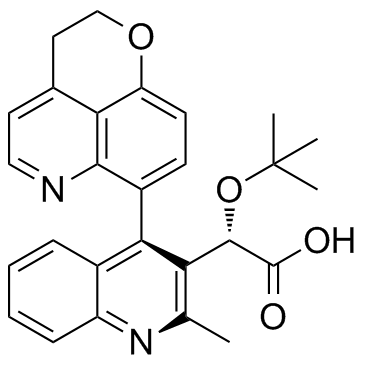
BI 224436 |
Catalog No.GC35510
 One-Click Copy Product Info
|

BI 224436 est un nouvel inhibiteur de l'intégrase du site non catalytique du VIH-1 avec des valeurs EC50 inférieures À 15 nM contre différentes souches de laboratoire du VIH-1.
Products are for research use only. Not for human use. We do not sell to patients.
Cas No.: 1155419-89-8
Sample solution is provided at 25 µL, 10mM.
_1-3.$$$39978408@51.jpg');)
_1-9.$$$38538795@65.jpg');)
_1-9.$$$39112701@51.jpg');)
_1-7.$$$37316672@70.jpg');)
_366-372.$$$36198801@70.jpg');)
.$$$38565142@65.jpg');)
_1867-1883.$$$33248023@67.jpg');)
_eads6055.$$$39977546@45.jpg');)
_eadm9805.$$$40080571@45.jpg');)
_eadj3020.$$$39666821@45.jpg');)
_1-20.$$$39757301@28.jpg');)
_1-24.$$$38898113@28.jpg');)
_273-287.$$$36806353@46.jpg');)
_1-16.$$$37156877@44.jpg');)
_1-19.$$$37460805@44.jpg');)
_1291-1307.$$$34518654@46.jpg');)
BI 224436 is a novel HIV-1 noncatalytic site integrase inhibitor with EC50 values of less than 15 nM against different HIV-1 laboratory strains. EC50: 15 nM (HIV-1)[1]
BI 224436 has cellular cytotoxicity of more than 90 μM. BI 224436 has a low, 2.1-fold decrease in antiviral potency in the presence of 50% human serum. BI 224436 retains full antiviral activity against recombinant viruses encoding INSTI resistance substitutions N155S, Q148H, and E92Q. BI 224436 displays an additive effect in combination with most approved antiretrovirals, including INSTIs. BI 224436 has drug-like in vitro absorption, distribution, metabolism, and excretion (ADME) properties, including Caco-2 cell permeability, solubility, and low cytochrome P450 inhibition[1].
BI 224436 exhibits excellent pharmacokinetic profiles in rat (clearance as a percentage of hepatic flow [CL], 0.7%; bioavailability [F], 54%), monkey (CL, 23%; F, 82%), and dog (CL, 8%; F, 81%)[1].
[1]. Fenwick C, et al. Preclinical profile of BI 224436, a novel HIV-1 non-catalytic-site integrase inhibitor. Antimicrob Agents Chemother. 2014 Jun;58(6):3233-44.
|
Kinase experiment: |
BI 224436 is dissolved in acetonitrile-methanol (50:50, vol/vol) to achieve a concentration of 1.5 mM. Phosphate buffer (pH 7.4), cofactor, and test substance or isoform-selective inhibitors are added to 96-well plates and are prewarmed to 37°C for 10 min. Cofactor concentrations are 1.3 mM NADP, 3.3 mM glucose-6-phosphate, and 0.4 U/mL glucose-6-phosphate dehydrogenase. Reactions are initiated by the addition of prewarmed (37°C) enzyme and substrate. Reaction mixtures are incubated at 37°C and terminated by the addition of 0.038 ml of 40:40:20 (vol/vol) methanol–acetonitrile–0.5 M Tris buffer. Formation of the fluorescent metabolites is measured using a microplate spectrofluorometer at specific excitation and emission wavelengths. The IC50 is determined using the 96-well 32 procedure supplied with the SAS software[1]. |
|
Animal experiment: |
Rats: For oral PK studies, BI 224436 is administered in a suspension of 0.5% (wt/vol) methyl cellulose (MC), 0.3% (vol/vol) Tween 80, and 1% (vol/vol) N-methyl-2-pyrrolidine (MP) in water. For i.v. dosing, BI 224436 is dissolved in 70% PEG 400–30% water (vol/vol). The appropriate amount of BI 224436 is dissolved in PEG 400 with sonication. The rats receive a single i.v. dose of 0.2 mg/kg of body weight (1 mL/kg) via the jugular vein as a bolus or received a single oral dose of 0.4 mg/kg (10 mL/kg) administered by gavage. Blood samples are obtained at 0, 0.25, 0.5, 1, 1.5, 2, 3, 4, 6, 8, 12, 24, and 32 h after dosing for analysis[1]. |
|
References: [1]. Fenwick C, et al. Preclinical profile of BI 224436, a novel HIV-1 non-catalytic-site integrase inhibitor. Antimicrob Agents Chemother. 2014 Jun;58(6):3233-44. |
|
| Cas No. | 1155419-89-8 | SDF | |
| Canonical SMILES | CC1=C([C@@H](C(O)=O)OC(C)(C)C)[C@@]([C@@]2=CC=C3C4=C2N=CC=C4CCO3)=C5C(C=CC=C5)=N1 | ||
| Formula | C27H26N2O4 | M.Wt | 442.51 |
| Solubility | DMSO: ≥ 50 mg/mL (112.99 mM) | Storage | Store at -20°C,unstable in solution, ready to use. |
| General tips | Please select the appropriate solvent to prepare the stock solution according to the
solubility of the product in different solvents; once the solution is prepared, please store it in
separate packages to avoid product failure caused by repeated freezing and thawing.Storage method
and period of the stock solution: When stored at -80°C, please use it within 6 months; when stored
at -20°C, please use it within 1 month. To increase solubility, heat the tube to 37°C and then oscillate in an ultrasonic bath for some time. |
||
| Shipping Condition | Evaluation sample solution: shipped with blue ice. All other sizes available: with RT, or with Blue Ice upon request. | ||
| Prepare stock solution | |||

|
1 mg | 5 mg | 10 mg |
| 1 mM | 2.2598 mL | 11.2992 mL | 22.5984 mL |
| 5 mM | 452 μL | 2.2598 mL | 4.5197 mL |
| 10 mM | 226 μL | 1.1299 mL | 2.2598 mL |
Step 1: Enter information below (Recommended: An additional animal making an allowance for loss during the experiment)
 g
μL
g
μL
Step 2: Enter the in vivo formulation (This is only the calculator, not formulation. Please contact us first if there is no in vivo formulation at the solubility Section.)
Calculation results:
Working concentration: mg/ml;
Method for preparing DMSO master liquid: mg drug pre-dissolved in μL DMSO ( Master liquid concentration mg/mL, Please contact us first if the concentration exceeds the DMSO solubility of the batch of drug. )
Method for preparing in vivo formulation: Take μL DMSO master liquid, next addμL PEG300, mix and clarify, next addμL Tween 80, mix and clarify, next add μL saline, mix and clarify.
Method for preparing in vivo formulation: Take μL DMSO master liquid, next add μL Corn oil, mix and clarify.
Note: 1. Please make sure the liquid is clear before adding the next solvent.
2. Be sure to add the solvent(s) in order. You must ensure that the solution obtained, in the previous addition, is a clear solution before proceeding to add the next solvent. Physical methods such as vortex, ultrasound or hot water bath can be used to aid dissolving.
3. All of the above co-solvents are available for purchase on the GlpBio website.
Quality Control & SDS
- View current batch:
- Purity: >98.00% Appearance: A solid
- COA (Certificate of Analysis)
- SDS (Safety Data Sheet)
- Datasheet
Average Rating: 5 (Based on Reviews and 15 reference(s) in Google Scholar.)