

γ-Aminobutyric acid (Standard) |
Catalog No.GC38010
 One-Click Copy Product Info
|

γ-Aminobutyric acid (GABA) est le principal neurotransmetteur inhibiteur dans le cerveau adulte.
Products are for research use only. Not for human use. We do not sell to patients.
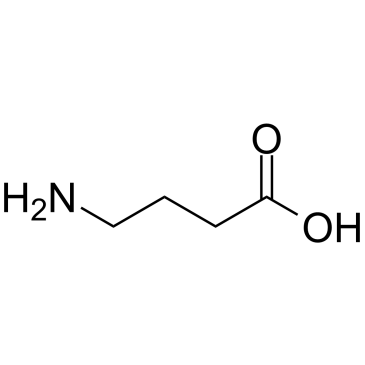
Cas No.: 56-12-2
Sample solution is provided at 25 µL, 10mM.
_1-3.$$$39978408@51.jpg');)
_1-9.$$$38538795@65.jpg');)
_1-9.$$$39112701@51.jpg');)
_1-7.$$$37316672@70.jpg');)
_366-372.$$$36198801@70.jpg');)
.$$$38565142@65.jpg');)
_1867-1883.$$$33248023@67.jpg');)
_eads6055.$$$39977546@45.jpg');)
_eadm9805.$$$40080571@45.jpg');)
_eadj3020.$$$39666821@45.jpg');)
_1-20.$$$39757301@28.jpg');)
_1-24.$$$38898113@28.jpg');)
_273-287.$$$36806353@46.jpg');)
_1-16.$$$37156877@44.jpg');)
_1-19.$$$37460805@44.jpg');)
_1291-1307.$$$34518654@46.jpg');)
γ-Aminobutyric acid (GABA) est le principal neurotransmetteur inhibiteur dans le cerveau adulte. Les valeurs publiées pour EC50 de γ-Aminobutyric acid varient de 6.6μM – 107μM [1]. γ-Aminobutyric acid joue un rôle dans la transmission synaptique inhibitrice rapide principalement via le biais de la libération présynaptique de γ-Aminobutyric acid médiée par le cytosol et l'activation postsynaptique de récepteur GABAA à faible affinité (GABAAR) [2]. γ-Aminobutyric acid joue un rôle important non-seulement dans le cerveau, mais également dans différents groupes métaboliques [3]. Par conséquent, γ-Aminobutyric acid est communément utilisé dans les recherches comme diverses maladies neurologiques et métaboliques.
In vitro, γ-Aminobutyric acid (100μM) a efficacement réduit la déplétion du glutathion (GSH) et les activités d'enzymes anti-oxydantes comme la catalase (CAT) et la dismutase du superoxyde (SOD) dans les myoblastes C2C12[4]. γ-Aminobutyric acid à des concentrations de 20mM ou plus ont entraîné une mort cellulaire significative[5]. γ-Aminobutyric acid (100μM et 200μM) a inversé efficacement l'effet inhibiteur de H2O2 (100μM) sur la prolifération d' HUVECs [6].
In vivo, γ-Aminobutyric acid a été administré par voie orale par forte-nourriture aux rats de Sprague-Dawley pendant 13 semaines à des doses de 500, 1250, et 2500mg/kg/jour, et il n'y avait aucun changement toxiologiquement significatif dans les signes cliniques, l'hématologie, la biochimie clinique et les changements histopathologiques chez les rats, indiquant que les rats ont toléré γ-Aminobutyric acid à des doses allant jusqu'à 2500mg/kg/jour [7]. γ-Aminobutyric acid (500μmol [50mg]) a été injecté par voie intra-péritonéale dans les rats C57BL/6NHsd pendant 7 jours, suivi de 500μg de facteur de nécrose tumorale-α (TNF-α) et 20mg de D-galactosamine injectés par voie intra-péritonéale pour induire une insuffisance hépatique aiguë chez les rats, qui a été induite 4-5 heures après l'injection. L'utilisation de Western blot, d'immunohistochimie et d'histopathologie pour analyser les protéines présentes dans les échantillons de sang et les tissus hépatiques des rats a montré que γ-Aminobutyric acid peut inhiber l'apoptose via la voie de signalisation STAT3[8].
References:
[1] Zhu, S.e.a.S.o.a.h.s.G.r.N.v., 7712 (2018): 67-72. doi:10.1038/s41586-018-0255-3.
[2] Koh W, K.H., Cheong E, Lee CJ, GABA tone regulation and its cognitive functions in the brain. Nat Rev Neurosci, 2023 Sep;24(9):523-539.
[3] Kim, K., and Haejin Yoon, Gamma-Aminobutyric Acid Signaling in Damage Response, Metabolism, and Disease. International journal of molecular sciences, vol. 24,5 4584. 26 Feb. 2023.
[4] Choe H, L.H., Lee J, Kim Y. Protective effect of gamma-aminobutyric acid against oxidative stress by inducing phase II enzymes in C2C12 myoblast cells. J Food Biochem. 2021 Apr;45(4):e13639. doi: 10.1111/jfbc.13639. Epub 2021 Feb 3. PMID: 33533516.
[5] Arachchilage Hasitha Maduranga Karunarathne W, H.C.Y., Lee MH, Kang CH, Kim GY. Gamma-aminobutyric acid (GABA)-mediated bone formation and its implications for anti-osteoporosis strategies: Exploring the relation between GABA and GABA receptors. Biochem Pharmacol. 2023 Dec;218:115888. doi: 10.1016/j.bcp.2023.115888. Epub 2023 Oct 29. PMID: 38084676.
[6] Zhu Z, S.Z., Xie C, Gong W, Hu Z, Peng Y. A novel mechanism of Gamma-aminobutyric acid (GABA) protecting human umbilical vein endothelial cells (HUVECs) against H2O2-induced oxidative injury. Comp Biochem Physiol C Toxicol Pharmacol. 2019 Mar;217:68-75. doi: 10.1016/j.cbpc.2018.11.018. Epub 2018 Nov 27. PMID: 30500452.
[7] Takeshima K, Y.A., Yamashita Y, Watabe K, Horie N, et al. Subchronic toxicity evaluation of gamma-aminobutyric acid (GABA) in rats. Food Chem Toxicol 2014:68:128–134.
[8] Hata, T.e.a.G., γ-Aminobutyric Acid, Protects Against Severe Liver Injury.” The Journal of surgical research vol. 236 (2019): 172-183. doi:10.1016/j.jss.2018.11.047.
| Expériences cellulaires [1]: | |
Lignées cellulaires | Myoblastes C2C12 |
Méthode de préparation | Les cellules C2C12 ont été traitées par γ-Aminobutyric acid à diverses concentrations (25, 50, et 100μM) pendant 24h, puis ont été exposées à 600μM de H2O2 pendant 2h. Enfin, le dosage au bromure de 3-(4,5-Diméthylthiazol-2-yl)-2,5-diphényltetrazolium (MTT) a été utilisé pour mesurer la cytotoxicité. |
Conditions de réaction | 25, 50 et 100μM; 24h |
Domaines d'application | H2O2 (600μM) a réduit la viabilité cellulaire des myoblastes C2C12. Cependant, le traitement avec γ-Aminobutyric acid a significativement augmenté de manière concentration-dépendante la viabilité cellulaire. De façon remarquable, le traitement avec 100μM de γ-Aminobutyric acid a montré la meilleure cytoprotection contre le stress oxydatif dans les myoblastes C2C12. |
| Expériences animales [2]: | |
Modèles animaux | Rats Sprague-Dawley |
Méthode de préparation | Traiter les rats Sprague-Dawley par injection intra-péritonéale de γ-Aminobutyric acid (1.5mg/kg) ou de l'inhibiteur GAD, l-allylglycine (40mg/kg) pendant 3 jours, puis, a analysé l'expression des protéines de signalisation ergique à γ-Aminobutyric acid dans le foie des rats. |
Forme de dosage | 1.5mg/kg/jour pendant 3 jours; injection intra-péritonéale |
Domaines d'application | γ-Aminobutyric acid (1.5mg/kg) n'a pas affecté le niveau de bilirubine totale, d' ALT et d' AST (aspartate aminotransférase) chez les rats Sprague-Dawley. Cependant, l'inhibition de la production endogène de γ-Aminobutyric acid par la l-allylglycine (une sorte d'inhibiteur de la synthétase de γ-Aminobutyric acid) a significativement diminué le niveau de glucose dans le sang. |
References: | |
| Cas No. | 56-12-2 | SDF | |
| Canonical SMILES | O=C(O)CCCN | ||
| Formula | C4H9NO2 | M.Wt | 103.12 |
| Solubility | Water: ≥ 50 mg/mL (484.87 mM) | Storage | Store at RT |
| General tips | Please select the appropriate solvent to prepare the stock solution according to the
solubility of the product in different solvents; once the solution is prepared, please store it in
separate packages to avoid product failure caused by repeated freezing and thawing.Storage method
and period of the stock solution: When stored at -80°C, please use it within 6 months; when stored
at -20°C, please use it within 1 month. To increase solubility, heat the tube to 37°C and then oscillate in an ultrasonic bath for some time. |
||
| Shipping Condition | Evaluation sample solution: shipped with blue ice. All other sizes available: with RT, or with Blue Ice upon request. | ||
| Prepare stock solution | |||

|
1 mg | 5 mg | 10 mg |
| 1 mM | 9.6974 mL | 48.4872 mL | 96.9744 mL |
| 5 mM | 1.9395 mL | 9.6974 mL | 19.3949 mL |
| 10 mM | 969.7 μL | 4.8487 mL | 9.6974 mL |
Step 1: Enter information below (Recommended: An additional animal making an allowance for loss during the experiment)
 g
μL
g
μL
Step 2: Enter the in vivo formulation (This is only the calculator, not formulation. Please contact us first if there is no in vivo formulation at the solubility Section.)
Calculation results:
Working concentration: mg/ml;
Method for preparing DMSO master liquid: mg drug pre-dissolved in μL DMSO ( Master liquid concentration mg/mL, Please contact us first if the concentration exceeds the DMSO solubility of the batch of drug. )
Method for preparing in vivo formulation: Take μL DMSO master liquid, next addμL PEG300, mix and clarify, next addμL Tween 80, mix and clarify, next add μL saline, mix and clarify.
Method for preparing in vivo formulation: Take μL DMSO master liquid, next add μL Corn oil, mix and clarify.
Note: 1. Please make sure the liquid is clear before adding the next solvent.
2. Be sure to add the solvent(s) in order. You must ensure that the solution obtained, in the previous addition, is a clear solution before proceeding to add the next solvent. Physical methods such as vortex, ultrasound or hot water bath can be used to aid dissolving.
3. All of the above co-solvents are available for purchase on the GlpBio website.
Quality Control & SDS
- View current batch:
- Purity: >99.00% Appearance: A solid
- COA (Certificate of Analysis)
- SDS (Safety Data Sheet)
- Datasheet
Average Rating: 5 (Based on Reviews and 38 reference(s) in Google Scholar.)