

KIN-59 (Synonyms: 5’-O-Tritylinosine) |
Catalog No.GC16460
 One-Click Copy Product Info
|

KIN-59 est un inhibiteur non-compétitif de la thymidine phosphorylase recombinante humaine et bactérienne (TPase), ses valeurs d'IC50 sont respectivement 67 et 44µM.
Products are for research use only. Not for human use. We do not sell to patients.
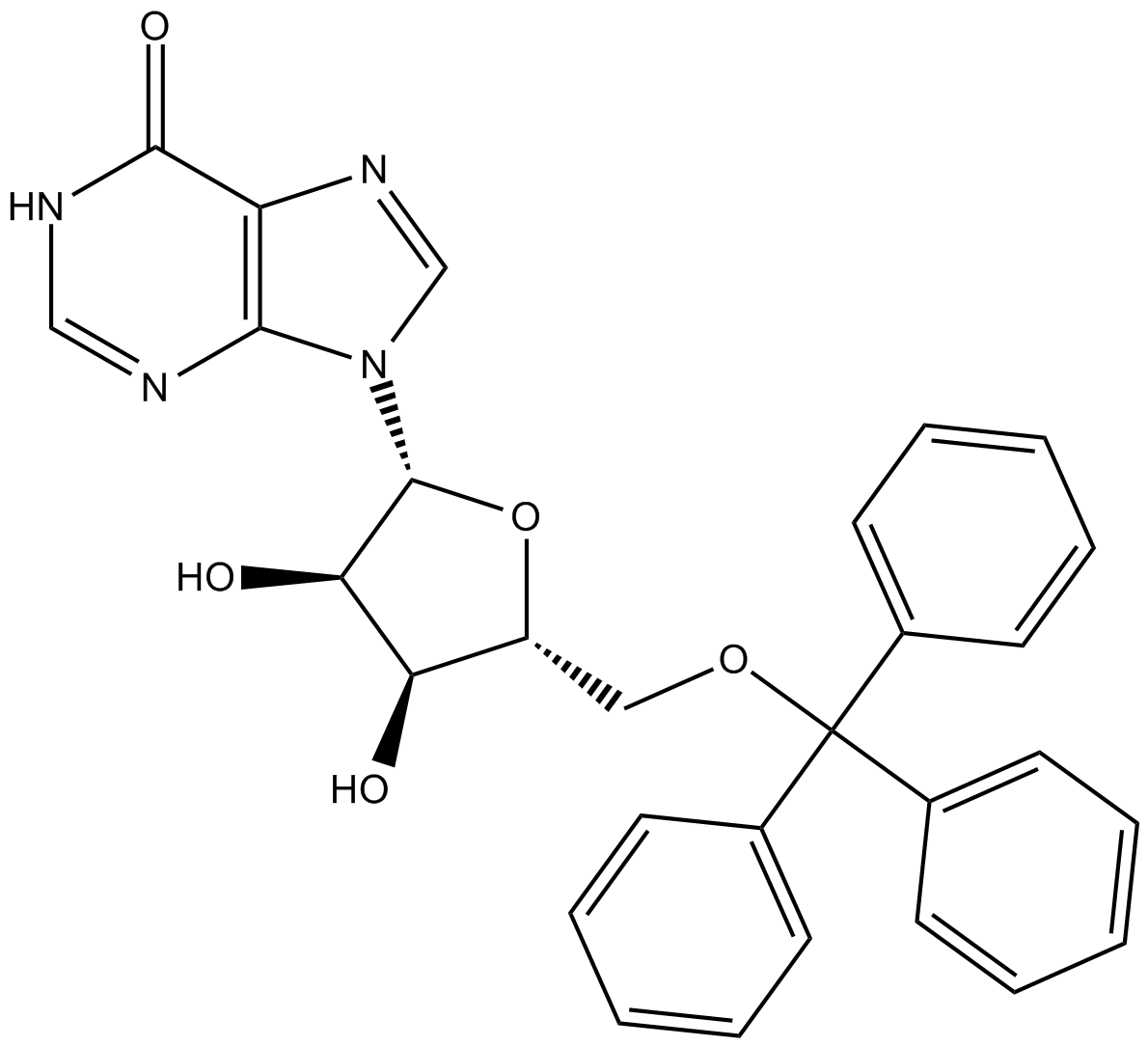
Cas No.: 4152-77-6
Sample solution is provided at 25 µL, 10mM.
_1-3.$$$39978408@51.jpg');)
_1-9.$$$38538795@65.jpg');)
_1-9.$$$39112701@51.jpg');)
_1-7.$$$37316672@70.jpg');)
_366-372.$$$36198801@70.jpg');)
.$$$38565142@65.jpg');)
_1867-1883.$$$33248023@67.jpg');)
_eads6055.$$$39977546@45.jpg');)
_eadm9805.$$$40080571@45.jpg');)
_eadj3020.$$$39666821@45.jpg');)
_1-20.$$$39757301@28.jpg');)
_1-24.$$$38898113@28.jpg');)
_273-287.$$$36806353@46.jpg');)
_1-16.$$$37156877@44.jpg');)
_1-19.$$$37460805@44.jpg');)
_1291-1307.$$$34518654@46.jpg');)
KIN-59 est un inhibiteur non-compétitif de la thymidine phosphorylase recombinante humaine et bactérienne (TPase), ses valeurs d'IC50 sont respectivement 67 et 44µM[1]. KIN-59 est un dérivé de la purine riboside qui bloque l'enzyme de manière non-compétitive vis-à-vis de la thymidine ou du phosphate, et nécessite à la fois le groupe 5′-O-trityle intact et le squelette ribose-hypoxanthine pour exercer son activité[2].
In vitro, KIN-59 (0–100µM) incubé avec des cellules endothéliales aortiques de rats (MAECs) pendant 5 jours a faiblement inhibé la prolifération cellulaire, sa valeur d'IC50 est 78 ± 2µM. KIN-59 a également ralenti de manière dose-dépendante la migration des cellules endothéliales dans un test de cicartrisation de plaie de 16 heures[3]. KIN-59 (250nmol) a été incubé avec des oeufs de poulet fécondés, avec ou sans 10µl de TPase, pendant 4 jours. KIN-59 a non-seulement annihilé l'angiogenèse induite par TPase, mais a également efficacement inhibé la formation de vaisseaux normaux de la membrane chorioallantoïdienne du poulet en absence de TPase ajoutée exogène[4]. Le pré-traitement avec KIN-59 (125–250μM) sur des plaquettes humaines ou murines de type sauvage pendant 5 minutes, avant stimulation par le collagène, ADP, la thrombine ou un peptide lié au collagène, a supprimé de manière réversible et dose-dépendante l'agrégation induite[5].
In vivo, KIN-59 (15mg/kg) a été injecté par voie sous-cutanée chez les rats nus immunodéficients deux fois par jour (une fois par jour pendant le week-end) jusqu'au jour 20. KIN-59 a inhibé la liaison du facteur de croissance des fibroblastes 2 (FGF2) au récepteur 1 de FGF, empêchant la croissance et la néovascularisation des tumeurs sous-cutanées induites par des cellules endothéliales transformées par FGF2[6].
References:
[1] Liekens S, Balzarini J, Hernández A I, et al. Thymidine phosphorylase is noncompetitively inhibited by 5'-O-trityl-inosine (KIN59) and related compounds. Nucleosides Nucleotides Nucleic Acids. 2006;25(9-11):975-80.
[2] Casanova E, Hernandez A I, Priego E M, et al. 5'-O-tritylinosine and analogues as allosteric inhibitors of human thymidine phosphorylase. J Med Chem. 2006 Sep 7;49(18):5562-70.
[3] Liekens, S., Bronckaers, A., Hernández, A.I., et al. 5'-O-tritylated nucleoside derivatives: inhibition of thymidine phosphorylase and angiogenesis. Mol. Pharmacol. 70(2), 501-509 (2006).
[4] Liekens, S., Hernández, A.I., Ribatti, D., et al. The nucleoside derivative 5'-O-trityl-inosine (KIN59) suppresses thymidine phosphorylase-triggered angiogenesis via a noncompetitive mechanism of action. The Journal of Biological Chemisty 279(28), 29598-29605 (2004).
[5] Li W, Gigante A, Perez-Perez M J, et al. Thymidine phosphorylase participates in platelet signaling and promotes thrombosis. Circ Res. 2014 Dec 5;115(12):997-1006.
[6] Liekens, S., Bronckaers, A., Belleri, M., et al. The thymidine phosphorylase inhibitor 5'-O-tritylinosine (KIN-59) is an antiangiogenic multitarget fibroblast growth factor-2 antagonist. Mol. Cancer Ther. 11(4), 817-829 (2012).
| Expérience sur la kinase [1]: | |
Méthode de préparation | 500µL de solution de réaction contenant 10mM Tris-HCl à pH 7.6, 1mM EDTA, 150mM NaCl, 2mM phosphate et 100μM thymidine avec 0.025U de l'enzyme TPase ont été incubés pendant 60 minutes à température ambiante. Les échantillons prélevés à 0, 20, 40, 60 minutes (aliquotes de 100µL) ont été portés à ébullition, refroidis et analysés par RP-8 HPLC (267nm) pour quantifier la formation de thymine. KIN-59 (1mM, 100μM, 10μM, et 0μM) a été ajouté au mélange réactionnel pour tester l'inhibition de TPase. |
Conditions de réaction | 0–1000μM; 60min |
Domaines d'application | KIN-59 a inhibé TPase de manière réversible et non-compétitive, sa valeur de Ki est approximativement 39μM. |
| Expériences cellulaires [2]: | |
Lignées cellulaires | Cellules endothéliales aortiques de veau foetal GM7373 |
Méthode de préparation | Cellules GM7373 surexprimant FGFR1 et cellules GM7373 surexprimant VEGFR2, privées de sérum, ont été incubées avec 60µM de KIN-59 ou un véhicule pendant 30 minutes, après quoi 10ng/mL de FGF2 ou 30ng/mL de VEGF ont été ajoutés. |
Conditions de réaction | 60μM; 30min |
Domaines d'application | KIN-59 a inhibé la croissance des cellules endothéliales stimulées par FGF2, mais pas celle stimulée par VEGF. |
| Expériences animales [2]: | |
Modèles animaux | Rats féminins athymiques nus nu/nu |
Méthode de préparation | Des rats féminins athymiques nus nu/nu âgés de 8 semaines, pesant approximativement 25g, ont été inoculés par voie sous-cutanée avec 200mL de DMEM sans sérum contenant 2×10⁶ cellules F2T-luc2.9. Le traitement avec KIN-59 a débuté 24 heures après l'inoculation et a continué jusqu'à la fin de l'expérience. KIN-59 a été administré par voie sous-cutanée à 15mg/kg, deux fois par jour (une fois par jour pendant le week-end), sur un site distant du site de la tumeur (site d'inoculation). |
Forme de dosage | 15mg/kg; s.c; deux fois par jour (une fois par jour pendant week-end) |
Domaines d'application | KIN-59 a inhibé la liaison du facteur de croissance des fibroblastes 2 (FGF2) au récepteur 1 de FGF, empêchant la croissance et la néovascularisation des tumeurs sous-cutanées induites par des cellules endothéliales transformées par FGF2. |
References: | |
| Cas No. | 4152-77-6 | SDF | |
| Synonymes | 5’-O-Tritylinosine | ||
| Chemical Name | 5'-O-(triphenylmethyl)-inosine | ||
| Canonical SMILES | O[C@H]1[C@@H](O)[C@H](N2C=NC3=C2N=CNC3=O)O[C@@H]1COC(C4=CC=CC=C4)(C5=CC=CC=C5)C6=CC=CC=C6 | ||
| Formula | C29H26N4O5 | M.Wt | 510.5 |
| Solubility | ≤0.3mg/ml in ethanol;16mg/ml in DMSO;5mg/ml in dimethyl formamide | Storage | Store at -20°C |
| General tips | Please select the appropriate solvent to prepare the stock solution according to the
solubility of the product in different solvents; once the solution is prepared, please store it in
separate packages to avoid product failure caused by repeated freezing and thawing.Storage method
and period of the stock solution: When stored at -80°C, please use it within 6 months; when stored
at -20°C, please use it within 1 month. To increase solubility, heat the tube to 37°C and then oscillate in an ultrasonic bath for some time. |
||
| Shipping Condition | Evaluation sample solution: shipped with blue ice. All other sizes available: with RT, or with Blue Ice upon request. | ||
| Prepare stock solution | |||

|
1 mg | 5 mg | 10 mg |
| 1 mM | 1.9589 mL | 9.7943 mL | 19.5886 mL |
| 5 mM | 391.8 μL | 1.9589 mL | 3.9177 mL |
| 10 mM | 195.9 μL | 979.4 μL | 1.9589 mL |
Step 1: Enter information below (Recommended: An additional animal making an allowance for loss during the experiment)
 g
μL
g
μL
Step 2: Enter the in vivo formulation (This is only the calculator, not formulation. Please contact us first if there is no in vivo formulation at the solubility Section.)
Calculation results:
Working concentration: mg/ml;
Method for preparing DMSO master liquid: mg drug pre-dissolved in μL DMSO ( Master liquid concentration mg/mL, Please contact us first if the concentration exceeds the DMSO solubility of the batch of drug. )
Method for preparing in vivo formulation: Take μL DMSO master liquid, next addμL PEG300, mix and clarify, next addμL Tween 80, mix and clarify, next add μL saline, mix and clarify.
Method for preparing in vivo formulation: Take μL DMSO master liquid, next add μL Corn oil, mix and clarify.
Note: 1. Please make sure the liquid is clear before adding the next solvent.
2. Be sure to add the solvent(s) in order. You must ensure that the solution obtained, in the previous addition, is a clear solution before proceeding to add the next solvent. Physical methods such as vortex, ultrasound or hot water bath can be used to aid dissolving.
3. All of the above co-solvents are available for purchase on the GlpBio website.
Quality Control & SDS
- View current batch:
- Purity: >98.00% Appearance: A solid
- COA (Certificate of Analysis)
- SDS (Safety Data Sheet)
- Datasheet
Average Rating: 5 (Based on Reviews and 9 reference(s) in Google Scholar.)