

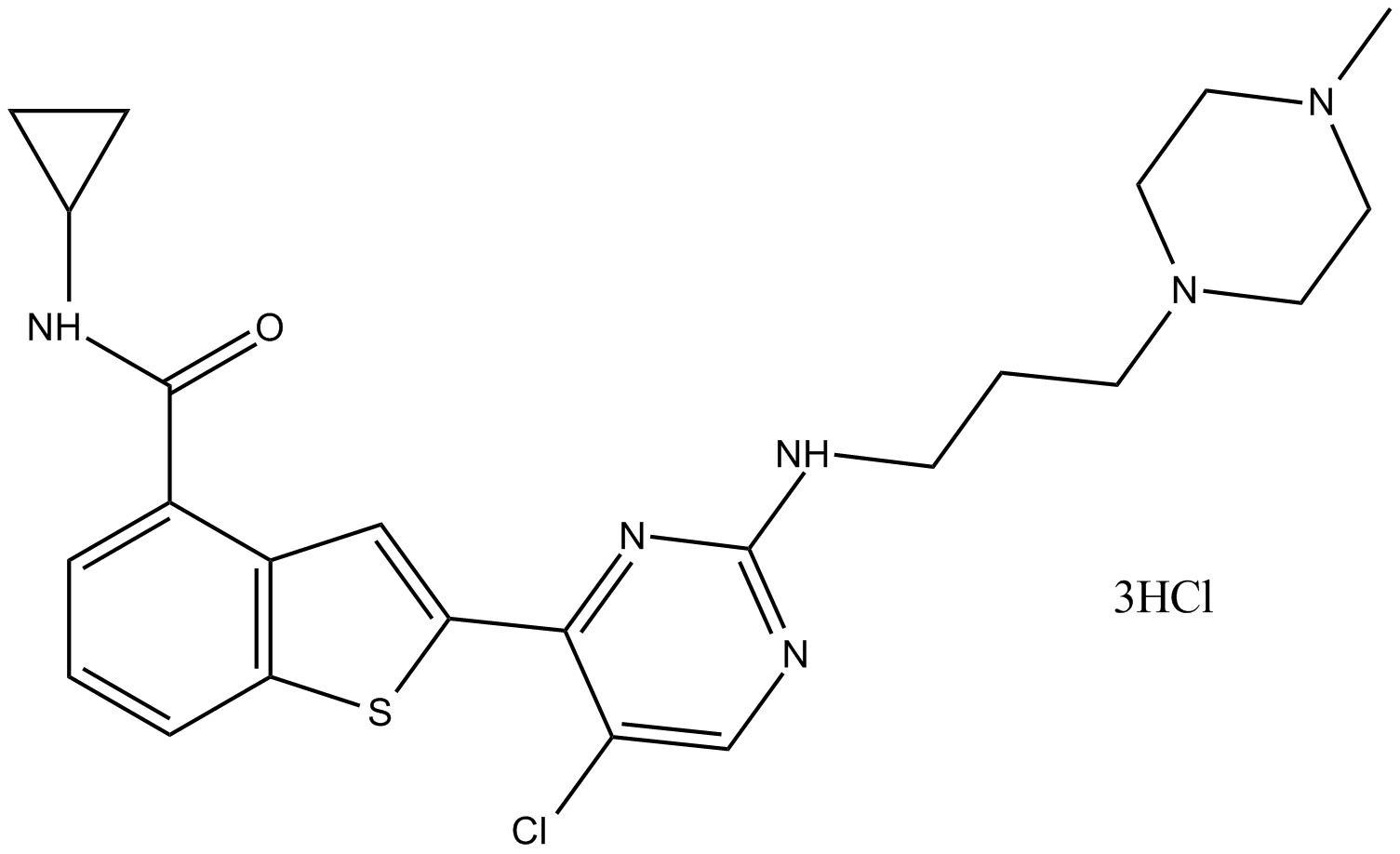
LY2409881 |
Catalog No.GC10093
 One-Click Copy Product Info
|

LY2409881 est une kinase sélective IκB β (IKK2) avec une IC50 de 30 nM.
Products are for research use only. Not for human use. We do not sell to patients.
Cas No.: 946518-60-1
Sample solution is provided at 25 µL, 10mM.
_1-3.$$$39978408@51.jpg');)
_1-9.$$$38538795@65.jpg');)
_1-9.$$$39112701@51.jpg');)
_1-7.$$$37316672@70.jpg');)
_366-372.$$$36198801@70.jpg');)
.$$$38565142@65.jpg');)
_1867-1883.$$$33248023@67.jpg');)
_eads6055.$$$39977546@45.jpg');)
_eadm9805.$$$40080571@45.jpg');)
_eadj3020.$$$39666821@45.jpg');)
_1-20.$$$39757301@28.jpg');)
_1-24.$$$38898113@28.jpg');)
_273-287.$$$36806353@46.jpg');)
_1-16.$$$37156877@44.jpg');)
_1-19.$$$37460805@44.jpg');)
_1291-1307.$$$34518654@46.jpg');)
LY2409881 is a potent and selective inhibitor of IKK2 with IC50 value of 30 nM [1].
IκB kinase β (IKK2) is an enzyme that serves as a subunit of IκB kinase, which is involved in the cytokine-activated immune responses. IKK2 activates nuclear factor kappa-B kinase (NF-κB).
LY2409881 is a selective IKK2 inhibitor and exhibited >10-fold selectivity over other common kinases and IKK1. In the ovarian cancer cell line SKOV3, LY2409881 showed moderate cytotoxicity. While coadministration of LY2409881 and TNFɑ significantly induced cells death, which suggested LY2409881 inhibited NF-κB mediated antiapoptotic signals in a TNFɑ-dependent way. In the DLBCL cell line LY10, LY2409881 (10 μM) inhibited TNFɑ-dependent phosphorylation of IκB. In the DLBCL cell line SUDHL2, LY2409881 (10 μM) inhibited the nuclear signals of p50 and NF-κB. Also, LY2409881 induced apoptosis in a concentration-dependent way [1].
In SCID-beige mice bearing LY10 cell-derived tumors, LY2409881 (50, 100 and 200 mg/kg) significantly inhibited tumor growth [1].
Reference:
[1]. Deng C, Lipstein M, Rodriguez R, et al. The novel IKK2 inhibitor LY2409881 potently synergizes with histone deacetylase inhibitors in preclinical models of lymphoma through the downregulation of NF-κB. Clin Cancer Res, 2015, 21(1): 134-145.
Cell experiment: | OCI-Ly1, OCI-Ly7, and Su-DHL4 are GCB DLBCL cell lines; OCI-Ly3, OCI-Ly10, HBL1, and Su-DHL2 are ABC DLBCL lines. These cell lines are grown in Iscove Modified Dulbecco Medium with 10% FCS. Fresh medium is added every 2 to 3 days, and the cells are kept at a cell concentration of 0.1 to 1×10⁶/mL. Cytotoxicity is evaluated using the CellTiter-Glo Reagent. Experiments are carried out in 96-well plates, with each treatment in triplicate. Samples are taken at typically 24, 48, and 72 hours after treatment. Cytotoxicity is expressed by the decreasing percentage of live cells in each treatment (LY2409881; 0.01, 0.1, 1 and 10 μM) relative to the untreated control from the same experiment, as a function of time. IC50 for each cell line is calculated using the CalcuSyn Version 2.0 software[1]. |
Animal experiment: | Mice[1]Mouse experiments are carried out. Five- to 7-week-old SCID beige mice are injected with 107 Ly10 cells mixed in Matrigel in the posterior flank subcutaneously. When the tumors approach 150 mm3, the mice are divided into four groups of 8 mice: (i) control group, which receive 5% dextrose in water; (ii) LY2409881 at 50 mg/kg in D5W; (iii) LY2409881 at 100 mg/kg in D5W; and (iv) LY2409881 at 200 mg/kg in D5W. LY2409881 or D5W is administered intraperitoneally on day 1 and 4 of every week for 4 weeks. The data are expressed as average tumor volume (mm3) per group as a function of time. Tumor volume is calculated. |
References: [1]. Deng C, et al. The novel IKK2 inhibitor LY2409881 potently synergizes with histone deacetylase inhibitors in preclinical models of lymphoma through the downregulation of NF-κB. Clin Cancer Res. 2015 Jan 1;21(1):134-45. | |
| Cas No. | 946518-60-1 | SDF | |
| Chemical Name | 2-(5-chloro-2-((3-(4-methylpiperazin-1-yl)propyl)amino)pyrimidin-4-yl)-N-cyclopropylbenzo[b]thiophene-4-carboxamide | ||
| Canonical SMILES | ClC1=CN=C(NCCCN2CCN(C)CC2)N=C1C3=CC4=C(S3)C=CC=C4C(NC5CC5)=O | ||
| Formula | C24H32Cl4N6OS | M.Wt | 594.43 |
| Solubility | ≥ 59.4mg/mL in DMSO with ultrasonic | Storage | Store at -20°C |
| General tips | Please select the appropriate solvent to prepare the stock solution according to the
solubility of the product in different solvents; once the solution is prepared, please store it in
separate packages to avoid product failure caused by repeated freezing and thawing.Storage method
and period of the stock solution: When stored at -80°C, please use it within 6 months; when stored
at -20°C, please use it within 1 month. To increase solubility, heat the tube to 37°C and then oscillate in an ultrasonic bath for some time. |
||
| Shipping Condition | Evaluation sample solution: shipped with blue ice. All other sizes available: with RT, or with Blue Ice upon request. | ||
| Prepare stock solution | |||

|
1 mg | 5 mg | 10 mg |
| 1 mM | 1.6823 mL | 8.4114 mL | 16.8228 mL |
| 5 mM | 336.5 μL | 1.6823 mL | 3.3646 mL |
| 10 mM | 168.2 μL | 841.1 μL | 1.6823 mL |
Step 1: Enter information below (Recommended: An additional animal making an allowance for loss during the experiment)
 g
μL
g
μL
Step 2: Enter the in vivo formulation (This is only the calculator, not formulation. Please contact us first if there is no in vivo formulation at the solubility Section.)
Calculation results:
Working concentration: mg/ml;
Method for preparing DMSO master liquid: mg drug pre-dissolved in μL DMSO ( Master liquid concentration mg/mL, Please contact us first if the concentration exceeds the DMSO solubility of the batch of drug. )
Method for preparing in vivo formulation: Take μL DMSO master liquid, next addμL PEG300, mix and clarify, next addμL Tween 80, mix and clarify, next add μL saline, mix and clarify.
Method for preparing in vivo formulation: Take μL DMSO master liquid, next add μL Corn oil, mix and clarify.
Note: 1. Please make sure the liquid is clear before adding the next solvent.
2. Be sure to add the solvent(s) in order. You must ensure that the solution obtained, in the previous addition, is a clear solution before proceeding to add the next solvent. Physical methods such as vortex, ultrasound or hot water bath can be used to aid dissolving.
3. All of the above co-solvents are available for purchase on the GlpBio website.
Quality Control & SDS
- View current batch:
- Purity: >98.50% Appearance: A solid
- COA (Certificate of Analysis)
- SDS (Safety Data Sheet)
- Datasheet
Average Rating: 5 (Based on Reviews and 31 reference(s) in Google Scholar.)