
Accueil>>Signaling Pathways>> Neuroscience>> 5-HT Receptor>>MHP 133

MHP 133

Catalog No.GC30446

MHP 133 est un médicament avec de multiples cibles du SNC et inhibe l'acétylcholinestérase (AChE) avec un Ki de 69 μM ; également actif contre les récepteurs muscariniques M1 et M2, les récepteurs de la sérotonine 5HT4 et les récepteurs de l'imidazole I2.

Products are for research use only. Not for human use. We do not sell to patients.
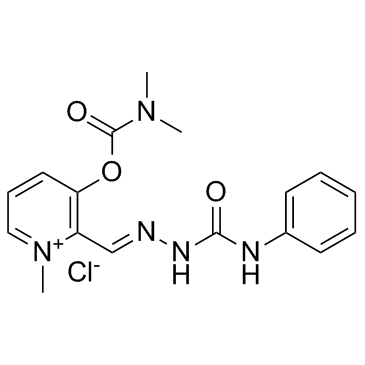
MHP 133 Chemical Structure

Cas No.: 147340-43-0

Taille Prix Stock Qté
1mg
717,00 $US
En stock
5mg
1 434,00 $US
En stock
10mg
2 436,00 $US
En stock
20mg
4 302,00 $US
En stock

Tel:(909) 407-4943 Email: sales@glpbio.com


Avis des clients

Based on customer reviews.

Sample solution is provided at 25 µL, 10mM.

Description of MHP 133

a drug with multiple CNS targets, and inhibits acetylcholinesterase (AChE) with Ki of 69 μM; also active against muscarinic M1 and M2 receptors, serotonin 5HT4 receptors, and imidazole I2 receptors.

MHP-133 is be active (>50% displacement or activity) against muscarinic M1 and M2 receptors, serotonin 5HT4 receptors, and imidazole I2 receptors. MHP-133 exhibits this nicotinic-like activity in the cell line. Although the ED50 for inducing TrkA expression is only about 1 μM, it does predicts the cytoprotective action of MHP-133 in differentiated PC-12 cells deprived of growth factor for 24 h. MHP-133 (10-100 μM) significantly increases the levels of sAPP from cultured astrocytes by 40-60%. MHP-133 produces a bi-phasic effect on slice survival, particularly in the dentate gyrus and the CA1 regions[1].

In rats, MHP-133 (50, 100, or 200 μg/kg, i.p.) enhances acquisition of the task and increases task accuracy. MHP-133 elicits significant improvements in task accuracies during sessions initiated 10 min after dosing[1].

[1]. Buccafusco JJ, et al. MHP-133, a drug with multiple CNS targets: potential for neuroprotection and enhanced cognition. Neurochem Res. 2007 Jul;32(7):1224-37. Epub 2007 Apr 3.

Protocol of MHP 133

Kinase experiment:

Rat cerebral cortex is homogenized in ice cold 50 mM Tris-HCl buffer containing 120 mM NaCl, 5 mM KCl, 1 mM MgCl2, and 2 mM CaCl2 (pH 7.0). The homogenate is centrifuged at 37,200 g for 20 min at 0°C. The pellet is washed twice and resuspended in fresh buffer. For nicotinic receptor binding, [3H]cytisine is incubated with 0.5 mg protein and various concentrations of MHP-133 or other ligand in a final volume of 250 μL ta 4°C for 120 min. About 10 μM (-)-nicotine is used to determine nonspecific binding. Bound radioactivity is isolated by rapid filtration through polyethyleneimine-treated glass fiber filters and by washing several times with icecold buffer (Tris-HCl, 50 mM). Filters are soaked in scintillation fluor for 6 h prior to quantification or radioactivity in a scintillation counter. Data are presented in triplicate.

Cell experiment:

PC-12 cells are maintained in 150-cm2 tissue-culture flasks in Dulbecco's modified Eagles medium containing 7% horse serum, 7% fetal calf serum, 1% nonessential amino-acids and 1% streptomycin (DMEM). The cells are incubated at 37°C in a 5% CO2-enriched, humidified atmosphere. For the actual experiments PC-12 cells are plated on poly-L-lysine coated 24-well plates at a density of 40,000 cells per well in DMEM medium containing 50 ng/mL nerve growth factor (NGF). To attain maximum differentiation, the cells are maintained in DMEM.NGF medium for 7 days with the medium being changed every 2 or 3 days. Next, the differentiated cells are incubated with vehicle or with a test drug (prepared in serum-free DMEM media with no exogenous NGF) for 24 h. A parallel set of control cells are maintained in DMEM.NGF medium in each experiment. Cell viability (cytotoxicity) is determined by using the Cell Titer 96 cell proliferation/cytotoxicity assay kit, which is based on the cellular conversion of a 3-(4,5- dimethylthiazol-2-yl)-2,5-diphenltetrazolium bromide (MTT) into a formazan product that can be detected spectrophotometrically. At the completion of the incubation period, the culture medium is aspirated and 15 μL of dye solution in DMEM is added. After 4 h at 37°C, 100 μL of solubilization/stop solution is added and the absorbance of solubilized MTT formazan products is measured at 579 nm. All data are normalized to untreated control cells in each plate.

Animal experiment:

Male Sprague-Dawley, outbred Wistar rats weighing 250-300 g are housed separately in our animal care facility for 1 week prior to experimentation. At the time of the experiment the 40 animals are randomLy assigned to one of four treatment groups, a saline vehicle group, or a group to be administered 50, 100 or 200 μg/kg of MHP-133. Vehicle (1 mL/kg body weight) is administered i.p. 30 min prior to testing in the Morris Water Maze apparatus. The apparatus consists of a water-filled (room temperature) tub 1.2 m in diameter. A mounting platform is fixed in place and slightly submerged in the northwest quadrant of the tub. The platform is similar in color to the inner surface of the tub so as to make it difficult to visualize. The tub is always maintained in the same orientation with respect to visual cues placed on the walls, around the testing room. Rats are tested by placing the animal in the water facing away from the platform. Four consecutive trials are administered with 10 min between trials. In each successive trial the rats are placed first in the south quadrant of the tub, followed by the north, east and west quadrants. The time required for the rat to find (place at least 2 paws on) the platform is monitored to the nearest 0.1 s. All rats found the platform in less than 90 s.

References:

[1]. Buccafusco JJ, et al. MHP-133, a drug with multiple CNS targets: potential for neuroprotection and enhanced cognition. Neurochem Res. 2007 Jul;32(7):1224-37. Epub 2007 Apr 3.

Chemical Properties of MHP 133

Cas No. 147340-43-0 SDF
Canonical SMILES O=C(N/N=C/C1=C(OC(N(C)C)=O)C=CC=[N+]1C)NC2=CC=CC=C2.[Cl-]
Formula C17H20ClN5O3 M.Wt 377.83
Solubility Soluble in DMSO Storage Store at -20°C
General tips Please select the appropriate solvent to prepare the stock solution according to the solubility of the product in different solvents; once the solution is prepared, please store it in separate packages to avoid product failure caused by repeated freezing and thawing.Storage method and period of the stock solution: When stored at -80°C, please use it within 6 months; when stored at -20°C, please use it within 1 month.
To increase solubility, heat the tube to 37°C and then oscillate in an ultrasonic bath for some time.
Shipping Condition Evaluation sample solution: shipped with blue ice. All other sizes available: with RT, or with Blue Ice upon request.

Complete Stock Solution Preparation Table of MHP 133

Prepare stock solution
1 mg 5 mg 10 mg
1 mM 2.6467 mL 13.2335 mL 26.4669 mL
5 mM 529.3 μL 2.6467 mL 5.2934 mL
10 mM 264.7 μL 1.3233 mL 2.6467 mL
  • Molarity Calculator

  • Dilution Calculator

  • Molecular Weight Calculator

Mass
=
Concentration
x
Volume
x
MW*


**When preparing stock solutions always use the batch-specific molecular weight of the product found on the vial label and MSDS / CoA (available online).

Calculate

In vivo Formulation Calculator (Clear solution) of MHP 133

Step 1: Enter information below (Recommended: An additional animal making an allowance for loss during the experiment)

mg/kg g μL

Step 2: Enter the in vivo formulation (This is only the calculator, not formulation. Please contact us first if there is no in vivo formulation at the solubility Section.)

% DMSO % % Tween 80 % ddH2O
%DMSO %

Calculation results:

Working concentration: mg/ml;

Method for preparing DMSO master liquid: mg drug pre-dissolved in μL DMSO ( Master liquid concentration mg/mL, Please contact us first if the concentration exceeds the DMSO solubility of the batch of drug. )

Method for preparing in vivo formulation: Take μL DMSO master liquid, next addμL PEG300, mix and clarify, next addμL Tween 80, mix and clarify, next add μL ddH2O, mix and clarify.

Method for preparing in vivo formulation: Take μL DMSO master liquid, next add μL Corn oil, mix and clarify.

Note: 1. Please make sure the liquid is clear before adding the next solvent.
2. Be sure to add the solvent(s) in order. You must ensure that the solution obtained, in the previous addition, is a clear solution before proceeding to add the next solvent. Physical methods such as vortex, ultrasound or hot water bath can be used to aid dissolving.
3. All of the above co-solvents are available for purchase on the GlpBio website.

Product Documents

Quality Control & SDS

View current batch:

Avis

Review for MHP 133

Average Rating: 5 ★★★★★ (Based on Reviews and 2 reference(s) in Google Scholar.)

5 Star
100%
4 Star
0%
3 Star
0%
2 Star
0%
1 Star
0%
Review for MHP 133

GLPBIO products are for RESEARCH USE ONLY. Please make sure your review or question is research based.

Required fields are marked with *

You may receive emails regarding this submission. Any emails will include the ability to opt-out of future communications.