

Naphthoquine phosphate |
Catalog No.GC16090
 One-Click Copy Product Info
|

Products are for research use only. Not for human use. We do not sell to patients.
Cas No.: 173531-58-3
Sample solution is provided at 25 µL, 10mM.
_1-3.$$$39978408@51.jpg');)
_1-9.$$$38538795@65.jpg');)
_1-9.$$$39112701@51.jpg');)
_1-7.$$$37316672@70.jpg');)
_366-372.$$$36198801@70.jpg');)
.$$$38565142@65.jpg');)
_1867-1883.$$$33248023@67.jpg');)
_eads6055.$$$39977546@45.jpg');)
_eadm9805.$$$40080571@45.jpg');)
_eadj3020.$$$39666821@45.jpg');)
_1-20.$$$39757301@28.jpg');)
_1-24.$$$38898113@28.jpg');)
_273-287.$$$36806353@46.jpg');)
_1-16.$$$37156877@44.jpg');)
_1-19.$$$37460805@44.jpg');)
_1291-1307.$$$34518654@46.jpg');)
IC50: 0.1-5.2 nM for various P. falciparum strains [1]
Malaria remains a disease of devastating global impact, killing more than 800,000 people every year-the vast majority being children under the age of 5. Naphthoquine phosphate is a antimalarial drug developed in China.
In vitro: Naphthoquine phosphate showed promising antimalaria acitivities against various P. falciparum strains. Moreover, previoius study highlighted that naphthoquine did not lose potency when tested against chloroquine resistant strains [1].
In vivo: In an study aiming to investigate the antimalarial activity of naphthoquine phosphate combined with artemisinine against Plasmodium knowlesi in rhesus monkey, it was found that the combination of naphthoquine phosphate and artemisinine was superior to the single component and the optimum proportion in the combination is 1 : 2.5 in treating P. knowlesi infection in monkeys [2].
Clinical trial: An oral single dose of the combination drug (400 mg of naphthoquine + 1000mg artemisinin) was administered to adult uncomplicated falciparum malaria patients. Mean fever clearance time, parasite clearance time were 18.2 ± 8.6 h and 34.6 ± 14.3 h, respectively. Adequate clinical and parasitological response was achieved in 52 out of 54 cases, the rate being 98.1%. The drug was well tolerated and no adverse reactionswere detected in the patients [3].
References:
[1] Delves M, Plouffe D, Scheurer C, Meister S, Wittlin S, Winzeler EA, Sinden RE, Leroy D. The activities of current antimalarial drugs on the life cycle stages of Plasmodium: a comparative study with human and rodent parasites. PLoS Med. 2012;9(2):e1001169.
[2] Wang JY, Ding DB, Li GF, Zhao JH. Therapeutic efficacy of naphthoquine phosphate combined with artemisinine against Plasmodium knowlesi. Zhongguo Ji Sheng Chong Xue Yu Ji Sheng Chong Bing Za Zhi. 2008;26(6):442-4.
[3] Tun T, Tint HS, Lin K, Kyaw TT, Myint MK, Khaing W, Tun ZW. Efficacy of oral single dose therapy with artemisinin-naphthoquine phosphate in uncomplicated falciparum malaria. Acta Trop. 2009;111(3):275-8.
| Cas No. | 173531-58-3 | SDF | |
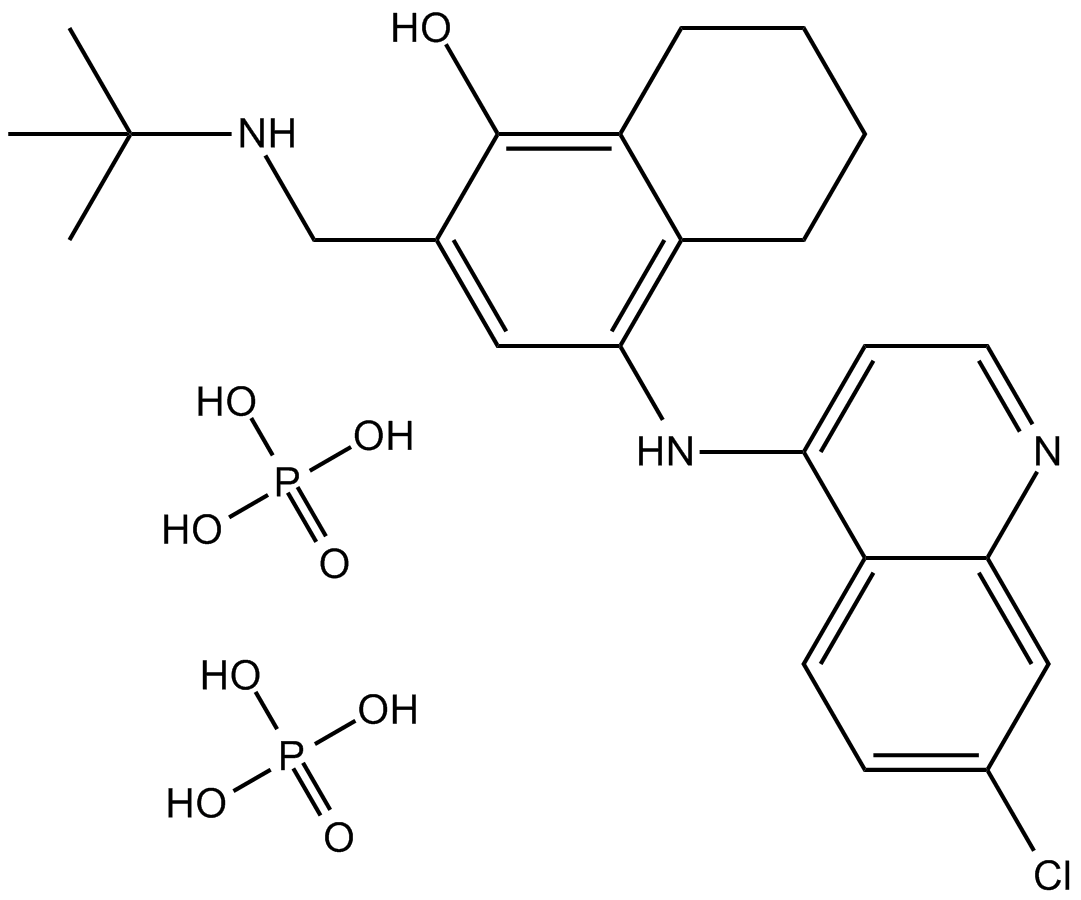
| Chemical Name | 2-[(tert-butylamino)methyl]-4-[(7-chloroquinolin-4-yl)amino]-5,6,7,8-tetrahydronaphthalen-1-ol;phosphoric acid | ||
| Canonical SMILES | CC(C)(C)NCC1=CC(=C2CCCCC2=C1O)NC3=C4C=CC(=CC4=NC=C3)Cl.OP(=O)(O)O.OP(=O)(O)O | ||
| Formula | C24H34ClN3O9P2 | M.Wt | 605.94 |
| Solubility | H2O : 3.33 mg/mL (5.50 mM; Need ultrasonic); DMSO : < 1 mg/mL (insoluble or slightly soluble) | Storage | Store at -20°C |
| General tips | Please select the appropriate solvent to prepare the stock solution according to the
solubility of the product in different solvents; once the solution is prepared, please store it in
separate packages to avoid product failure caused by repeated freezing and thawing.Storage method
and period of the stock solution: When stored at -80°C, please use it within 6 months; when stored
at -20°C, please use it within 1 month. To increase solubility, heat the tube to 37°C and then oscillate in an ultrasonic bath for some time. |
||
| Shipping Condition | Evaluation sample solution: shipped with blue ice. All other sizes available: with RT, or with Blue Ice upon request. | ||
| Prepare stock solution | |||

|
1 mg | 5 mg | 10 mg |
| 1 mM | 1.6503 mL | 8.2516 mL | 16.5033 mL |
| 5 mM | 330.1 μL | 1.6503 mL | 3.3007 mL |
| 10 mM | 165 μL | 825.2 μL | 1.6503 mL |
Step 1: Enter information below (Recommended: An additional animal making an allowance for loss during the experiment)
 g
μL
g
μL
Step 2: Enter the in vivo formulation (This is only the calculator, not formulation. Please contact us first if there is no in vivo formulation at the solubility Section.)
Calculation results:
Working concentration: mg/ml;
Method for preparing DMSO master liquid: mg drug pre-dissolved in μL DMSO ( Master liquid concentration mg/mL, Please contact us first if the concentration exceeds the DMSO solubility of the batch of drug. )
Method for preparing in vivo formulation: Take μL DMSO master liquid, next addμL PEG300, mix and clarify, next addμL Tween 80, mix and clarify, next add μL saline, mix and clarify.
Method for preparing in vivo formulation: Take μL DMSO master liquid, next add μL Corn oil, mix and clarify.
Note: 1. Please make sure the liquid is clear before adding the next solvent.
2. Be sure to add the solvent(s) in order. You must ensure that the solution obtained, in the previous addition, is a clear solution before proceeding to add the next solvent. Physical methods such as vortex, ultrasound or hot water bath can be used to aid dissolving.
3. All of the above co-solvents are available for purchase on the GlpBio website.
Quality Control & SDS
- View current batch:
- Purity: >98.00% Appearance: A solid
- COA (Certificate of Analysis)
- SDS (Safety Data Sheet)
- Datasheet
Average Rating: 5 (Based on Reviews and 30 reference(s) in Google Scholar.)