

Neurotensin |
Catalog No.GC16357
 One-Click Copy Product Info
|

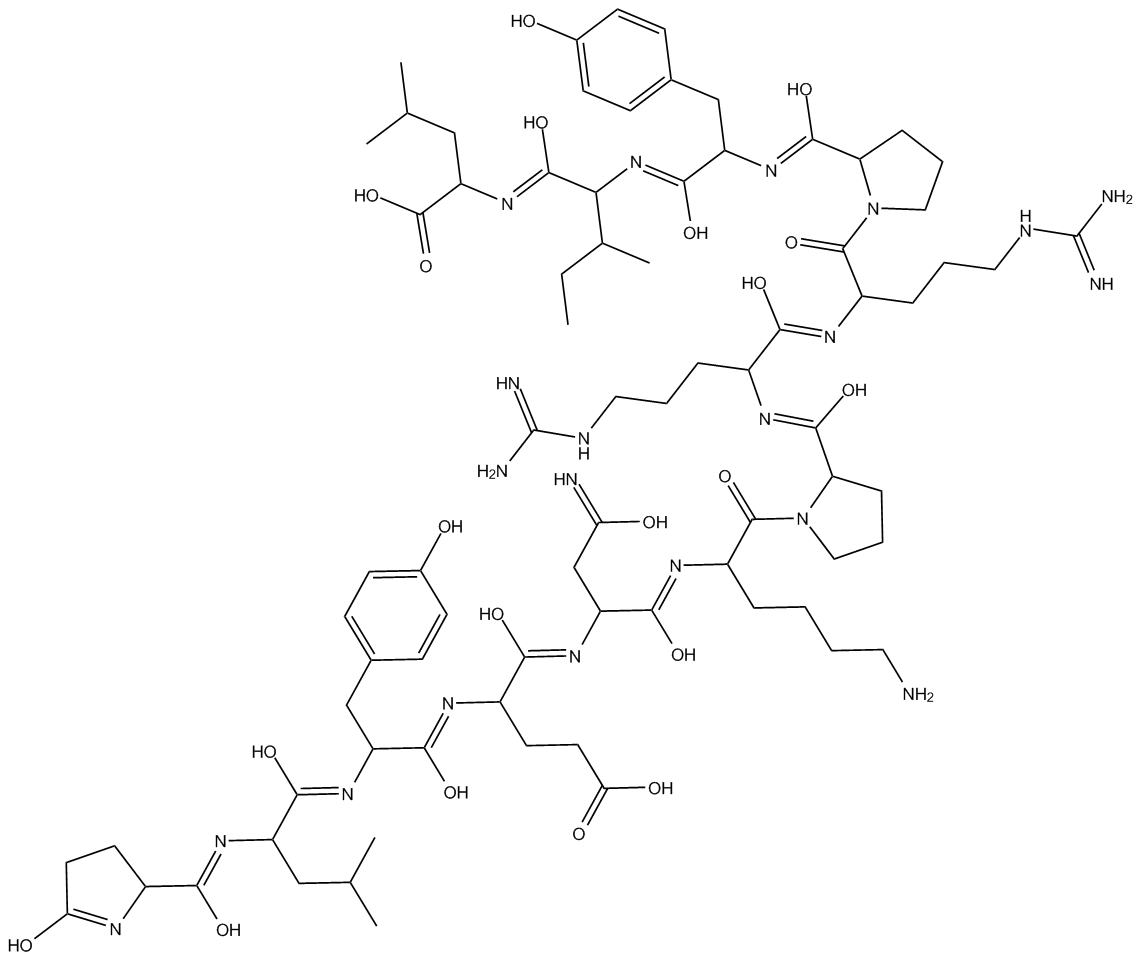
Neurotensin est un neuropeptide composé de 13 acides aminés, qui correspond à un neurotransmetteur, une hormone et un neuromodulateur.
Products are for research use only. Not for human use. We do not sell to patients.
Cas No.: 39379-15-2
Sample solution is provided at 25 µL, 10mM.
_1-3.$$$39978408@51.jpg');)
_1-9.$$$38538795@65.jpg');)
_1-9.$$$39112701@51.jpg');)
_1-7.$$$37316672@70.jpg');)
_366-372.$$$36198801@70.jpg');)
.$$$38565142@65.jpg');)
_1867-1883.$$$33248023@67.jpg');)
_eads6055.$$$39977546@45.jpg');)
_eadm9805.$$$40080571@45.jpg');)
_eadj3020.$$$39666821@45.jpg');)
_1-20.$$$39757301@28.jpg');)
_1-24.$$$38898113@28.jpg');)
_273-287.$$$36806353@46.jpg');)
_1-16.$$$37156877@44.jpg');)
_1-19.$$$37460805@44.jpg');)
_1291-1307.$$$34518654@46.jpg');)
Neurotensin est un neuropeptide composé de 13 acides aminés, qui correspond à un neurotransmetteur, une hormone et un neuromodulateur. Neurotensin réduit la pression artérielle, inhibe la motilité gastro-intestinale et la sécrétion d'acide gastrique pour réguler la fonction digestive, et module la synthèse des céramides par la signalisation NTS-NTSR2 afin de réduire l'inflammation et de réguler le métabolisme. Neurotensin peut être utilisée dans l'étude sur les troubles neuropsychiatriques (comme la schizophrénie et Parkinson) et les maladies métaboliques (comme l'obésité et la stéatopathie métabolique associée)[1-4].
In vitro, Neurotensin (1μM) a été appliquée durant 5 minutes sur les cellules de cancer gastrique MKN-1 et MKN-45. Neurotensin a activé l'expression et l'activité de la métalloprotéinase matricielle 9 (MMP-9) par l'intermédiaire du récepteur NTR1, ce qui a favorisé l'invasion et la migration cellulaires[5]. Neurotensin (0.1μM) a été appliquée durant 5 minutes sur les cellules de cancer pulmonaire non à petites cellules Calu-3, NCI-H358 et NCI-H441. Neurotensin a augmenté la phosphorylation tyrosine de HER3 et a favorisé la formation des hétérodimères EGFR/HER3 et HER2/HER3[6].
In vivo, Neurotensin (1pg–25ng; injection unique) a été administrée par voie intracérébroventriculaire à des souris CD-1. Neurotensin a antagonisé l'effet analgésique induit par la morphine[7]. Neurotensin (10μg; injection unique) a été administrée par voie intrathécale à des souris C57BL/6. Neurotensin a atténué la douleur liée à la chaleur et la douleur induite par le formaldéhyde[8].
References:
[1] Staley J, Fiskum G, Davis TP, et al. Neurotensin elevates cytosolic calcium in small cell lung cancer cells. Peptides. 1989 Nov-Dec;10(6):1217-21.
[2] Ehlers RA, Zhang Y, Hellmich MR, et al. Neurotensin-mediated activation of MAPK pathways and AP-1 binding in the human pancreatic cancer cell line, MIA PaCa-2. Biochem Biophys Res Commun. 2000 Mar 24;269(3):704-8.
[3] Okamoto A, Nakanishi T, Tonai S, et al. Neurotensin induces sustainable activation of the ErbB-ERK1/2 pathway, which is required for developmental competence of oocytes in mice. Reprod Med Biol. 2024 Mar 20;23(1):e12571.
[4] Banerjee M, Song J, Yan B, et al. Neurotensin promotes hepatic steatosis by regulating lipid uptake and mitochondrial adaptation in hepatocytes. Cell Death Dis. 2025 Apr 27;16(1):347.
[5] Akter H, Park M, Kwon OS, et al. Activation of matrix metalloproteinase-9 (MMP-9) by neurotensin promotes cell invasion and migration through ERK pathway in gastric cancer. Tumour Biol. 2015 Aug;36(8):6053-62.
[6] Moody TW, Ramos-Alvarez I, Jensen RT. Adding of neurotensin to non-small cell lung cancer cells increases tyrosine phosphorylation of HER3. Peptides. 2022 Oct;156:170858.
[7] Holmes BB, Rady JJ, Smith DJ, et al. Supraspinal neurotensin-induced antianalgesia in mice is mediated by spinal cholecystokinin. Jpn J Pharmacol. 1999 Feb;79(2):141-9.
[8] Barnwal A, Tamang R, Sanjeev Das, et al. Ponatinib delays the growth of solid tumours by remodelling immunosuppressive tumour microenvironment through the inhibition of induced PD-L1 expression. Br J Cancer. 2023 Oct;129(6):1007-1021.
| Expériences cellulaires [1]: | |
Lignées cellulaires | Cellules Calu-3, NCI-H358 et NCI-H441 (lignées cellulaires de cancer du poumon non à petites cellules) |
Méthode de préparation | Les cellules ont été cultivées dans un milieu RPMI-1640 contenant 10% de sérum bovin foetal (SBF). A confluence, les cellules ont été lavées avec un milieu SIT (RPMI-1640 contenant du sélénite de sodium, de l'insuline bovin et de l'apo-transferrine) durant 2 heures. Les cellules ont été traitées avec des inhibiteurs(ex.SR48692, mAb3481, PP2, GM6001, PD98059, LY294002, N-acétylcystéine ou Tiron) durant 30min. Ensuite, Neurotensin (0.1μM) ou Neureguline 1 (NRG1) a été ajoutée. |
Conditions de réaction | 0.1μM; 5min |
Domaines d'application | Neurotensin a augmenté la phosphorylation tyrosine de HER3 dans les cellules de CBNPC. L'ajout de Neurotensin aux cellules NCI-H441 a entraîné la formation des hétérodimères EGFR/HER3 et HER2/HER3. L'ajout de Neurotensin aux cellules de CBNPC a augmenté la phosphorylation de ERK, HER3 et AKT. Neurotensin a augmenté la formation de colonies par les cellules de CBNPC. La capacité de Neurotensin à augmenter la phosphorylation tyrosine de HER3 a été diminuée par SR48692 (antagoniste de NTSR1), l'anticorps monoclonal 3481 (bloqueur de HER3), GM6001 (inhibiteur de MMP), PP2 (inhibiteur de Src), Tiron (piégeur de superoxyde) ou la N-acétylcystéine (antioxidant). |
| Expériences animales [2]: | |
Modèles animaux | Des souris mâles CD-1 (pesant 25 à 30g) |
Méthode de préparation | Les souris ont reçu Neurotensin (1pg à 25ng) par voie intracérébroventriculaire (i.c.v.) dans un volume de 4μl sous anesthésie légère à l'halothane, généralement 10min avant le test du mouvement de la queue (TFT). La morphine a été administrée par voie intrachécale (i.t.) 5min avant TFT. |
Forme de dosage | 1pg à 25ng; i.c.v.; injection unique |
Domaines d'application | Neurotensin a antagonisé l'action antinociceptive (analgésique) de la morphine administrée par voie intrathécale. Cette action antianalgésique de Neurotensin a été médiée par la cholécystokinine (CCK) spinale. |
References: | |
| Cas No. | 39379-15-2 | SDF | |
| Chemical Name | (Z)-5-(((Z)-1-((6-amino-1-(2-((Z)-(((Z)-1-((1-(2-((Z)-(((Z)-1-(((Z)-1-((1-carboxy-3-methylbutyl)imino)-1-hydroxy-3-methylpentan-2-yl)imino)-1-hydroxy-3-(4-hydroxyphenyl)propan-2-yl)imino)(hydroxy)methyl)pyrrolidin-1-yl)-5-guanidino-1-oxopentan-2-yl)imino) | ||
| Canonical SMILES | CCC(C(/N=C(O)/C(/N=C(O)/C1CCCN1C(C(/N=C(O)/C(/N=C(O)/C2CCCN2C(C(/N=C(O)/C(/N=C(O)/C(/N=C(O)/C(/N=C(O)/C(/N=C(O)/C3CCC(O)=N3)CC(C)C)CC4=CC=C(O)C=C4)CCC(O)=O)CC(O)=N)CCCCN)=O)CCCNC(N)=N)CCCNC(N)=N)=O)CC5=CC=C(O)C=C5)/C(O)=N/C(C(O)=O)CC(C)C)C | ||
| Formula | C78H121N21O20 | M.Wt | 1672.94 |
| Solubility | Soluble to 0.70 mg/ml in sterile water | Storage | Desiccate at -20°C |
| General tips | Please select the appropriate solvent to prepare the stock solution according to the
solubility of the product in different solvents; once the solution is prepared, please store it in
separate packages to avoid product failure caused by repeated freezing and thawing.Storage method
and period of the stock solution: When stored at -80°C, please use it within 6 months; when stored
at -20°C, please use it within 1 month. To increase solubility, heat the tube to 37°C and then oscillate in an ultrasonic bath for some time. |
||
| Shipping Condition | Evaluation sample solution: shipped with blue ice. All other sizes available: with RT, or with Blue Ice upon request. | ||
| Prepare stock solution | |||

|
1 mg | 5 mg | 10 mg |
| 1 mM | 597.8 μL | 2.9888 mL | 5.9775 mL |
| 5 mM | 119.6 μL | 597.8 μL | 1.1955 mL |
| 10 mM | 59.8 μL | 298.9 μL | 597.8 μL |
Step 1: Enter information below (Recommended: An additional animal making an allowance for loss during the experiment)
 g
μL
g
μL
Step 2: Enter the in vivo formulation (This is only the calculator, not formulation. Please contact us first if there is no in vivo formulation at the solubility Section.)
Calculation results:
Working concentration: mg/ml;
Method for preparing DMSO master liquid: mg drug pre-dissolved in μL DMSO ( Master liquid concentration mg/mL, Please contact us first if the concentration exceeds the DMSO solubility of the batch of drug. )
Method for preparing in vivo formulation: Take μL DMSO master liquid, next addμL PEG300, mix and clarify, next addμL Tween 80, mix and clarify, next add μL saline, mix and clarify.
Method for preparing in vivo formulation: Take μL DMSO master liquid, next add μL Corn oil, mix and clarify.
Note: 1. Please make sure the liquid is clear before adding the next solvent.
2. Be sure to add the solvent(s) in order. You must ensure that the solution obtained, in the previous addition, is a clear solution before proceeding to add the next solvent. Physical methods such as vortex, ultrasound or hot water bath can be used to aid dissolving.
3. All of the above co-solvents are available for purchase on the GlpBio website.
Quality Control & SDS
- View current batch:
- Purity: >98.00% Appearance: A solid
- COA (Certificate of Analysis)
- SDS (Safety Data Sheet)
- Datasheet
Average Rating: 5 (Based on Reviews and 40 reference(s) in Google Scholar.)