

Niclosamide (Synonyms: NSC 178296) |
Catalog No.GC13586
 One-Click Copy Product Info
|

Niclosamide, un médicament vermifuge, est un inhibiteur moléculaire petit de STAT3, sa valeur d'IC50 est 0.25±0.07μM.
Products are for research use only. Not for human use. We do not sell to patients.
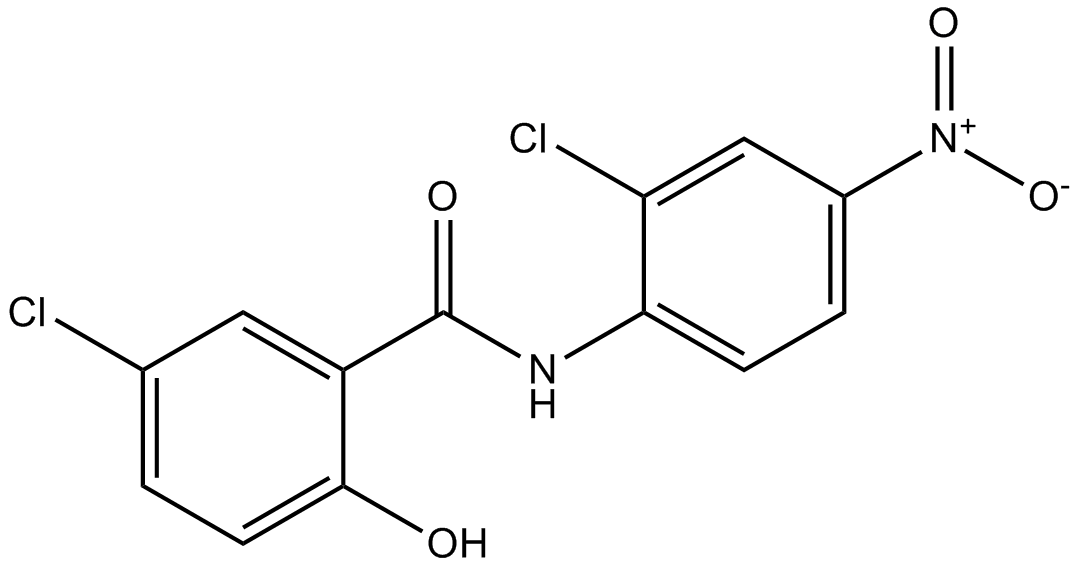
Cas No.: 50-65-7
Sample solution is provided at 25 µL, 10mM.
_1-3.$$$39978408@51.jpg');)
_1-9.$$$38538795@65.jpg');)
_1-9.$$$39112701@51.jpg');)
_1-7.$$$37316672@70.jpg');)
_366-372.$$$36198801@70.jpg');)
.$$$38565142@65.jpg');)
_1867-1883.$$$33248023@67.jpg');)
_eads6055.$$$39977546@45.jpg');)
_eadm9805.$$$40080571@45.jpg');)
_eadj3020.$$$39666821@45.jpg');)
_1-20.$$$39757301@28.jpg');)
_1-24.$$$38898113@28.jpg');)
_273-287.$$$36806353@46.jpg');)
_1-16.$$$37156877@44.jpg');)
_1-19.$$$37460805@44.jpg');)
_1291-1307.$$$34518654@46.jpg');)
Niclosamide, un médicament vermifuge, est un inhibiteur moléculaire petit de STAT3, sa valeur d'IC50 est 0.25±0.07μM[1]. Niclosamide a été largement utilisé dans la recherche du cancer et les études de régulation métabolique, et est employé en tant que composé modèle pour développer une série de dérivés[2].
Le traitement in vitro avec Niclosamide pendant 3 jours a significativement inhibé la viabilité des cellules HL-60, sa valeur d'IC50 est 0.28 ± 0.03μM[3]. Le traitement avec 0.6µM de Niclosamide pendant 24 heures a considérablement inhibé l'expression de LRP6 dans les cellules HEK293 et a bloqué l'activation de la voie de signalisation Wnt/β-caténine[4]. Le traitement avec 20μM de Niclosamide pendant 24 heures a significativement inhibé la viabilité des cellules TPC-1, entraînant la vacuolisation et la désintégration des cellules[5]. Le traitement avec 0.5μM de Niclosamide pendant 12 heures a considérablement inhibé le taux de migration des cellules BD140A et a réduit le niveau des médiateurs de la transition épithélio-mésenchymateuse (N-cadhérine et vimentine)[6].
Le traitement in vivo avec Niclosamide via injection intra-péritonéale quotidienne à la dose de 10mg/kg pendant 21 jours peut significativement atténuer les symptômes de fibrose pulmonaire induits par la bléomycine chez le rat et inhiber l'accumulation de collagène[7]. L'administration orale de Niclosamide à une dose de 200mg/kg/jour pendant 9 semaines a amélioré l'hypertrophie myocardique, la fibrose cardiaque et la dysfonction cardiaque chez les rats présentant une coarctation aortique[8].
References:
[1] Ren X, Duan L, He Q, et al. Identification of niclosamide as a new small-molecule inhibitor of the STAT3 signaling pathway[J]. ACS medicinal chemistry letters, 2010, 1(9): 454-459.
[2] Kang B, Mottamal M, Zhong Q, et al. Design, synthesis, and evaluation of niclosamide analogs as therapeutic agents for enzalutamide-resistant prostate cancer[J]. Pharmaceuticals, 2023, 16(5): 735.
[3] Chae H D, Cox N, Dahl G V, et al. Niclosamide suppresses acute myeloid leukemia cell proliferation through inhibition of CREB-dependent signaling pathways[J]. Oncotarget, 2017, 9(4): 4301.
[4] Lu W, Lin C, Roberts M J, et al. Niclosamide suppresses cancer cell growth by inducing Wnt co-receptor LRP6 degradation and inhibiting the Wnt/β-catenin pathway[J]. PloS one, 2011, 6(12): e29290.
[5] Yu K, Wang T, Li Y, et al. Niclosamide induces apoptosis through mitochondrial intrinsic pathway and inhibits migration and invasion in human thyroid cancer in vitro[J]. Biomedicine & Pharmacotherapy, 2017, 92: 403-411.
[6] Satoh K, Zhang L, Zhang Y, et al. Identification of niclosamide as a novel anticancer agent for adrenocortical carcinoma[J]. Clinical Cancer Research, 2016, 22(14): 3458-3466.
[7] Boyapally R, Pulivendala G, Bale S, et al. Niclosamide alleviates pulmonary fibrosis in vitro and in vivo by attenuation of epithelial-to-mesenchymal transition, matrix proteins & Wnt/β-catenin signaling: A drug repurposing study[J]. Life sciences, 2019, 220: 8-20.
[8] Fu Y, Hu N, Cao M, et al. Anthelmintic niclosamide attenuates pressure-overload induced heart failure in mice[J]. European Journal of Pharmacology, 2021, 912: 174614.
| Expériences cellulaires [1]: | |
Lignées cellulaires | Cellules TPC-1 |
Méthode de préparation | Les cellules TPC-1 ont été cultivées dans un milieu RPMI 1640 contenant 10% de sérum de veau foetal (SVF) inactivé par la chaleur et 1% d'antibiotique (pénicilline et streptomycine) à 37°C et 5% CO2. Les cellules TPC-1 en croissance exponentielle (3000-5000 cellules par puits) ont été ensemencées dans les plaques à 96 puits. Après une incubation de 24 heures, les cellules ont été traitées avec différentes concentrations de Niclosamide (0, 1.25, 2.5, 5, 10, et 20μM). Chaque traitement a été réalisé pendant 24 heures, puis 20µL de MTT à 5mg/mL ont été ajoutés à chaque puits et incubés à 37°C. Le milieu a été retiré, et 150µL de DMSO ont été ajoutés à chaque puits pour dissoudre le bleu de méthylène. L'absorbance a été enregistrée à 570nm. |
Conditions de réaction | 0, 1.25, 2.5, 5, 10, et 20μM; 24h |
Domaines d'application | Le traitement avec Niclosamide a significativement inhibé la viabilité des cellules TPC-1 de manière concentration-dépendante. |
| Expériences animales [2]: | |
Modèles animaux | Rats Swiss albino |
Méthode de préparation | Des rats mâles Swiss albino âgés de huit semaines ont été élevés dans un environnement standard avec un accès libre à la nourriture et à l'eau, et ont été maintenues sous un cycle lumière-obscurité de 12/12. Les rats ont été divisés aléatoirement en groupes suivants (n=10) : groupe témoin; groupe traité uniquement avec Bléomycine (1.5IU/kg de Bléomycine); groupe Bléomycine + Niclosamide (10mg/kg). DMSO et du polyéthylène glycol 200 (dans un rapport de 1:4) ont été utilisés en tant que vecteur pour l'administration de Niclosamide dans la saline physiologique. La concentration de DMSO dans la saline était 1%. La quantité requise de Niclosamide a été pesée, dissoute dans la saline DMSO:PEG (rapport 1:4), et les échantillons ont été soigneusement traités par ultrasons avant l'administration. Les rats ont reçu une injection de 1,5 IU/kg de Bléomycine au jour 0, et une injection intra-péritonéale de Niclosamide une fois par jour du jour 1 au jour 21. Au jour de la fin de l'expérience (le jour 21), les tissus pulmonaires ont été prélevés et conservés pour évaluer divers paramètres biochimiques, des études de pathologie et de biologie moléculaire. |
Forme de dosage | 10mg/kg pendant 21 jours; i.p. |
Domaines d'application | Le traitement avec Niclosamide a atténué la fibrose pulmonaire induite par bléomycine dans les rats. |
References: | |
| Cas No. | 50-65-7 | SDF | |
| Synonymes | NSC 178296 | ||
| Chemical Name | 5-chloro-N-(2-chloro-4-nitrophenyl)-2-hydroxybenzamide | ||
| Canonical SMILES | C1=CC(=C(C=C1[N+](=O)[O-])Cl)NC(=O)C2=C(C=CC(=C2)Cl)O | ||
| Formula | C13H8Cl2N2O4 | M.Wt | 327.12 |
| Solubility | ≥ 12.75mg/mL in EtOH with gentle warming; 4.55 mg/mL in DMSO (Need ultrasonic) | Storage | Store at RT |
| General tips | Please select the appropriate solvent to prepare the stock solution according to the
solubility of the product in different solvents; once the solution is prepared, please store it in
separate packages to avoid product failure caused by repeated freezing and thawing.Storage method
and period of the stock solution: When stored at -80°C, please use it within 6 months; when stored
at -20°C, please use it within 1 month. To increase solubility, heat the tube to 37°C and then oscillate in an ultrasonic bath for some time. |
||
| Shipping Condition | Evaluation sample solution: shipped with blue ice. All other sizes available: with RT, or with Blue Ice upon request. | ||
| Prepare stock solution | |||

|
1 mg | 5 mg | 10 mg |
| 1 mM | 3.057 mL | 15.2849 mL | 30.5698 mL |
| 5 mM | 611.4 μL | 3.057 mL | 6.114 mL |
| 10 mM | 305.7 μL | 1.5285 mL | 3.057 mL |
Step 1: Enter information below (Recommended: An additional animal making an allowance for loss during the experiment)
 g
μL
g
μL
Step 2: Enter the in vivo formulation (This is only the calculator, not formulation. Please contact us first if there is no in vivo formulation at the solubility Section.)
Calculation results:
Working concentration: mg/ml;
Method for preparing DMSO master liquid: mg drug pre-dissolved in μL DMSO ( Master liquid concentration mg/mL, Please contact us first if the concentration exceeds the DMSO solubility of the batch of drug. )
Method for preparing in vivo formulation: Take μL DMSO master liquid, next addμL PEG300, mix and clarify, next addμL Tween 80, mix and clarify, next add μL saline, mix and clarify.
Method for preparing in vivo formulation: Take μL DMSO master liquid, next add μL Corn oil, mix and clarify.
Note: 1. Please make sure the liquid is clear before adding the next solvent.
2. Be sure to add the solvent(s) in order. You must ensure that the solution obtained, in the previous addition, is a clear solution before proceeding to add the next solvent. Physical methods such as vortex, ultrasound or hot water bath can be used to aid dissolving.
3. All of the above co-solvents are available for purchase on the GlpBio website.
Quality Control & SDS
- View current batch:
- Purity: >98.50% Appearance: A solid
- COA (Certificate of Analysis)
- SDS (Safety Data Sheet)
- Datasheet
Average Rating: 5 (Based on Reviews and 15 reference(s) in Google Scholar.)