

Sulfatinib (HMPL-012) (Synonyms: HMPL-012) |
Catalog No.GC32805
 One-Click Copy Product Info
|

Le sulfatinib (HMPL-012) (HMPL-012) est un inhibiteur puissant et hautement sélectif de la tyrosine kinase contre VEGFR1/2/3, FGFR1 et CSF1R avec des IC50 dans une plage de 1 À 24 nM.
Products are for research use only. Not for human use. We do not sell to patients.
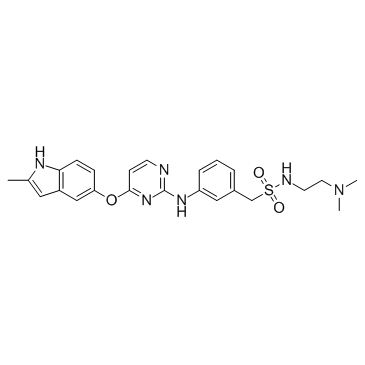
Cas No.: 1308672-74-3
Sample solution is provided at 25 µL, 10mM.
_1-3.$$$39978408@51.jpg');)
_1-9.$$$38538795@65.jpg');)
_1-9.$$$39112701@51.jpg');)
_1-7.$$$37316672@70.jpg');)
_366-372.$$$36198801@70.jpg');)
.$$$38565142@65.jpg');)
_1867-1883.$$$33248023@67.jpg');)
_eads6055.$$$39977546@45.jpg');)
_eadm9805.$$$40080571@45.jpg');)
_eadj3020.$$$39666821@45.jpg');)
_1-20.$$$39757301@28.jpg');)
_1-24.$$$38898113@28.jpg');)
_273-287.$$$36806353@46.jpg');)
_1-16.$$$37156877@44.jpg');)
_1-19.$$$37460805@44.jpg');)
_1291-1307.$$$34518654@46.jpg');)
Sulfatinib (HMPL-012) is a potent and highly selective tyrosine kinase inhibitor against VEGFR1/2/3, FGFR1 and CSF1R with IC50s of in a range of 1 to 24 nM.
Sulfatinib inhibits VEGFR1, 2, and 3, FGFR1 and CSF1R kinases with IC50s in a range of 1 to 24 nM, and it strongly blocks VEGF induced VEGFR2 phosphorylation in HEK293KDR cells and CSF1 stimulated CSF1R phosphorylation in RAW264.7 cells with IC50 of 2 and 79 nM, respectively. Sulfatinib also attenuates VEGF or FGF stimulated HUVEC cells proliferation with IC50< 50 nM[1]. Also, it is a hERG inhibitor with IC50 of 6.8 μM in CHO cell[2].
In animal studies, a single oral dosing of Sulfatinib inhibits VEGF stimulated VEGFR2 phosphorylation in lung tissues of nude mice in an exposure-dependent manner. Furthermore, elevation of FGF23 levels in plasma 24 hours post dosing suggests suppression of FGFR signaling. Sulfatinib demonstrates potent tumor growth inhibition in multiple human xenograft models and decreases CD31 expression remarkably, suggesting strong inhibition on angiogenesis through VEGFR and FGFR signaling. In a syngeneic murine colon cancer model CT-26, Sulfatinib demonstrates moderate tumor growth inhibition after single agent treatment[1]. After oral dosing of 10 mg/kg, the AUC and Cmax are 397 ng/mL and 138ng/mL in the mouse, respectively[1].
[1]. PCT Int. Appl. (2011), WO 2011060746 A1 20110526.
Kinase experiment: | The KDR kinase inhibition activity is tested using the the Z-lyte assay kit. The testing system contains 300 ng/mL of recombinant human KDR catalytic domain, 10 μM of ATP, 1 μM of substrate peptide, and a test compound (Sulfatinib) at a series of different concentrations in 384-well plate; total volume is 10 μL. The enzyme inhibition proceeds at room temperature (25°C), for 1 hour at room temperature on the shaker. 5 μL of stop solution is added to stop the reaction[2]. |
Animal experiment: | The phamacokinetics of Sulfatinib are studied with male ICR mice (n=6 for each group, weight 20-30g) after a single intraveneous and oral dosing at 2.5 and 10mg/kg, respectively. For i.v. dosing formulation, Sulfatinib is dissolved in DMSO (0.25%)-solutol(10%)-ethanol(10%)-physiological saline(79.75%) at the concentration of 0.25 mg/mL. And the p.o. Dosing formulation (1mg/mL) is prepared with 0.5% CMC-Na. After i.v. Or p.o. Dosing, blood samples are collected via the ophthalmic vein at 0 (pre-close), 5, 15, 30 min and 1, 1.5, 2, 4, 8, 24 h, anti-coagulated with heparin-Na. After centrifugation, plasma samples are seprated and protein precipitated with acetonitrilel containing internal standard[2]. |
References: [1]. PCT Int. Appl. (2011), WO 2011060746 A1 20110526. | |
| Cas No. | 1308672-74-3 | SDF | |
| Synonymes | HMPL-012 | ||
| Canonical SMILES | O=S(CC1=CC=CC(NC2=NC=CC(OC3=CC4=C(NC(C)=C4)C=C3)=N2)=C1)(NCCN(C)C)=O | ||
| Formula | C24H28N6O3S | M.Wt | 480.58 |
| Solubility | DMSO : ≥ 30 mg/mL (62.42 mM) | Storage | Store at -20°C |
| General tips | Please select the appropriate solvent to prepare the stock solution according to the
solubility of the product in different solvents; once the solution is prepared, please store it in
separate packages to avoid product failure caused by repeated freezing and thawing.Storage method
and period of the stock solution: When stored at -80°C, please use it within 6 months; when stored
at -20°C, please use it within 1 month. To increase solubility, heat the tube to 37°C and then oscillate in an ultrasonic bath for some time. |
||
| Shipping Condition | Evaluation sample solution: shipped with blue ice. All other sizes available: with RT, or with Blue Ice upon request. | ||
| Prepare stock solution | |||

|
1 mg | 5 mg | 10 mg |
| 1 mM | 2.0808 mL | 10.4041 mL | 20.8082 mL |
| 5 mM | 416.2 μL | 2.0808 mL | 4.1616 mL |
| 10 mM | 208.1 μL | 1.0404 mL | 2.0808 mL |
Step 1: Enter information below (Recommended: An additional animal making an allowance for loss during the experiment)
 g
μL
g
μL
Step 2: Enter the in vivo formulation (This is only the calculator, not formulation. Please contact us first if there is no in vivo formulation at the solubility Section.)
Calculation results:
Working concentration: mg/ml;
Method for preparing DMSO master liquid: mg drug pre-dissolved in μL DMSO ( Master liquid concentration mg/mL, Please contact us first if the concentration exceeds the DMSO solubility of the batch of drug. )
Method for preparing in vivo formulation: Take μL DMSO master liquid, next addμL PEG300, mix and clarify, next addμL Tween 80, mix and clarify, next add μL saline, mix and clarify.
Method for preparing in vivo formulation: Take μL DMSO master liquid, next add μL Corn oil, mix and clarify.
Note: 1. Please make sure the liquid is clear before adding the next solvent.
2. Be sure to add the solvent(s) in order. You must ensure that the solution obtained, in the previous addition, is a clear solution before proceeding to add the next solvent. Physical methods such as vortex, ultrasound or hot water bath can be used to aid dissolving.
3. All of the above co-solvents are available for purchase on the GlpBio website.
Quality Control & SDS
- View current batch:
- Purity: >98.00% Appearance: A solid
- COA (Certificate of Analysis)
- SDS (Safety Data Sheet)
- Datasheet
Average Rating: 5 (Based on Reviews and 28 reference(s) in Google Scholar.)