
Thio-TEPA (Synonyms: NCI C01649, NSC 6396, Triethylenethiophosphoramide) |
| Catalog No.GC16158 |
Thio-TEPA est un agent alkylant de l'ADN, avec une activité antitumorale.
Products are for research use only. Not for human use. We do not sell to patients.
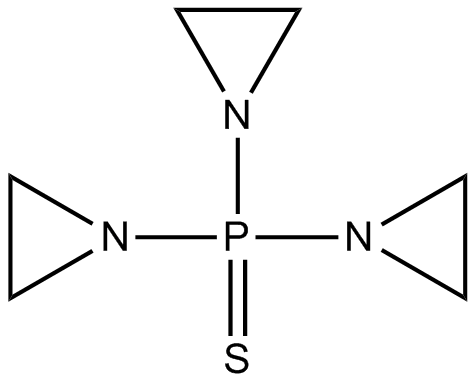
Cas No.: 52-24-4
Sample solution is provided at 25 µL, 10mM.
Thio-TEPA is a DNA alkylating agent, with antitumor activity.
Thio-TEPA exhibits alkylating activity in rat liver slice incubation. Thio-TEPA does not affect the viability of rat liver slices, and is not accumulated in the slices at all doses of 2, 5, 10 mM[1].
Thio-TEPA (20 mg/kg, i.p.) with total body irradiation (TBI) enhances donor-type blood chimerism during the first 10 weeks but is not dramatically higher than that of TBI group alone. Thio-TEPA alone improves both short- and long-term engraftment in mice[2].
References:
[1]. Hagen B, et al. Metabolism and alkylating activity of thio-TEPA in rat liver slice incubation. Cancer Chemother Pharmacol. 1991;28(6):441-7.
[2]. Down JD, et al. Thiotepa improves allogeneic bone marrow engraftment without enhancing stem cell depletion in irradiated mice. Bone Marrow Transplant. 1998 Feb;21(4):327-30.

Cell experiment: | The effect of Thio-TEPA on slice viability is studied by the determination of intracellular potassium (K+) leakage. Intracellular K+ is measured by flame photometry and is expressed in relation to the DNA content as measured using fluorometry. Thio-TEPA is added at concentrations of 1, 2, 5, and 10 mM and slices are incubated for 6, 12, and 24 h. The results are compared with the values found for drug-free controls. Thio-TEPA in medium and slices is measured following 3, 6, and 9 h incubation at the three highest concentrations. Krebs-HEPES buffer is used as the slicing buffer and Waymouth's MB 752/1 medium supplemented with 10 μg gentamycin is used as the incubation medium[1]. |
Animal experiment: | Mice[2]Male C57BL/6JIco mice, 19 weeks old, 25 to 30 g, are used as recipients. Congenic C57BL/6J-Gpi-1a/Gpi-1a (B6-Gpi-1a) and BALB.B10LiLa (Gpi-1a) mice are used as a source of syngeneic and allogeneic donor bone marrow, respectively. The latter combination is H-2-compatible (both H-2b), but mismatched on a number of minor histocompatibility loci. Thio-TEPA is dissolved in PBS and injected i.p. at a single bolus of 20 mg/kg. Preliminary pilot experiments have established that this approximated to the maximal tolerated dose when higher doses result in lethal gastrointestinal toxicity. Cyclophosphamide (CY) is dissolved in PBS and administered i.p. at a single dose of 200 mg/kg. Total body irradiation is delivered using a 137Cs γ-irradiation unit at a dose rate of 87 cGy/min to a dose of 5 Gy. After Thio-TEPA treatment the mice are maintained on neomycin (3.5 g/L sterile drinking water) for 2 weeks to minimize the possible problems of endotoxemia via gut toxicity[2]. |
References: [1]. Hagen B, et al. Metabolism and alkylating activity of thio-TEPA in rat liver slice incubation. Cancer Chemother Pharmacol. 1991;28(6):441-7. | |
| Cas No. | 52-24-4 | SDF | |
| Synonymes | NCI C01649, NSC 6396, Triethylenethiophosphoramide | ||
| Canonical SMILES | S=P(N1CC1)(N2CC2)N3CC3 | ||
| Formula | C6H12N3PS | M.Wt | 189.22 |
| Solubility | ≥ 7.5mg/mL in DMSO | Storage | 4°C, protect from light |
| General tips | Please select the appropriate solvent to prepare the stock solution according to the
solubility of the product in different solvents; once the solution is prepared, please store it in
separate packages to avoid product failure caused by repeated freezing and thawing.Storage method
and period of the stock solution: When stored at -80°C, please use it within 6 months; when stored
at -20°C, please use it within 1 month. To increase solubility, heat the tube to 37°C and then oscillate in an ultrasonic bath for some time. |
||
| Shipping Condition | Evaluation sample solution: shipped with blue ice. All other sizes available: with RT, or with Blue Ice upon request. | ||
| Prepare stock solution | |||
|
1 mg | 5 mg | 10 mg |
| 1 mM | 5.2849 mL | 26.4243 mL | 52.8485 mL |
| 5 mM | 1.057 mL | 5.2849 mL | 10.5697 mL |
| 10 mM | 528.5 μL | 2.6424 mL | 5.2849 mL |
Step 1: Enter information below (Recommended: An additional animal making an allowance for loss during the experiment)
Step 2: Enter the in vivo formulation (This is only the calculator, not formulation. Please contact us first if there is no in vivo formulation at the solubility Section.)
Calculation results:
Working concentration: mg/ml;
Method for preparing DMSO master liquid: mg drug pre-dissolved in μL DMSO ( Master liquid concentration mg/mL, Please contact us first if the concentration exceeds the DMSO solubility of the batch of drug. )
Method for preparing in vivo formulation: Take μL DMSO master liquid, next addμL PEG300, mix and clarify, next addμL Tween 80, mix and clarify, next add μL ddH2O, mix and clarify.
Method for preparing in vivo formulation: Take μL DMSO master liquid, next add μL Corn oil, mix and clarify.
Note: 1. Please make sure the liquid is clear before adding the next solvent.
2. Be sure to add the solvent(s) in order. You must ensure that the solution obtained, in the previous addition, is a clear solution before proceeding to add the next solvent. Physical methods such as vortex, ultrasound or hot water bath can be used to aid dissolving.
3. All of the above co-solvents are available for purchase on the GlpBio website.
Quality Control & SDS
- View current batch:
- Purity: >98.00%
- COA (Certificate Of Analysis)
- SDS (Safety Data Sheet)
- Datasheet
Average Rating: 5 (Based on Reviews and 14 reference(s) in Google Scholar.)
GLPBIO products are for RESEARCH USE ONLY. Please make sure your review or question is research based.
Required fields are marked with *


