

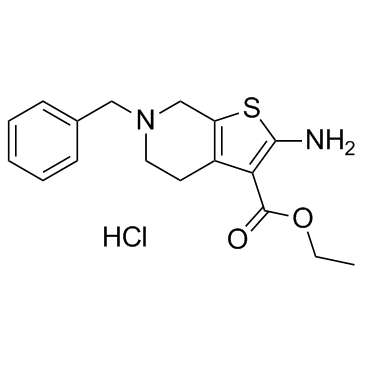
Tinoridine hydrochloride (Y-3642 hydrochloride) |
Catalog No.GC31882
 One-Click Copy Product Info
|

Le chlorhydrate de tinoridine (chlorhydrate de Y-3642) est un médicament anti-inflammatoire non stéroÏdien et possède également une puissante activité antiradicalaire et antiperoxydante.
Products are for research use only. Not for human use. We do not sell to patients.
Cas No.: 25913-34-2
Sample solution is provided at 25 µL, 10mM.
_1-3.$$$39978408@51.jpg');)
_1-9.$$$38538795@65.jpg');)
_1-9.$$$39112701@51.jpg');)
_1-7.$$$37316672@70.jpg');)
_366-372.$$$36198801@70.jpg');)
.$$$38565142@65.jpg');)
_1867-1883.$$$33248023@67.jpg');)
_eads6055.$$$39977546@45.jpg');)
_eadm9805.$$$40080571@45.jpg');)
_eadj3020.$$$39666821@45.jpg');)
_1-20.$$$39757301@28.jpg');)
_1-24.$$$38898113@28.jpg');)
_273-287.$$$36806353@46.jpg');)
_1-16.$$$37156877@44.jpg');)
_1-19.$$$37460805@44.jpg');)
_1291-1307.$$$34518654@46.jpg');)
Tinoridine hydrochloride is a nonsteroidal anti-inflammatory drug and also has potent radical scavenger and antiperoxidative activity.
Tinoridine reduces a stable free radical, diphenyl-p-picrylhydrazyl, in the molar ratio of about 1:2, indicating its free radical scavenging ability. Tinoridine inhibits the lipid peroxidation in rat liver microsomes induced by xanthine-xanthine oxidase system in the presence of ADP and Fe2+, in which hydroxyl radical is formed. Tinoridine is demonstrated to be oxidized in the course of the lipid peroxidation by following the fluorescence derived from the oxidation product of tinoridine. It is also oxidized by the xanthine-xanthine oxidase system in the presence of Fe2+, but its oxidation is slow in the absence of Fe2+ and almost completely inhibited by catalase. Tinoridine is also oxidized by H2O2-Fe2+ system producing OH (Fenton reaction), but it does not affect the reduction of cytochrome c caused by superoxide radical[1].
CCl4 aministration produces a marked decrease in the concentrations of liver microsomal cytochrome P-450 and G6Pase, indicating that hepatic endoplasmic reticulum function is disrupted. Prior treatment of the animals with tinoridine (100 mg/kg) significantly reduces the CCl4-induced alterations in the enzyme activities, and a rapid recovery toward the normal values is observed[2].
[1]. O Shimada, et al. Hydroxyl radical scavenging action of tinoridine. Agents Actions. 1986 Nov;19(3-4):208-14. [2]. Yasuda H, et al. The protective effect of tinoridine against carbon tetrachloride hepatotoxicity. Toxicol Appl Pharmacol. 1980 Mar 15;52(3):407-13.
Kinase experiment: | CCl4 aministration produces a marked decrease in the concentrations of liver microsomal cytochrome P-450 and G6Pase, indicating that hepatic endoplasmic reticulum function is disrupted. Prior treatment of the animals with tinoridine (100 mg/kg) significantly reduces the CCl4-induced alterations in the enzyme activities, and a rapid recovery toward the normal values is observed[2]. |
Animal experiment: | Rat: Male Wistar rats (180-220 g) are used in the experiments. Drugs (Tinoridine) are given orally as a suspension in 0.5% methylcellulose solution 1 hr before CCl4, administration. Control animals receive an equivalent amount of the vehicle. CCl4 is administered ip at a dose of 0.25 ml/kg as a 5% (v/v) solution in olive oil. The animals are killed by carotid excision at different times after CCl4 administration; the livers are rapidly removed, weighed and processed for biochemical or histologic analysis[2]. |
References: [1]. O Shimada, et al. Hydroxyl radical scavenging action of tinoridine. Agents Actions. 1986 Nov;19(3-4):208-14. | |
| Cas No. | 25913-34-2 | SDF | |
| Canonical SMILES | O=C(C1=C(N)SC2=C1CCN(CC3=CC=CC=C3)C2)OCC.Cl | ||
| Formula | C17H21ClN2O2S | M.Wt | 352.88 |
| Solubility | DMSO : ≥ 31 mg/mL (87.85 mM) | Storage | Store at -20°C |
| General tips | Please select the appropriate solvent to prepare the stock solution according to the
solubility of the product in different solvents; once the solution is prepared, please store it in
separate packages to avoid product failure caused by repeated freezing and thawing.Storage method
and period of the stock solution: When stored at -80°C, please use it within 6 months; when stored
at -20°C, please use it within 1 month. To increase solubility, heat the tube to 37°C and then oscillate in an ultrasonic bath for some time. |
||
| Shipping Condition | Evaluation sample solution: shipped with blue ice. All other sizes available: with RT, or with Blue Ice upon request. | ||
| Prepare stock solution | |||

|
1 mg | 5 mg | 10 mg |
| 1 mM | 2.8338 mL | 14.1691 mL | 28.3382 mL |
| 5 mM | 566.8 μL | 2.8338 mL | 5.6676 mL |
| 10 mM | 283.4 μL | 1.4169 mL | 2.8338 mL |
Step 1: Enter information below (Recommended: An additional animal making an allowance for loss during the experiment)
 g
μL
g
μL
Step 2: Enter the in vivo formulation (This is only the calculator, not formulation. Please contact us first if there is no in vivo formulation at the solubility Section.)
Calculation results:
Working concentration: mg/ml;
Method for preparing DMSO master liquid: mg drug pre-dissolved in μL DMSO ( Master liquid concentration mg/mL, Please contact us first if the concentration exceeds the DMSO solubility of the batch of drug. )
Method for preparing in vivo formulation: Take μL DMSO master liquid, next addμL PEG300, mix and clarify, next addμL Tween 80, mix and clarify, next add μL saline, mix and clarify.
Method for preparing in vivo formulation: Take μL DMSO master liquid, next add μL Corn oil, mix and clarify.
Note: 1. Please make sure the liquid is clear before adding the next solvent.
2. Be sure to add the solvent(s) in order. You must ensure that the solution obtained, in the previous addition, is a clear solution before proceeding to add the next solvent. Physical methods such as vortex, ultrasound or hot water bath can be used to aid dissolving.
3. All of the above co-solvents are available for purchase on the GlpBio website.
Quality Control & SDS
- View current batch:
- Purity: >98.00% Appearance: A solid
- COA (Certificate of Analysis)
- SDS (Safety Data Sheet)
- Datasheet
Average Rating: 5 (Based on Reviews and 35 reference(s) in Google Scholar.)