

VT103 |
Catalog No.GC63257
 One-Click Copy Product Info
|

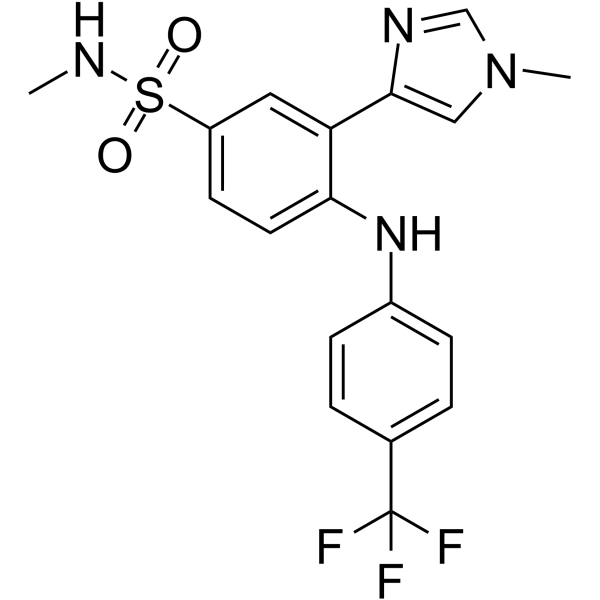
VT103 est un inhibiteur sélectif de la palmitoylation de la protéine TEAD1.
Products are for research use only. Not for human use. We do not sell to patients.
Cas No.: 2290608-13-6
Sample solution is provided at 25 µL, 10mM.
_1-3.$$$39978408@51.jpg');)
_1-9.$$$38538795@65.jpg');)
_1-9.$$$39112701@51.jpg');)
_1-7.$$$37316672@70.jpg');)
_366-372.$$$36198801@70.jpg');)
.$$$38565142@65.jpg');)
_1867-1883.$$$33248023@67.jpg');)
_eads6055.$$$39977546@45.jpg');)
_eadm9805.$$$40080571@45.jpg');)
_eadj3020.$$$39666821@45.jpg');)
_1-20.$$$39757301@28.jpg');)
_1-24.$$$38898113@28.jpg');)
_273-287.$$$36806353@46.jpg');)
_1-16.$$$37156877@44.jpg');)
_1-19.$$$37460805@44.jpg');)
_1291-1307.$$$34518654@46.jpg');)
VT103 est un inhibiteur sélectif de la palmitoylation de la protéine TEAD1. VT103 inhibe la transcription des gènes contrôlées par le complexe YAP/TAZ-TEAD, empêche l'autopalmitoylation de TRAD, rompt l'interaction entre YAP/TAZ et TEAD[1-2]. VT103 peut être utilisé à rechercher le cancer du sein HER2 positif, le cancer de la prostate et le cancer du sein triple négatif[3-4].
VT103 (10μM) a été in vitro utilisé à traiter les fibroblastes cardiaques de rats nouveau-nés (NMCFs) stimulés par l'angiotensine II (Ang-II; 100nM) pendant 48h. VT103 a inversé l'augmentation de l'expression de α-SMA induite par Ang-II, inhibé la contraction du gel de collagène ainsi que la migration de cellule[5]. VT103 (10μM) a été également utilisé à traiter les cellules de muscle lisse des artères coronaires humaines (HCASMCs) surexprimant METTL14 pendant 24h. VT103 a réduit l'expression de TEAD1, PDGFRB, CTGF et Cyr61, restauré celle des marqueurs contractiles ACTA2, CNN1 et SM22α, atténué l'augmentation de la viabilité, de la prolifération et de la migration de cellule causée par la surexpression de METTL14[6].
In vivo, VT103 (100mg/kg) combiné avec Dabrafenib (30mg/kg) a été administré quotidiennement par voie orale pendant 14 jours à traiter les rats BALB/c-nu féminins porteurs les tumeurs xénogreffes KTOR81. VT103 a significativement inhibé la croissance de tumeur, maintenu une régression soutenue des tumeurs pendant 42 jours d'observation, n'affecte pas significativement de poids des rats[7]. VT103 (0.3, 1, 3mg/kg) a été administré quotidiennement par voie orale pendant 45 jours à traiter les rats porteurs de tumeurs xénogreffes NCI-H226. VT103 a considérablement inhibé la croissance de tumeur, à la dose de 3mg/kg, VT103 a induit la régression de tumeur, n'a affecté pas de poids corporel pendant le traitement[8].
References:
[1] Heinrich T, Peterson C, Schneider R, et al. Optimization of TEAD P-Site Binding Fragment Hit into In Vivo Active Lead MSC-4106. J Med Chem. 2022 Jul 14;65(13):9206-9229.
[2] Vaparanta K, Song Z, Farahani I, et al. Phosphoproteomic analysis reveals the diversity of signaling behind ErbB-inhibitor-induced phenotypes. FEBS J. 2025 Dec;292(24):6557-6575.
[3] Zhang S, Tan YQ, Zhang X, et al. TFF3 drives Hippo dependent EGFR-TKI resistance in lung adenocarcinoma. Oncogene. 2025 Mar;44(11):753-768.
[4] Evsen L, Morris PJ, Thomas CJ, et al. Comparative Assessment and High-Throughput Drug-Combination Profiling of TEAD-Palmitoylation Inhibitors in Hippo Pathway Deficient Mesothelioma. Pharmaceuticals (Basel). 2023 Nov 21;16(12):1635.
[5] Song S, Zhang X, Huang Z, et al. TEA domain transcription factor 1(TEAD1) induces cardiac fibroblasts cells remodeling through BRD4/Wnt4 pathway. Signal Transduct Target Ther. 2024 Feb 19;9(1):45.
[6] Wang L, Xia G, Tang Y, et al. METTL14 Promotes Vascular Smooth Muscle Cell Proliferation and Neointima Formation via m6A Methylation TEAD1 mRNA. J Biochem Mol Toxicol. 2025 May;39(5):e70284.
[7] Hosoya K, Ozasa H, Yoshida H, et al. Novel TEAD1 Inhibitor VT103 Enhances Dabrafenib Efficacy in BRAF V600E Mutated Lung Adenocarcinoma via Survivin Downregulation. Cancer Sci. 2025 Jul;116(7):1883-1896.
[8] Tang TT, Konradi AW, Feng Y, et al. Small Molecule Inhibitors of TEAD Auto-palmitoylation Selectively Inhibit Proliferation and Tumor Growth of NF2-deficient Mesothelioma. Mol Cancer Ther. 2021 Jun;20(6):986-998.
| Expériences cellulaires [1]: | |
Lignées cellulaires | Fibroblastes cardiaques de rats nouveau-nés (NMCFs) |
Méthode de préparation | Les fibroblastes cardiaques de rats nouveau-nés (NMCFs) ont été stimulés par l'angiotensine II (Ang-II; 100nM). Les cellules ont été traitées avec VT103 (10μM) pendant 48h. |
Conditions de réaction | 10μM; 48h. |
Domaines d'application | VT103 a inversé l'augmentation de l'expression de α-SMA. Il a également inhibé la contraction du gel de collagène et la migration cellulaire. |
| Expériences animales [2]: | |
Modèles animaux | Rats féminins BALB/c-nu âgés de six semaines |
Méthode de préparation | Les cellules KTOR81 (5x10⁶) en suspension dans Matrigel ont été injectées par voie sous-cutanée dans le dos des rats. Le traitement a débuté lorsque le volume tumoral a atteint 200mm³. Les rats ont été traités avec VT103 (100mg/kg). |
Forme de dosage | 100mg/kg; p.o.; administration quotidienne pendant 14 jours |
Domaines d'application | L'association de dabrafenib et de VT103 a induit une réduction tumorale significative, a montré une réponse soutenue, avec une régression tumorale maintenue pendant la période d'observation de 42 jours. Ce traitement combiné n'a pas provoqué d'effets indésirables significatifs sur le poids corporel des rats. |
References: | |
| Cas No. | 2290608-13-6 | SDF | |
| Formula | C18H17F3N4O2S | M.Wt | 410.41 |
| Solubility | DMSO : 50 mg/mL (121.83 mM; Need ultrasonic) | Storage | Store at -20°C |
| General tips | Please select the appropriate solvent to prepare the stock solution according to the
solubility of the product in different solvents; once the solution is prepared, please store it in
separate packages to avoid product failure caused by repeated freezing and thawing.Storage method
and period of the stock solution: When stored at -80°C, please use it within 6 months; when stored
at -20°C, please use it within 1 month. To increase solubility, heat the tube to 37°C and then oscillate in an ultrasonic bath for some time. |
||
| Shipping Condition | Evaluation sample solution: shipped with blue ice. All other sizes available: with RT, or with Blue Ice upon request. | ||
| Prepare stock solution | |||

|
1 mg | 5 mg | 10 mg |
| 1 mM | 2.4366 mL | 12.1829 mL | 24.3659 mL |
| 5 mM | 487.3 μL | 2.4366 mL | 4.8732 mL |
| 10 mM | 243.7 μL | 1.2183 mL | 2.4366 mL |
Step 1: Enter information below (Recommended: An additional animal making an allowance for loss during the experiment)
 g
μL
g
μL
Step 2: Enter the in vivo formulation (This is only the calculator, not formulation. Please contact us first if there is no in vivo formulation at the solubility Section.)
Calculation results:
Working concentration: mg/ml;
Method for preparing DMSO master liquid: mg drug pre-dissolved in μL DMSO ( Master liquid concentration mg/mL, Please contact us first if the concentration exceeds the DMSO solubility of the batch of drug. )
Method for preparing in vivo formulation: Take μL DMSO master liquid, next addμL PEG300, mix and clarify, next addμL Tween 80, mix and clarify, next add μL saline, mix and clarify.
Method for preparing in vivo formulation: Take μL DMSO master liquid, next add μL Corn oil, mix and clarify.
Note: 1. Please make sure the liquid is clear before adding the next solvent.
2. Be sure to add the solvent(s) in order. You must ensure that the solution obtained, in the previous addition, is a clear solution before proceeding to add the next solvent. Physical methods such as vortex, ultrasound or hot water bath can be used to aid dissolving.
3. All of the above co-solvents are available for purchase on the GlpBio website.
Quality Control & SDS
- View current batch:
- Purity: >99.00% Appearance: A solid
- COA (Certificate of Analysis)
- SDS (Safety Data Sheet)
- Datasheet
Average Rating: 5 (Based on Reviews and 6 reference(s) in Google Scholar.)