

2-D08 |
Catalog No.GC10408
 One-Click Copy Product Info
|

2-D08 es un inhibidor de flavonoides sintéticos y un modificador similar a la ubiquitina pequeña (SUMO) permeable a las células, que también inhibe el obbjetivo de Axl con un IC50 de 0.49nM
Products are for research use only. Not for human use. We do not sell to patients.
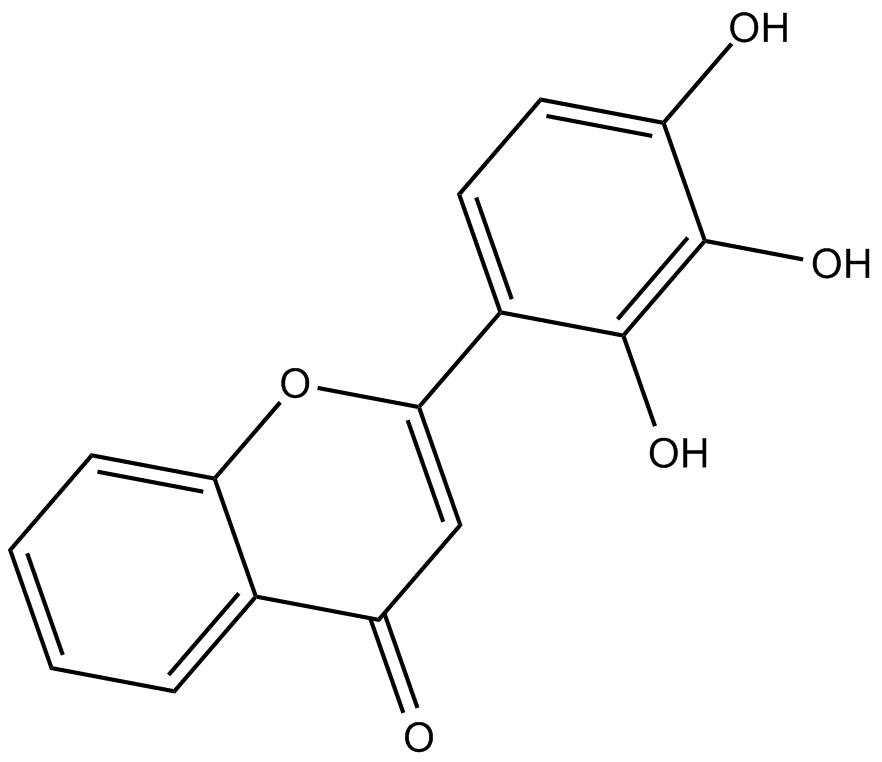
Cas No.: 144707-18-6
Sample solution is provided at 25 µL, 10mM.
_1-3.$$$39978408@51.jpg');)
_1-9.$$$38538795@65.jpg');)
_1-9.$$$39112701@51.jpg');)
_1-7.$$$37316672@70.jpg');)
_366-372.$$$36198801@70.jpg');)
.$$$38565142@65.jpg');)
_1867-1883.$$$33248023@67.jpg');)
_eads6055.$$$39977546@45.jpg');)
_eadm9805.$$$40080571@45.jpg');)
_eadj3020.$$$39666821@45.jpg');)
_1-20.$$$39757301@28.jpg');)
_1-24.$$$38898113@28.jpg');)
_273-287.$$$36806353@46.jpg');)
_1-16.$$$37156877@44.jpg');)
_1-19.$$$37460805@44.jpg');)
_1291-1307.$$$34518654@46.jpg');)
2-D08 es un inhibidor de flavonoides sintéticos y un modificador similar a la ubiquitina pequeña (SUMO) permeable a las células, que también inhibe el obbjetivo de Axl con un IC50 de 0.49nM[1]. La SUMOylation de proteínas es una modificación post-translational dinámica involucrada en varios procesos biológicos en la homeostasis y el desarrollo celular. 2-D08 inhibe la SUMOylation al evitar la transferencia de SUMO del tioéster UBC9-SUMO a los sustratos[2]. 2-D08 se usa comúnmente para invesitgar el papel de la SUMOylation en varias vías y enfermedades biológicas, como la leucemia mieloide aguda y los trastornos desmielinizantes [3,4].
In vitro, la inucbación de mioblastos C2C12 con 2-D08 (50, 100μM) durante 24h indujo cambios morfológicos significativos e inhibió notablemente la viabilidad celular, con la dosis más alta de 100µMreduciendo la viabilidad celular hasta en un 20%[5]. El tratamiento del leiomiosarcoma uterino humano (Ut-LMS) SK-LMS-1 y SK-UT-1B con 2-D08 (10-100μM) durante 7 días resultó en una disminución dependiente de la dosis en la fracción de supervivencia celular e inhibió la capacidad de formación de colonias de las células Ut-LMS[6]. La incubación de células precursoras de oligadendrovitos cultivados primarios (OPCs) con 2-D08 (50μM) durante 72h aumentó significativamente el nivel de fosofrilación de la tirosina quinasa FYN y mejoró la expresión de las proteínas Kir4.1 y MBP [4].
In vivo, la administración de 2-D08 (1mg/kg; i.p.) diariamente, comenzando 48h después de la inmunización MOG35-55, alivió significativamente la gravedad de la enfermedad y promovió el aumento de peso durante la fase aguda en ratones experimentales de encefalomielitis autoinmune (EAE) 20 días después de la inmunización. 2-D08 (1mg/kg; i.v.) administrado diariamente durante 30 días, comenzando después del inicio de los síntomas en EAE marmosets, promovido de la médula espinal y la mejora de la coordinación motora [4]. 2-D08 (10mg/kg; cada tres días) administrado a través de inyección intratumoral a ratones C57BL/6J con tumores RM-1 durante 2 semanas, suprimió significativamente el crecimiento tumoral, redujo la masa tumoral y aumentó la apoptosis de las células tumorales[7].
References:
[1] FUJINO N, KUBO H, MACIEWICZ R A. Phenotypic screening identifies Axl kinase as a negative regulator of an alveolar epithelial cell phenotype[J]. Laboratory Investigation, 2017, 97(9): 1047-1062.
[2] KIM Y S, KEYSER S G L, SCHNEEKLOTH J S J. Synthesis of 2’, 3’, 4’-trihydroxyflavone (2-D08), an inhibitor of protein sumoylation[J]. Bioorganic & Medicinal Chemistry Letters, 2014, 24(4): 1094-1097.
[3] ZHOU P, CHEN X, LI M, et al. 2-D08 as a SUMOylation inhibitor induced ROS accumulation mediates apoptosis of acute myeloid leukemia cells possibly through the deSUMOylation of NOX2[J]. Biochemical and Biophysical Research Communications, 2019, 513(4): 1063-1069.
[4] LIU M, JIN S, FU X, et al. Activation of Kir4.1 Channels by 2-D08 Promotes Myelin Repair in Multiple Sclerosis[J]. Advanced Science, 2025: e02032.
[5] LIU H, LEE S M, JOUNG H. 2-D08 treatment regulates C2C12 myoblast proliferation and differentiation via the Erk1/2 and proteasome signaling pathways[J]. Journal of Muscle Research and Cell Motility, 2021, 42(2): 193-202.
[6] JOUNG H, LIU H. 2-D08 mediates notable anticancer effects through multiple cellular pathways in uterine leiomyosarcoma cells[J]. Oncology Reports, 2024, 52(1): 97.
[7] XIAO J, SUN F, WANG Y N, et al. UBC9 deficiency enhances immunostimulatory macrophage activation and subsequent antitumor T cell response in prostate cancer[J]. Journal of Clinical Investigation, 2023, 133(4): e158352.
| Experimentos celulares [1]: | |
Líneas celulares | C2C12 (células de mioblastos de ratón) |
Método de preparación | Las células C2C12 se platearon en placas de 96 pozos (5 × 10³ células/pocillo) durante la noche bajo condiciones de crecimiento propicias y se trataron con la concentración indicada de 2-D08 (0, 10, 20, 50 y 100 μM) durante 24 horas. Para medir la viabilidad celular, se utilizó el ensayo MTT para medir la tasa de proliferación celular. |
Condiciones de reacción | 0, 10, 20, 50 y 100 μM; 24h |
Áreas de aplicación | El tratamiento de células C2C12 con 2-D08 (50, 100μM) durante 24 horas indujo distintos cambios morfológicos e inhibió significativamente la viabilidad celular, con la reducción máxima del 20% observada a la dosis más alta de 100µM. |
| Experimentos con animales [2]: | |
Modelos animales | Ratones machos adultos C57BL/6J modelo de EAE |
Método de preparación | A los ratones EAE se les administró 1 mg/kg de 2-D08 a través de inyección intraperitoneal diaria (i.p.), comenzando 48 horas después de la inmunización (tratamiento profiláctico). |
Forma de dosificación | 1 mg/kg; una vez al día; i.p. |
Áreas de aplicación | 2-D08 alivió significativamente la gravedad de la enfermedad y promovió el aumento de peso durante la fase aguda de EAE en ratones a los 20 días posteriores a la inmunización. |
References: | |
| Cas No. | 144707-18-6 | SDF | |
| Chemical Name | 2-(2,3,4-trihydroxyphenyl)-4H-1-benzopyran-4-one | ||
| Canonical SMILES | O=C1C2=CC=CC=C2OC(C3=CC=C(O)C(O)=C3O)=C1 | ||
| Formula | C15H10O5 | M.Wt | 270.2 |
| Solubility | ≤1mg/ml in ethanol;30mg/ml in DMSO;30mg/ml in dimethyl formamide | Storage | 4°C, protect from light |
| General tips | Please select the appropriate solvent to prepare the stock solution according to the
solubility of the product in different solvents; once the solution is prepared, please store it in
separate packages to avoid product failure caused by repeated freezing and thawing.Storage method
and period of the stock solution: When stored at -80°C, please use it within 6 months; when stored
at -20°C, please use it within 1 month. To increase solubility, heat the tube to 37°C and then oscillate in an ultrasonic bath for some time. |
||
| Shipping Condition | Evaluation sample solution: shipped with blue ice. All other sizes available: with RT, or with Blue Ice upon request. | ||
| Prepare stock solution | |||

|
1 mg | 5 mg | 10 mg |
| 1 mM | 3.701 mL | 18.5048 mL | 37.0096 mL |
| 5 mM | 740.2 μL | 3.701 mL | 7.4019 mL |
| 10 mM | 370.1 μL | 1.8505 mL | 3.701 mL |
Step 1: Enter information below (Recommended: An additional animal making an allowance for loss during the experiment)
 g
μL
g
μL
Step 2: Enter the in vivo formulation (This is only the calculator, not formulation. Please contact us first if there is no in vivo formulation at the solubility Section.)
Calculation results:
Working concentration: mg/ml;
Method for preparing DMSO master liquid: mg drug pre-dissolved in μL DMSO ( Master liquid concentration mg/mL, Please contact us first if the concentration exceeds the DMSO solubility of the batch of drug. )
Method for preparing in vivo formulation: Take μL DMSO master liquid, next addμL PEG300, mix and clarify, next addμL Tween 80, mix and clarify, next add μL saline, mix and clarify.
Method for preparing in vivo formulation: Take μL DMSO master liquid, next add μL Corn oil, mix and clarify.
Note: 1. Please make sure the liquid is clear before adding the next solvent.
2. Be sure to add the solvent(s) in order. You must ensure that the solution obtained, in the previous addition, is a clear solution before proceeding to add the next solvent. Physical methods such as vortex, ultrasound or hot water bath can be used to aid dissolving.
3. All of the above co-solvents are available for purchase on the GlpBio website.
Quality Control & SDS
- View current batch:
- Purity: >98.00% Appearance: A solid
- COA (Certificate of Analysis)
- SDS (Safety Data Sheet)
- Datasheet
Average Rating: 5 (Based on Reviews and 27 reference(s) in Google Scholar.)