

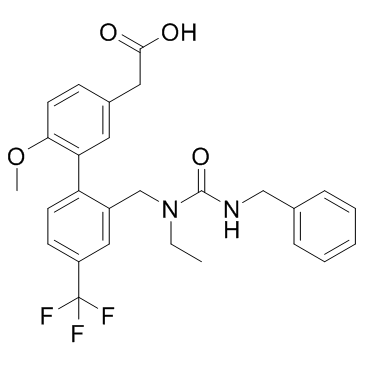
AM211 (AM211 free acid) (Synonyms: AM211 free acid) |
Catalog No.GC31718
 One-Click Copy Product Info
|

AM211 (Ácido libre de AM211) es un antagonista potente, selectivo y biodisponible por vÍa oral del receptor de prostaglandina D2 (PGD2) tipo 2 (DP2), con IC50 de 4,9 nM, 7,8 nM, 4,9 nM, 10,4 nM para humanos, ratones, cobayas y rata DP2, respectivamente.
Products are for research use only. Not for human use. We do not sell to patients.
Cas No.: 1175526-27-8
Sample solution is provided at 25 µL, 10mM.
_1-3.$$$39978408@51.jpg');)
_1-9.$$$38538795@65.jpg');)
_1-9.$$$39112701@51.jpg');)
_1-7.$$$37316672@70.jpg');)
_366-372.$$$36198801@70.jpg');)
.$$$38565142@65.jpg');)
_1867-1883.$$$33248023@67.jpg');)
_eads6055.$$$39977546@45.jpg');)
_eadm9805.$$$40080571@45.jpg');)
_eadj3020.$$$39666821@45.jpg');)
_1-20.$$$39757301@28.jpg');)
_1-24.$$$38898113@28.jpg');)
_273-287.$$$36806353@46.jpg');)
_1-16.$$$37156877@44.jpg');)
_1-19.$$$37460805@44.jpg');)
_1291-1307.$$$34518654@46.jpg');)
AM211 is a potent, selective and orally bioavailable prostaglandin D2 (PGD2) receptor type 2 (DP2) antagonist, with IC50s of 4.9 nM, 7.8 nM, 4.9 nM, 10.4 nM for human, mouse, guinea pig, and rat DP2, respectively.
AM211 is a potent, selective and orally bioavailable prostaglandin D2 (PGD2) receptor type 2 (DP2) antagonist, with IC50s of 4.9 nM, 7.8 nM, 4.9 nM, 10.4 nM for human, mouse, guinea pig, and rat DP2, respectively. In the presence of 0.2% serum albumin, AM211 inhibits radiolabeled PGD2 binding to human, mouse, guinea pig, and rat DP2 with IC50 values of 12.2, 20.1, 22.9, and 34.2 nM, respectively. AM211 displays high selectivity for DP2 versus other receptors in the prostanoid family, with IC50 values for the inhibition of radioligand binding to human TP, IP, DP1, and FP of more than 100 μM. AM211 (100 μM) shows no activity at COX-1, COX-2 enzymes as well as PPAR family of nuclear receptors[1].
AM211 (1, 10, and 30 mg/kg, p.o.) dose-dependently decreases in the number of DK-PGD2-induced peripheral blood leukocytes, with a calculated ED50 of 0.85 mg/kg. AM211 (30 mg/kg) also decreases antigen-induced pulmonary inflammation in guinea pigs. AM211 (10 mg/kg, p.o.) causes significant decrease in ovalbumin (OVA)-induced sneezing in a mouse model of allergic rhinitis[1].
[1]. Bain G, et al. Pharmacology of AM211, a potent and selective prostaglandin D2 receptor type 2 antagonist that is active in animal models of allergic inflammation. J Pharmacol Exp Ther. 2011 Jul;338(1):290-301.
Animal experiment: | Mice[1]In brief, mice are immunized by an intraperitoneal injection of 10 μg of ovalbumin (OVA) complexed with Imject Alum in a volume of 0.2 mL on days 1 and 8. Seven days later (day 15) mice are challenged intranasally with 20 μL of a 10 mg/mL solution of OVA. The challenge period occurs daily from days 15 to 19. Mice (seven/group) are randomLy assigned to receive either compound (AM211, 10 mg/kg) or vehicle (methyl cellulose, 10 mL/kg) and treated by oral gavage 1 h before each OVA challenge. The number of sneezes are counted for 8 min immediately after the OVA challenge on days 15, 17, and 19 by an independent observer who is blinded to the treatment groups[1]. |
References: [1]. Bain G, et al. Pharmacology of AM211, a potent and selective prostaglandin D2 receptor type 2 antagonist that is active in animal models of allergic inflammation. J Pharmacol Exp Ther. 2011 Jul;338(1):290-301. | |
| Cas No. | 1175526-27-8 | SDF | |
| Sinónimos | AM211 free acid | ||
| Canonical SMILES | O=C(O)CC1=CC(C2=CC=C(C(F)(F)F)C=C2CN(CC)C(NCC3=CC=CC=C3)=O)=C(OC)C=C1 | ||
| Formula | C27H27F3N2O4 | M.Wt | 500.51 |
| Solubility | DMSO : ≥ 125 mg/mL (249.75 mM);Water : < 0.1 mg/mL (insoluble) | Storage | Store at -20°C |
| General tips | Please select the appropriate solvent to prepare the stock solution according to the
solubility of the product in different solvents; once the solution is prepared, please store it in
separate packages to avoid product failure caused by repeated freezing and thawing.Storage method
and period of the stock solution: When stored at -80°C, please use it within 6 months; when stored
at -20°C, please use it within 1 month. To increase solubility, heat the tube to 37°C and then oscillate in an ultrasonic bath for some time. |
||
| Shipping Condition | Evaluation sample solution: shipped with blue ice. All other sizes available: with RT, or with Blue Ice upon request. | ||
| Prepare stock solution | |||

|
1 mg | 5 mg | 10 mg |
| 1 mM | 1.998 mL | 9.9898 mL | 19.9796 mL |
| 5 mM | 399.6 μL | 1.998 mL | 3.9959 mL |
| 10 mM | 199.8 μL | 999 μL | 1.998 mL |
Step 1: Enter information below (Recommended: An additional animal making an allowance for loss during the experiment)
 g
μL
g
μL
Step 2: Enter the in vivo formulation (This is only the calculator, not formulation. Please contact us first if there is no in vivo formulation at the solubility Section.)
Calculation results:
Working concentration: mg/ml;
Method for preparing DMSO master liquid: mg drug pre-dissolved in μL DMSO ( Master liquid concentration mg/mL, Please contact us first if the concentration exceeds the DMSO solubility of the batch of drug. )
Method for preparing in vivo formulation: Take μL DMSO master liquid, next addμL PEG300, mix and clarify, next addμL Tween 80, mix and clarify, next add μL saline, mix and clarify.
Method for preparing in vivo formulation: Take μL DMSO master liquid, next add μL Corn oil, mix and clarify.
Note: 1. Please make sure the liquid is clear before adding the next solvent.
2. Be sure to add the solvent(s) in order. You must ensure that the solution obtained, in the previous addition, is a clear solution before proceeding to add the next solvent. Physical methods such as vortex, ultrasound or hot water bath can be used to aid dissolving.
3. All of the above co-solvents are available for purchase on the GlpBio website.
Quality Control & SDS
- View current batch:
- Purity: >98.00% Appearance: A solid
- COA (Certificate of Analysis)
- SDS (Safety Data Sheet)
- Datasheet
Average Rating: 5 (Based on Reviews and 35 reference(s) in Google Scholar.)