

BAPTA-AM (Synonyms: BAPTA Acetoxymethyl ester) |
Catalog No.GC13517
 One-Click Copy Product Info
|

BAPTA-AM es un quelante de iones de calcio que atraviesa la membrana celular. Este compuesto inhibe directamente los canales de potasio dependientes de los voltajes hKv1.5, hERG y hKv1.3, con valores de IC50=1.3, 1.45, 1.23µM.
Products are for research use only. Not for human use. We do not sell to patients.
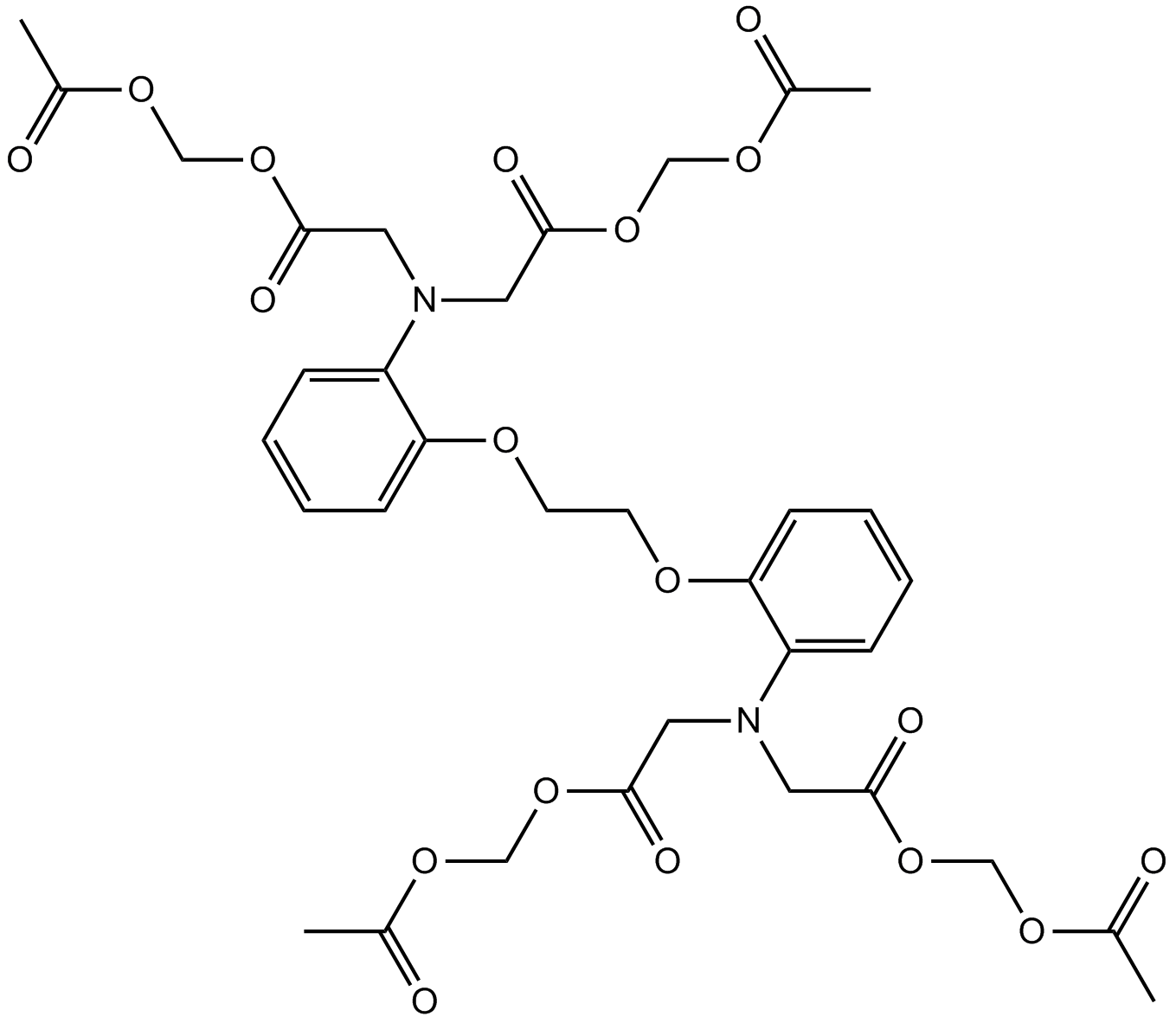
Cas No.: 126150-97-8
Sample solution is provided at 25 µL, 10mM.
BAPTA-AM es un quelante de iones de calcio que atraviesa la membrana celular. Este compuesto inhibe directamente los canales de potasio dependientes de los voltajes hKv1.5, hERG y hKv1.3, con valores de IC50=1.3, 1.45, 1.23µM. Por cierto, BAPTA-AM quela de forma selectiva el Ca²⁺ libre intracelular. Sirve para contrarrestar el daño celular derivado de la sobrecarga cálcica. También disminuye las especies reactivas de oxígeno dentro de la célula. Impide el colapso del potencial de membrana mitocondrial y la liberación de citocromo C. Además, atenúa la activación de las Caspase-8/9. Protege a las neuronas frente a lesiones isquémicas. En resumen, se emplea en investigaciones sobre excitotocidad, daño cerebral isquémico, apoptosis, señalización cálcica, arritmias y regulación de la función de células inmunes[1-4].
IEn ensayos in vitro, al incubar células HeLa y SH-SY5Y durante 24 horas con 10-50µM BAPTA-AM y 20µM Aβ42, se bloqueó la muerte celular provocada por Aβ42. Se redujo el aumento de actividad de las caspase-3, -6, -8, -9, así como la elevación de la actividad de catepsina L y sus niveles en el citosol[5]. Por otro lado, cuando las células SH-SY5Y se trataron 24-48 horas con 10µM-30µM BAPTA-AM y 3µM MG132, se frenó la producción de anión superóxido inducida por MG132 y se redujo la proporción de células apoptóticas[6]. En condrocitos de ratón, la exposición de 6-24 horas a 10µM BAPTA-AM más citrato férrico amónico 100µM bajó la concentración de hierro intracelular, suprimió la generación de ROS inducida por este compuesto y evitó el colapso del potencial de membrana mitocondrial[7].
En estudios in vivo, ratones C57BL/6 recibieron inyección intraperitoneal de 2.5mg/kg BAPTA-AM 0.5 horas antes de la ventilación mecánica con volumen trial elevado (20mL/kg). Gracias a esto, se evitó la sobrecarga cálcica citosólica provocada por el alto volumen de marea. Mejoró el engrosamiento del tabique alveolar y el edema pulmonar, y se redujo la relación peso húmedo-seco pulmonar, los niveles de proteína en el líquido de lavado broncoalveolar y la infiltración de célulasd inflamatorias[8]. Una semana después de la cirugía de desestabilización del menisco medial (DMM), los ratones C57BL/6J recibieron inyección intraarticular en la rodilla derecha de 1.5µg/kg-15µg/kg BAPTA-AM, una vez por semana durante 8 semanas consecutivas. El fármaco mitigó la degeneración del cartílago, y disminuyó la formación de osteofitos y la gravedad de la sinovitis[9]. En ratones Suizos, se administró por vía intraperitoneal 2.5-10mg/kg BAPTA-AM 30 minutos antes de inyectar etanol 2.5g/kg por la misma vía. El tratamiento bloqueó la estimulación locomotora inducida por el etanol[10].
| Experimento celular [1]: | |
|
Líneas celulares |
Células SH-SY5Y (línea celular de neuroblastoma humano) |
|
Método de preparación |
Las células SH-SY5Y se cultivaron en un medio RPMI-1640 con 10% FCS, 100μg/mL streptomycin, 100IU/mL penicillin, 1μg/mL de fungizona a 37°C, 5% de CO2. Las células fueron tratadas con 10μM o 30μM BAPTA-AM durante 24h o 48h junto con 3μM MG132. Después del tratamiento, se detectó un anión superóxido intracelular mediante tinción DHE, apoptosis mediante el recuento de morfología nuclear Hoechst33342 y la afectación de NOX5 se sondeó mediante RT-PCR/Western blot junto con BAPTA-AM cohorts. |
|
Condiciones de reacción |
10μM o 30μM; 24h o 48h |
|
Aplicaciones |
BAPTA-AM redujo el número de células SH-SY5Y positivas para DHE inducidas por MG132. BAPTA-AM redujo el número de células SH-SY5Y apoptóticas positivas de Hoechst33342 inducidas por MG132. BAPTA-AM suprimió la generación de aniones superóxido inducida por MG132 a través de la inhibición de NOX5 mediada por quelación de calcio en células SH-SY5Y. |
| Experimento animal [2]: | |
|
Modelos animales |
Ratones machos de tipo salvaje C57BL/6J de 8 semanas de edad sometidos a una cirugía de desestabilización del menisco medial (DMM) |
|
Método de preparación |
Una semana después de la cirugía DMM, los ratones recibieron una inyección intraarticualr de vehículo de 10μL o 10μL de BAPTA-AM (1.5μg/kg o 15μg/kg) en la articulación de la rodilla derecha una vez por semana durante 8 semanas consecutivas. Las articulaciones de la rodilla se recogieron después de 8 semanas para la tinción Safranin O/Fast green y H&E, immunohistochemistry, micro-CT y H&E synovitis scoring. |
|
Forma farmacéutica |
1.5μg/kg o 15μg/kg; inyección intraarticular; una vez a la semana durante 8 semanas |
|
Aplicaciones |
Degeneración del cartílago atenuada por BAPTA-AM (puntuación OARSI más baja, mayor grosor del cartílago). BAPTA-AM redujo los marcadores de catabolismo MMP13 y ADAMTS5 en el cartílago articular. BAPTA-AM redujo los marcadores inflamatorios COX2 e iNOS en el cartílago articular. BAPTA-AM aumentó los marcadores de anabolismo COL2A1 y Aggrecan en el cartílago articular. BAPTA-AM redujo el tamaño de la formación de osteofitos. BAPTA-AM redujo la puntuación de gravedad de la sinovitis. |
| Cas No. | 126150-97-8 | SDF | |
| Sinónimos | BAPTA Acetoxymethyl ester | ||
| Canonical SMILES | O=C(CN(CC(OCOC(C)=O)=O)C1=CC=CC=C1OCCOC2=CC=CC=C2N(CC(OCOC(C)=O)=O)CC(OCOC(C)=O)=O)OCOC(C)=O | ||
| Formula | C34H40N2O18 | M.Wt | 764.68 |
| Solubility | ≥ 16.3mg/mL in DMSO with gentle warming | Storage | Desiccate at -20°C |
| Shipping Condition | Evaluation sample solution: shipped with blue ice. All other sizes available: with RT, or with Blue Ice upon request. | ||
| Prepare stock solution | |||

|
1 mg | 5 mg | 10 mg |
| 1 mM | 1.3077 mL | 6.5387 mL | 13.0774 mL |
| 5 mM | 261.5 μL | 1.3077 mL | 2.6155 mL |
| 10 mM | 130.8 μL | 653.9 μL | 1.3077 mL |
Step 1: Enter information below (Recommended: An additional animal making an allowance for loss during the experiment)
 g
μL
g
μL
Step 2: Enter the in vivo formulation (This is only the calculator, not formulation. Please contact us first if there is no in vivo formulation at the solubility Section.)
Calculation results:
Working concentration: mg/ml;
Method for preparing DMSO master liquid: mg drug pre-dissolved in μL DMSO ( Master liquid concentration mg/mL, Please contact us first if the concentration exceeds the DMSO solubility of the batch of drug. )
Method for preparing in vivo formulation: Take μL DMSO master liquid, next addμL PEG300, mix and clarify, next addμL Tween 80, mix and clarify, next add μL saline, mix and clarify.
Method for preparing in vivo formulation: Take μL DMSO master liquid, next add μL Corn oil, mix and clarify.
Note: 1. Please make sure the liquid is clear before adding the next solvent.
2. Be sure to add the solvent(s) in order. You must ensure that the solution obtained, in the previous addition, is a clear solution before proceeding to add the next solvent. Physical methods such as vortex, ultrasound or hot water bath can be used to aid dissolving.
3. All of the above co-solvents are available for purchase on the GlpBio website.
Quality Control & SDS
- View current batch:
- Purity: >99.00% Appearance: A solid
- COA (Certificate of Analysis)
- SDS (Safety Data Sheet)
- Datasheet
-
Related Biological Data

Excessive intracellular Ca2+ concentration activates calpain to degrade the microtubule of N2a cells.(D) SK-N-SH cells were transfected with Vector or CVS-M-FLAG for 36 h or transfected with CVS-M-FLAG for 12 h and treated with BAPTA-AM (25 µM) for 24 h; lysates were analyzed by WB.
N2a cells were transfected with Vector or CVS-M-FLAG for 12 h; then, cells were treated with DMSO, EGTA-AM, BAPTA-AM (Glpbio) (25 µM), Calpain inhibitor III, or Z-VAD-FMK for 24 h; lysates were analyzed by WB.
Mbio (2024). PMID: 38349129 IF: 6.3996 -
Related Biological Data

Different dihydropyridine-derived calcium channel blockers inhibit HTNV infection. (C) Huh7 cells were infected with HTNV upon treatment with BAPTA-AM, 24 hpi.
The calcium chelator BAPTA-AM was purchased from GlpBio (Montclair, CA, United States).
Front Pharmacol 13 (2022): 940178. PMID: 36105208 IF: 5.6 -
Related Biological Data

The PLC/IP3R/STIM-dependent Ca2+ channel inhibitors attenuate histone-induced apoptosis and defective bacterial phagocytosis in macrophages. A–D The percentage of apoptotic cells was quantified by Annexin V-FITC/PI staining.
To explore the effect of BAPTA-AM on histone-induced macrophage damage in CLP mice, mice were pretreated intraperitoneally with BAPTA-AM (GlpBio) (7.5 mg/kg) for 30 min and then subjected to CLP, followed by intravenous injection of histones (20 mg/kg).
Int Immunopharmacol 132 (2024): 111870. PMID: 38547771 IF: 5.5999 -
Related Biological Data

Isoflurance preconditioning was involved in intracellular Ca2+ of liver macrophages. C. The activation of NF-KB in KCs was examined by laser scanning confocal microscope (600×).
BAPTA-AM (GLPBIO, USA), a selective calcium chelator, was used to inhibit intracellular Ca2+.
Int Immunopharmacol 99 (2021): 107977. PMID: 34332342 IF: 4.93 -
Related Biological Data

The effects of BAPTA-AM on the IP3R-MCU calcium regulation axis in GC-1 spg cells.GC-1 spg cells were pretreated with BAPTA-AM before CdCl2 exposure. The mRNA expression levels in GC-1 spg cells were detected by RT-PCR.
However, BAPTA-AM (GlpBio) (10μM or 15μM) significantly increased the viability of the GC-1spg cells inhibited by CdCl2.
Toxicology (2023): 153448. PMID: 36731763 IF: 4.571 -
Related Biological Data

Activation of Piezo1 promoted chondrocytes senescence through Ca2+ accumulation. A and B. Representative fluorescence imaging of intracellular Ca2+, ROS and mean fluorescence intensity of chondrocytes after Yoda1 or BAPTA-AM treatment.
When primary chondrocytes proliferated to 80% density, they were intervened with 5 mM Yoda1 with or without 10 mM BAPTA-AM (GLPBio, GC13517) for 24 h, as in the previous study.
Biochem Bioph Res Co (2022). PMID: 35367826 IF: 3.5753
Average Rating: 5 (Based on Reviews and 20 reference(s) in Google Scholar.)