

CA77.1 |
Catalog No.GC62881
 One-Click Copy Product Info
|

CA77.1 es un derivado de molécula pequeña oralmente activo de 7-chloro-3-(p-tolyl)-2H-benzo[b]oxazine (AR7) y puede actuar como activador de la autofagia mediada por chaperona (CMA)
Products are for research use only. Not for human use. We do not sell to patients.
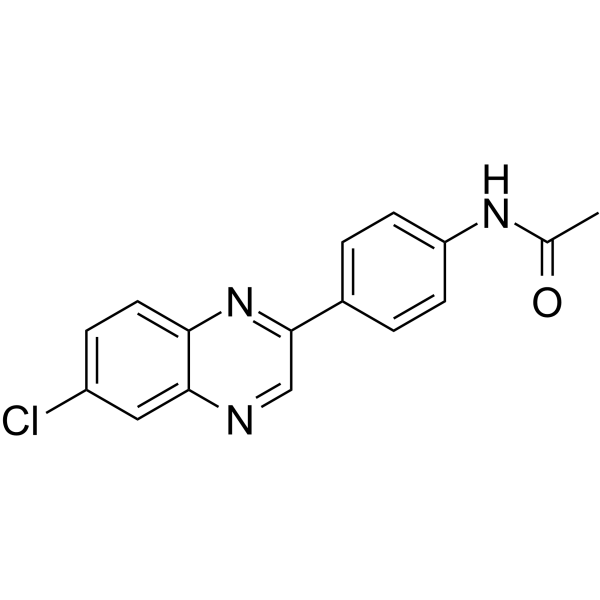
Cas No.: 2412270-22-3
Sample solution is provided at 25 µL, 10mM.
_1-3.$$$39978408@51.jpg');)
_1-9.$$$38538795@65.jpg');)
_1-9.$$$39112701@51.jpg');)
_1-7.$$$37316672@70.jpg');)
_366-372.$$$36198801@70.jpg');)
.$$$38565142@65.jpg');)
_1867-1883.$$$33248023@67.jpg');)
_eads6055.$$$39977546@45.jpg');)
_eadm9805.$$$40080571@45.jpg');)
_eadj3020.$$$39666821@45.jpg');)
_1-20.$$$39757301@28.jpg');)
_1-24.$$$38898113@28.jpg');)
_273-287.$$$36806353@46.jpg');)
_1-16.$$$37156877@44.jpg');)
_1-19.$$$37460805@44.jpg');)
_1291-1307.$$$34518654@46.jpg');)
CA77.1 es un derivado de molécula pequeña oralmente activo de 7-chloro-3-(p-tolyl)-2H-benzo[b][1,4]oxazine (AR7) y puede actuar como activador de la autofagia mediada por chaperona (CMA)[1]. CA77.1 ejerce efectos neuroprotectores y se está desarrollando para el tratamiento de varias enfermedades crónicas del CNS, incluida la enfermedad de Alzheimer, la enfermedad de Parkinson y la degeneración retiniana[2].
In vitro, CA77.1 (12μM) pretrató las células BV2 microgliales murinas durante 12h seguidas de tratamiento con LPS. CA77.1 disminuyó la expresión de iNOS y COX-2 inducida por LPS, redujo los factores proinflamatorios NO e IL-6 y redujo la expresión de mRNA de iNOS, COX-2, IL-6 e IL-1β sin afectar la viabilidad celular[3]. El tratamiento de CA77.1 (20µM) en células de neuroblasto Neuro-2a (N2a) de ratón durante 24h promovió la degradación de GAPDH (un sustrato canónico de CMA) y aumentó la eliminación de subunidades de Na+ /K+ -ATPase β1, acompañado de una disminución de la actividad de Na+ /K+ -ATPase y un aumento de la concentración de Na+ intracelular, sin cambios en los niveles de mRNA[4]. El tratamiento CA77.1 (0-30μM) en células renales porcinas PK-15 que expresan la proteína no estructural 3D del virus de la enfermedad de la fiebre aftosa (FMDV) durante 24h disminuyó efectivamente los niveles de polimerasa 3D de FMDV y suprime la replicación de FMDV a través de la activación de la vía de la CMA[5].
In vivo, CA77.1 (10mg/kg/día) se inyectó intraperitonealmente en modelos de ratones de hemorragia intracerebral (ICH) durante seis días consecutivos. La administración de CA77.1 revirtió el aumento inducido por la ICH de los astrocitos reactivos A1, el daño de la mielina, la muerte neuronal y los trastornos neuroconductuales [6]. CA77.1 (10mg/kg) se administró por vía intraperitoneal en ratones expuestos a la toxina mitocondrial BDE-47 con deterioro cognitivo cada tres días durante 4 semanas. CA77.1 mitigó el deterioro cognitivo inducido por BDE-47 en ratones al suprimir la ferroptosis, prevenir la pérdida sináptica en los hipocampos de ratones y rescatar la atrofia estructural neuronal del hipocampo[7].
References:
[1] Bourdenx M, Martín-Segura A, Scrivo A, et al. Chaperone-mediated autophagy prevents collapse of the neuronal metastable proteome.Cell. 2021 May 13;184(10):2696-2714.e25.
[2] Wu J, Xu W, Su Y, et al. Targeting chaperone-mediated autophagy in neurodegenerative diseases: mechanisms and therapeutic potential.Acta Pharmacol Sin. 2025 Apr;46(4):816-828.
[3] Wu J, Han Y Y, Xu H, et al. Deficient chaperone-mediated autophagy facilitates LPS-induced microglial activation via regulation of the p300/NF-κB/NLRP3 pathway. Sci Adv. 2023 Oct 6;9(40):eadi8343.
[4] Zhang Y X, Wu H H, Zhang Q, et al. LAMP2A-mediated neuronal hyperexcitability by enhancing NKAβ1 degradation underlies depression-induced allodynia. Cell Rep. 2025 Apr 22;44(4):115489.
[5] Ren M, Zhou H Q, Wu J E, et al. Heat shock protein A1 inhibits the replication of foot-and-mouth disease virus by degrading viral RNA polymerase 3D through chaperone-mediated autophagy. J Virol. 2025 May 20;99(5):e0016825.
[6] Zheng Y, Peng L, Jiang G N, et al. Activation of chaperone-mediated autophagy exerting neuroprotection effect on intracerebral hemorrhage-induced neuronal injury by targeting Lamp2a. Exp Neurol. 2024 Dec:382:114986.
[7] Yuan Q, Wang M W, Zhang Z X, et al. The ameliorative effects of melatonin against BDE-47-induced hippocampal neuronal ferroptosis and cognitive dysfunction through Nrf2-Chaperone-mediated autophagy of ACSL4 degradation. Ecotoxicol Environ Saf. 2025 Jan 15:290:117542.
| Experimentos celulares [1]: | |
Líneas celulares | Células BV2 microgliales murinas |
Método de preparación | Las células BV2 fueron pretratadas con 12μM CA77.1 durante 12h y luego expuestas a LPS durante 10min. |
Condiciones de reacción | 12 μM; 12h |
Áreas de aplicación | CA77.1 disminuyó la expresión inducida por LPS de las proteínas iNOS y COX-2, redujo los factores proinflamatorios NO e IL-6 y redujo la expresión de ARNm de iNOS, COX-2, IL-6 e IL-1β sin afectar la viabilidad celular. |
| Experimentos con animales [2]: | |
Modelos animales | Ratones macho C57BL/6 |
Método de preparación | Los ratones se dividieron aleatoriamente en los siguientes grupos: grupo de control, grupo 2,2',4,4'-éter tetrabromodifenilo (BDE-47), grupo BDE-47 + CA77.1. Los ratones del grupo BDE-47 recibieron por vía oral de 20 mg/kg/día BDE-47 y también se inyectaron por vía intraperitoneal con solución salina normal que contenía un 2 % de DMSO durante 8 semanas. Los ratones del grupo BDE-47 + CA77.1 recibieron una inyección intraperitoneal de 10 mg/kg de CA77.1 cada tres días durante las últimas 4 semanas antes de la administración de 20 mg/kg/día de BDE-47. |
Forma de dosificación | 10 mg/kg; i.p.; cada 3 días durante las últimas 4 semanas |
Áreas de aplicación | CA77.1 mitigó el deterioro cognitivo inducido por BDE-47 en ratones al suprimir la ferroptosis, prevenir la pérdida sináptica en los hipocampos de ratones y rescatar la atrofia estructural neuronal del hipocampo. |
References: | |
| Cas No. | 2412270-22-3 | SDF | |
| Formula | C16H12ClN3O | M.Wt | 297.74 |
| Solubility | DMSO : 5 mg/mL (16.79 mM; ultrasonic and warming and heat to 60°C)|Ethanol : < 1 mg/mL (ultrasonic;warming;heat to 60°C) (insoluble) | Storage | 4°C, protect from light |
| General tips | Please select the appropriate solvent to prepare the stock solution according to the
solubility of the product in different solvents; once the solution is prepared, please store it in
separate packages to avoid product failure caused by repeated freezing and thawing.Storage method
and period of the stock solution: When stored at -80°C, please use it within 6 months; when stored
at -20°C, please use it within 1 month. To increase solubility, heat the tube to 37°C and then oscillate in an ultrasonic bath for some time. |
||
| Shipping Condition | Evaluation sample solution: shipped with blue ice. All other sizes available: with RT, or with Blue Ice upon request. | ||
| Prepare stock solution | |||

|
1 mg | 5 mg | 10 mg |
| 1 mM | 3.3586 mL | 16.7932 mL | 33.5864 mL |
| 5 mM | 671.7 μL | 3.3586 mL | 6.7173 mL |
| 10 mM | 335.9 μL | 1.6793 mL | 3.3586 mL |
Step 1: Enter information below (Recommended: An additional animal making an allowance for loss during the experiment)
 g
μL
g
μL
Step 2: Enter the in vivo formulation (This is only the calculator, not formulation. Please contact us first if there is no in vivo formulation at the solubility Section.)
Calculation results:
Working concentration: mg/ml;
Method for preparing DMSO master liquid: mg drug pre-dissolved in μL DMSO ( Master liquid concentration mg/mL, Please contact us first if the concentration exceeds the DMSO solubility of the batch of drug. )
Method for preparing in vivo formulation: Take μL DMSO master liquid, next addμL PEG300, mix and clarify, next addμL Tween 80, mix and clarify, next add μL saline, mix and clarify.
Method for preparing in vivo formulation: Take μL DMSO master liquid, next add μL Corn oil, mix and clarify.
Note: 1. Please make sure the liquid is clear before adding the next solvent.
2. Be sure to add the solvent(s) in order. You must ensure that the solution obtained, in the previous addition, is a clear solution before proceeding to add the next solvent. Physical methods such as vortex, ultrasound or hot water bath can be used to aid dissolving.
3. All of the above co-solvents are available for purchase on the GlpBio website.
Quality Control & SDS
- View current batch:
- Purity: >99.00% Appearance: A solid
- COA (Certificate of Analysis)
- SDS (Safety Data Sheet)
- Datasheet
Average Rating: 5 (Based on Reviews and 31 reference(s) in Google Scholar.)