
CU CPT 4a (Synonyms: TLR3-IN-1) |
| Catalog No.GC11461 |
CU CPT 4a (TLR3-IN-1) es un potente inhibidor de señalización de TLR3 altamente selectivo. CU CPT 4a reprime la expresión de vías de señalización posteriores mediadas por el complejo TLR3/dsRNA, incluidos TNF-α e IL-1β.
Products are for research use only. Not for human use. We do not sell to patients.
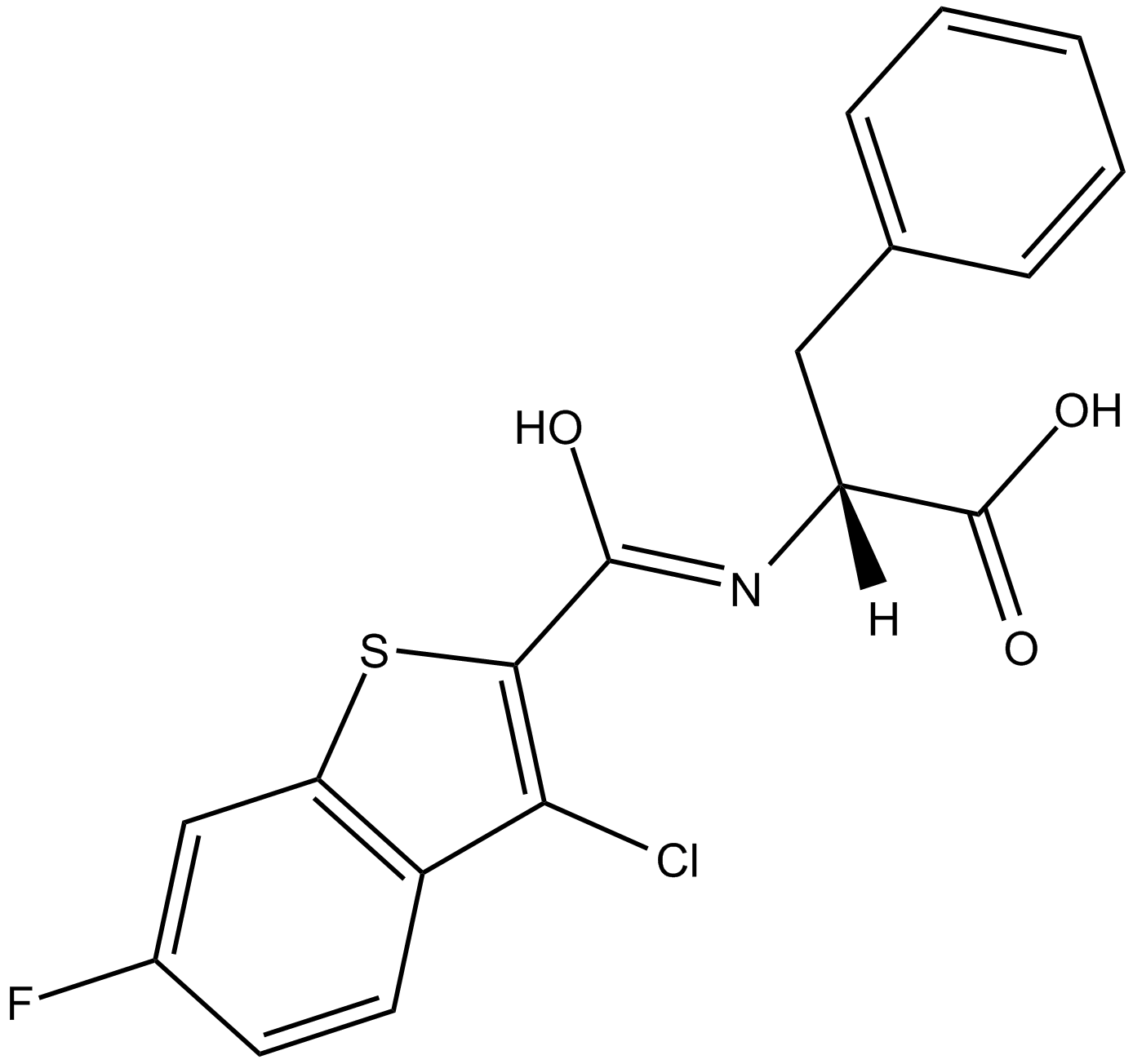
Cas No.: 1279713-77-7
Sample solution is provided at 25 µL, 10mM.
CU CPT 4a is a potent inhibitor of toll-like receptor 3 (TLR3), with an IC50 value of 3.44μM [1]. CU CPT 4a suppresses the downstream signaling pathways mediated by TLR3/dsRNA complex, resulting in inhibition of interferons and pro-inflammatory cytokines (TNF-α, IL-1β, and IL-6) production[2]. CU CPT 4a has been widely used to regulate TLR3-mediated inflammation in animal models[3].
In vitro, CU CPT 4a pretreatment at 40μM for 1 hour significantly inhibited invasion of KKU213 cells induced by 2.5μg/ml Poly(I:C) (12h)[4]. CU CPT 4a treatment at 20µM for 1h significantly inhibited Tributyltin (TBT) (25nM)-induced IL-1β and IL-6 production in human peripheral blood mononuclear cells (PBMCs) [5]. CU CPT 4a treatment (10µM) for 24h abolished the stimulatory effect of histamine on TBK1/IRF3 signaling in SARS-CoV-2-infected Caco2 cells[6]. Treatment with 40μM CU CPT 4a for 24 hours reduced Caspase-3/7 activation without attenuating LPS-stimulated apoptosis in mouse cardiomyocytes[7].
In vivo, CU CPT 4a treatment via intraperitoneally injection (30μg/10μl; three times within 5 days) significantly caused delayed development and decreased intensity of clinical signs and pathological lesions, low viral load, significantly reduced Negri bodies (NBs) formation, and increased survival time in SRABV-infected mice[8].
References:
[1] Wang Y, Zhang S, Li H, et al. Small-molecule modulators of toll-like receptors[J]. Accounts of chemical research, 2020, 53(5): 1046-1055.
[2] Cheng K, Wang X, Yin H. Small-molecule inhibitors of the TLR3/dsRNA complex[J]. Journal of the American Chemical Society, 2011, 133(11): 3764-3767.
[3] Takemura N, Kawasaki T, Kunisawa J, et al. Blockade of TLR3 protects mice from lethal radiation-induced gastrointestinal syndrome[J]. Nature communications, 2014, 5(1): 3492.
[4] Lomphithak T, Choksi S, Mutirangura A, et al. Receptor-interacting protein kinase 1 is a key mediator in TLR3 ligand and Smac mimetic-induced cell death and suppresses TLR3 ligand-promoted invasion in cholangiocarcinoma[J]. Cell Communication and Signaling, 2020, 18(1): 161.
[5] Alcala A, Osborne B, Allen B, et al. Toll-like receptors in the mechanism of tributyltin-induced production of pro-inflammatory cytokines, IL-1β and IL-6[J]. Toxicology, 2022, 472: 153177.
[6] Mukherjee R, Bhattacharya A, Bojkova D, et al. Famotidine inhibits toll-like receptor 3-mediated inflammatory signaling in SARS-CoV-2 infection[J]. Journal of Biological Chemistry, 2021, 297(2).
[7] Neu C, Thiele Y, Horr F, et al. DAMPs released from proinflammatory macrophages induce inflammation in cardiomyocytes via activation of TLR4 and TNFR[J]. International journal of molecular sciences, 2022, 23(24): 15522.
[8] Sardana S, Singh K P, Saminathan M, et al. Effect of inhibition of Toll-like receptor 3 signaling on pathogenesis of rabies virus in mouse model[J]. Acta Tropica, 2022, 234: 106589.
| Cell experiment [1]: | |
Cell lines | Peripheral blood mononuclear cells (PBMCs) |
Preparation Method | PBMCs (at a concentration of 4×10⁶ cells/0.67ml) were treated with CU CPT 4a (20μM) or the appropriate DMSO control for 1h and then exposed to TBT (25nM) for 24h. The cells were precipitated, the supernatant was collected, and the secretion of IL-1β or IL-6 in the supernatant was measured by enzyme-linked immunosorbent assay (ELISA). Cell precipitates were treated with lysis buffer and incubated on ice for 20min with vortexing every 5min. After a 20-min incubation period, lysates were centrifuged at 10,000rpm for 10min at 4°C in a microcentrifuge. The resulting lysates were collected to assess intracellular levels of IL-1β and IL-6 by Western blotting. |
Reaction Conditions | 20μM; 1h |
Applications | CU CPT 4a treatment reduced TBT-induced IL-1β and IL-6 production in PBMCs. |
| Animal experiment [2]: | |
Animal models | Young Swiss albino mice |
Preparation Method | Young Swiss albino mice, aged 2-3 weeks, were housed under controlled sterile environmental conditions. Mice were divided into three groups. Group I (SRABV + DMSO, n = 25) mice were intraperitoneally injected with 20μl of 100 LD50 SRABV with a 33-gauge needle on day 0 and simulated treatment with three intraperitoneal injections of 10μl DMSO within 5 days of infection. Group II (SRABV+CU CPT 4a, n = 25) mice were intraperitoneally injected with 20μl of 100 LD50 SRABV on day 0, and 10μl CU CPT 4a (30μg, dissolved in DMSO) was intraperitoneally injected three times within 5 days of infection. Group III (CU CPT 4a+DMSO, n = 21) mice received three injections of 30μl CU CPT 4a (30μg dissolved in DMSO) within 5 days of infection. Tissues were collected for analysis 15 days after infection. |
Dosage form | 30μg/10μl; three times within 5 days; i.p. |
Applications | CU CPT 4a treatment significantly inhibited TLR3 expression, resulting in delayed development and decreased intensity of clinical signs and pathological lesions, low viral load, significantly reduced NBs formation, and increased survival time in SRABV-infected mice. |
References: | |
| Cas No. | 1279713-77-7 | SDF | |
| Sinónimos | TLR3-IN-1 | ||
| Chemical Name | (R,Z)-2-(((3-chloro-6-fluorobenzo[b]thiophen-2-yl)(hydroxy)methylene)amino)-3-phenylpropanoic acid | ||
| Canonical SMILES | ClC(C1=C(S2)C=C(F)C=C1)=C2/C(O)=N/[C@](C(O)=O)([H])CC3=CC=CC=C3 | ||
| Formula | C18H13ClFNO3S | M.Wt | 377.82 |
| Solubility | <37.78mg/ml in DMSO | Storage | Store at 4°C |
| General tips | Please select the appropriate solvent to prepare the stock solution according to the
solubility of the product in different solvents; once the solution is prepared, please store it in
separate packages to avoid product failure caused by repeated freezing and thawing.Storage method
and period of the stock solution: When stored at -80°C, please use it within 6 months; when stored
at -20°C, please use it within 1 month. To increase solubility, heat the tube to 37°C and then oscillate in an ultrasonic bath for some time. |
||
| Shipping Condition | Evaluation sample solution: shipped with blue ice. All other sizes available: with RT, or with Blue Ice upon request. | ||
| Prepare stock solution | |||
|
1 mg | 5 mg | 10 mg |
| 1 mM | 2.6468 mL | 13.2338 mL | 26.4676 mL |
| 5 mM | 529.4 μL | 2.6468 mL | 5.2935 mL |
| 10 mM | 264.7 μL | 1.3234 mL | 2.6468 mL |
Step 1: Enter information below (Recommended: An additional animal making an allowance for loss during the experiment)
Step 2: Enter the in vivo formulation (This is only the calculator, not formulation. Please contact us first if there is no in vivo formulation at the solubility Section.)
Calculation results:
Working concentration: mg/ml;
Method for preparing DMSO master liquid: mg drug pre-dissolved in μL DMSO ( Master liquid concentration mg/mL, Please contact us first if the concentration exceeds the DMSO solubility of the batch of drug. )
Method for preparing in vivo formulation: Take μL DMSO master liquid, next addμL PEG300, mix and clarify, next addμL Tween 80, mix and clarify, next add μL ddH2O, mix and clarify.
Method for preparing in vivo formulation: Take μL DMSO master liquid, next add μL Corn oil, mix and clarify.
Note: 1. Please make sure the liquid is clear before adding the next solvent.
2. Be sure to add the solvent(s) in order. You must ensure that the solution obtained, in the previous addition, is a clear solution before proceeding to add the next solvent. Physical methods such as vortex, ultrasound or hot water bath can be used to aid dissolving.
3. All of the above co-solvents are available for purchase on the GlpBio website.
Quality Control & SDS
- View current batch:
- Purity: >98.00%
- COA (Certificate Of Analysis)
- SDS (Safety Data Sheet)
- Datasheet
Average Rating: 5 (Based on Reviews and 28 reference(s) in Google Scholar.)
GLPBIO products are for RESEARCH USE ONLY. Please make sure your review or question is research based.
Required fields are marked with *


