

SX-682 |
Catalog No.GC38204
 One-Click Copy Product Info
|

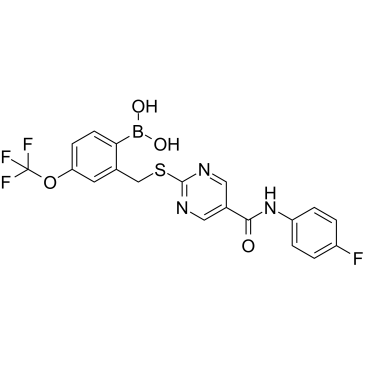
SX-682 es un pequeño inhibidor que se absorbe bien por la boca. Actúa sobre CXCR1 y CXCR2, sus IC50 son 31 y 21nM, respectivamente
Products are for research use only. Not for human use. We do not sell to patients.
Cas No.: 1648843-04-2
Sample solution is provided at 25 µL, 10mM.
_1-3.$$$39978408@51.jpg');)
_1-9.$$$38538795@65.jpg');)
_1-9.$$$39112701@51.jpg');)
_1-7.$$$37316672@70.jpg');)
_366-372.$$$36198801@70.jpg');)
.$$$38565142@65.jpg');)
_1867-1883.$$$33248023@67.jpg');)
_eads6055.$$$39977546@45.jpg');)
_eadm9805.$$$40080571@45.jpg');)
_eadj3020.$$$39666821@45.jpg');)
_1-20.$$$39757301@28.jpg');)
_1-24.$$$38898113@28.jpg');)
_273-287.$$$36806353@46.jpg');)
_1-16.$$$37156877@44.jpg');)
_1-19.$$$37460805@44.jpg');)
_1291-1307.$$$34518654@46.jpg');)
SX-682 es un pequeño inhibidor que se absorbe bien por la boca. Actúa sobre CXCR1 y CXCR2, sus IC50 son 31 y 21nM, respectivamente[1]. Mira que las células tumorales dejan de ser mesenquimales y pasan a epiteliales. Además, las hace más fáciles de atacar por el sistema inmunológico[2]. Muchos estudios lo utilizan, pues para frenar el avance del cáncer colorrectal[3].
En ensayos de laboratorio, con 5μM durante cuatro días, las células B16F0 y B16F10 dejan de crecer. También baja la producción de Cxcl1 y del factor VEGF[4]. Si juntas 2.5µM de SX-682 con 25µg/mL de bintrafusp alfa por tres días. Las células 4T1 se agrupan más. Sube la E-cadherin, y baja la vimetina, el Caracol y el Zeb-1[5]. Prepararlas antes con 10µM por 72 horas. Las células UM-SCC-11B responden mejor al deocetaxel, y sobreviven mucho menos[6].
En animales vivos, 200mg/kg dos veces al día por dos semanas, vía oral, frenta tumores de pulmón en ratones. Los neutrófilos del tumor no bajan con esto[7]. Y si lo combinas, SX-682 a 0.756g/kg al día por boca, junto al anticuerpo anti-PD-1, tres semanas, tumores de melanoma en ratones de injerto crecen menos. Hay menos células supresoras mieloides, y más células B1b con CXCL11 dentro del tumor[8].
References:
[1] Maeda D Y, Peck A M, Schuler A D, et al. Boronic acid-containing CXCR1/2 antagonists: Optimization of metabolic stability, in vivo evaluation, and a proposed receptor binding model[J]. Bioorganic & medicinal chemistry letters, 2015, 25(11): 2280-2284.
[2] Horn L, Hamilton D, Maeda D, et al. Abstract B04: Multimodal cancer immunotherapy combining IL-8 inhibition, adenovirus vaccine, IL-15 super agonist, and anti-PD-L1/TGFβRII agent reduces mesenchymalization and enhances anti-tumor efficacy[J]. Cancer Immunology Research, 2020, 8(4_Supplement): B04-B04.
[3] Sherry C, Dadgar N, Liu Z, et al. The Interleukin-8-CXCR1/2 Axis as a Therapeutic Target in Peritoneal Carcinomatosis[J]. Current Oncology, 2025, 32(9): 496.
[4] Yang J, Bergdorf K, Yan C, et al. CXCR2 expression during melanoma tumorigenesis controls transcriptional programs that facilitate tumor growth[J]. Molecular Cancer, 2023, 22(1): 92.
[5] Horn L A, Riskin J, Hempel H A, et al. Simultaneous inhibition of CXCR1/2, TGF-β, and PD-L1 remodels the tumor and its microenvironment to drive antitumor immunity[J]. Journal for immunotherapy of cancer, 2020, 8(1): e000326.
[6] Horn L A, Lind H, Fousek K, et al. Inhibition of the chemokine receptors CXCR1 and CXCR2 synergizes with docetaxel for effective tumor control and remodeling of the immune microenvironment of HPV-negative head and neck cancer models[J]. Journal of Experimental & Clinical Cancer Research, 2024, 43(1): 318
[7] Kwak J W, Nguyen H Q, Camai A, et al. CXCR1/2 antagonism inhibits neutrophil function and not recruitment in cancer[J]. Oncoimmunology, 2024, 13(1): 2384674.
[8] Yang J, Yan C, Vilgelm A E, et al. Targeted deletion of CXCR2 in myeloid cells alters the tumor immune environment to improve antitumor immunity[J]. Cancer immunology research, 2021, 9(2): 200-213.
| Experimentos celulares [1]: | |
Líneas celulares | Células 4T1 |
Método de preparación | Las células 4T1 se cultivaron en medio IMDM que contenía un 10% de FBS durante 72h con 2.5µM SX-682, 25µg/ml bintrafusp alfa o 2.5µM SX-682 combinado con 25µg/ml bintrafusp alfa. Se analizaron la expresión de la E-cadherin y los factores de transcripción mesenquimal en las células. |
Condiciones de reacción | 2.5µM; 72h |
Áreas de aplicación | El tratamiento SX-682 reguló la expresión de E-cadherin y redujo los factores de transcripción mesenquimal Caracol y Zeb-1 en células 4T1. |
| Experimentos con animales [2]: | |
Modelos animales | C57BL/6 ratones |
Método de preparación | Las células de melanoma Rich1.1 homólogas BrafV637E PtenR74X, Q396X fueron implantadas por vía subcutánea en ratones C57BL/6 inmunocompetentes. Los ratones C57BL/6 fueron alimentados con alimento que contenía SX-682 (0.756g/kg), y simultáneamente fueron inyectados con anticuerpo anti-PD-1 (100μg por ratón), o IgG de control, o alimentados con alimentación de control del vehículo sin SX-682, y fueron inyectados con anticuerpo anti-PD-1 o el mismo tipo de IgG de control cada dos días. Después de 3 semanas de tratamiento, se extirparon los tejidos pulmonares de los ratones para su análisis. |
Forma de dosificación | 0.756g/kg/día durante 3 semanas; p.o. |
Áreas de aplicación | El tratamiento combinado con SX-682 y anticuerpo anti-PD-1 inhibió el crecimiento de tumores pulmonares en ratones, redujo las células supresoras derivadas de mieloides (MDSC) dentro de los tumores y aumentó las células B1b que expresan CXCL11 dentro de los tumores. |
References: | |
| Cas No. | 1648843-04-2 | SDF | |
| Canonical SMILES | O=C(NC1=CC=C(F)C=C1)C(C=N2)=CN=C2SCC3=CC(OC(F)(F)F)=CC=C3B(O)O | ||
| Formula | C19H14BF4N3O4S | M.Wt | 467.2 |
| Solubility | DMSO: 250 mg/mL (535.10 mM) | Storage | Store at -20°C |
| General tips | Please select the appropriate solvent to prepare the stock solution according to the
solubility of the product in different solvents; once the solution is prepared, please store it in
separate packages to avoid product failure caused by repeated freezing and thawing.Storage method
and period of the stock solution: When stored at -80°C, please use it within 6 months; when stored
at -20°C, please use it within 1 month. To increase solubility, heat the tube to 37°C and then oscillate in an ultrasonic bath for some time. |
||
| Shipping Condition | Evaluation sample solution: shipped with blue ice. All other sizes available: with RT, or with Blue Ice upon request. | ||
| Prepare stock solution | |||

|
1 mg | 5 mg | 10 mg |
| 1 mM | 2.1404 mL | 10.7021 mL | 21.4041 mL |
| 5 mM | 428.1 μL | 2.1404 mL | 4.2808 mL |
| 10 mM | 214 μL | 1.0702 mL | 2.1404 mL |
Step 1: Enter information below (Recommended: An additional animal making an allowance for loss during the experiment)
 g
μL
g
μL
Step 2: Enter the in vivo formulation (This is only the calculator, not formulation. Please contact us first if there is no in vivo formulation at the solubility Section.)
Calculation results:
Working concentration: mg/ml;
Method for preparing DMSO master liquid: mg drug pre-dissolved in μL DMSO ( Master liquid concentration mg/mL, Please contact us first if the concentration exceeds the DMSO solubility of the batch of drug. )
Method for preparing in vivo formulation: Take μL DMSO master liquid, next addμL PEG300, mix and clarify, next addμL Tween 80, mix and clarify, next add μL saline, mix and clarify.
Method for preparing in vivo formulation: Take μL DMSO master liquid, next add μL Corn oil, mix and clarify.
Note: 1. Please make sure the liquid is clear before adding the next solvent.
2. Be sure to add the solvent(s) in order. You must ensure that the solution obtained, in the previous addition, is a clear solution before proceeding to add the next solvent. Physical methods such as vortex, ultrasound or hot water bath can be used to aid dissolving.
3. All of the above co-solvents are available for purchase on the GlpBio website.
Quality Control & SDS
- View current batch:
- Purity: >98.00% Appearance: A solid
- COA (Certificate of Analysis)
- SDS (Safety Data Sheet)
- Datasheet
Average Rating: 5 (Based on Reviews and 30 reference(s) in Google Scholar.)