

SX-682 |
カタログ番号GC38204
 One-Click Copy Product Info
|

SX-682はCXCR1とCXCR2の経口生物利用可能な小分子阻害剤であり、IC50値はそれぞれ31と21nMである。
Products are for research use only. Not for human use. We do not sell to patients.
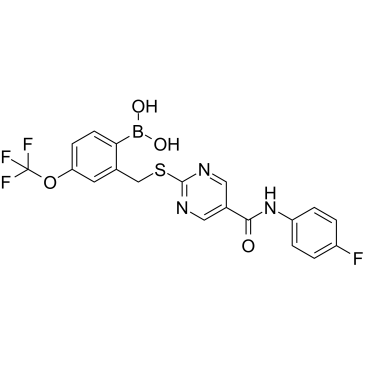
Cas No.: 1648843-04-2
Sample solution is provided at 25 µL, 10mM.
_1-3.$$$39978408@51.jpg');)
_1-9.$$$38538795@65.jpg');)
_1-9.$$$39112701@51.jpg');)
_1-7.$$$37316672@70.jpg');)
_366-372.$$$36198801@70.jpg');)
.$$$38565142@65.jpg');)
_1867-1883.$$$33248023@67.jpg');)
_eads6055.$$$39977546@45.jpg');)
_eadm9805.$$$40080571@45.jpg');)
_eadj3020.$$$39666821@45.jpg');)
_1-20.$$$39757301@28.jpg');)
_1-24.$$$38898113@28.jpg');)
_273-287.$$$36806353@46.jpg');)
_1-16.$$$37156877@44.jpg');)
_1-19.$$$37460805@44.jpg');)
_1291-1307.$$$34518654@46.jpg');)
SX-682はCXCR1とCXCR2の経口生物利用可能な小分子阻害剤であり、IC50値はそれぞれ31と21nMである[1]。SX-682は、間葉系から上皮性腫瘍表現型への転換を効果的に促進し、同時に免疫媒介の細胞毒性への腫瘍細胞の感受性を増強する[2]。SX-682は抗癌剤として広く使われ、大腸癌の進行を阻害してきている[3]。
体外で、SX-682(5μM)で4日間処理した結果、B16F0とB16F10細胞の成長を著しく阻害し、Cxcl1と血管内皮増殖因子(VEGF)の産生を減らした[4]。2.5µMのSX-682と25µg/mLのbintrafusp alfaの3日間の併用処理は、4T1細胞の著しい凝集を起こし、E-カドヘリンの発見を上方制御し、間葉系細胞ビメンチン、間葉系転写因子SnailとZeb-1の発見を下げた[5]。10µMのSX-682で72時間事前処理した結果、docetaxelに対するUM-SCC-11B細胞の感受性を著しく増強し、細胞の生存率を大きく減らした[6]。
体内で、200mg/kgのSX-682を2週間、毎日二回経口投与した結果、マウスで、腫瘍関連の好中球の含有量を減らさずに、肺腫瘍の成長を著しく阻害した[7]。SX-682(0.756g/kg/日;経口投与)と抗PD-1抗体の3週間の併用処理は、Rich1.1黒色腫細胞異種移植マウスモデルで、腫瘍の成長を著しく阻害し、腫瘍内で骨髄系由来の抑制細胞(MDSC)を減らし、腫瘍内でCXCL11を発見するB1b細胞を増やした[8]。
References:
[1] Maeda D Y, Peck A M, Schuler A D, et al. Boronic acid-containing CXCR1/2 antagonists: Optimization of metabolic stability, in vivo evaluation, and a proposed receptor binding model[J]. Bioorganic & medicinal chemistry letters, 2015, 25(11): 2280-2284.
[2] Horn L, Hamilton D, Maeda D, et al. Abstract B04: Multimodal cancer immunotherapy combining IL-8 inhibition, adenovirus vaccine, IL-15 super agonist, and anti-PD-L1/TGFβRII agent reduces mesenchymalization and enhances anti-tumor efficacy[J]. Cancer Immunology Research, 2020, 8(4_Supplement): B04-B04.
[3] Sherry C, Dadgar N, Liu Z, et al. The Interleukin-8-CXCR1/2 Axis as a Therapeutic Target in Peritoneal Carcinomatosis[J]. Current Oncology, 2025, 32(9): 496.
[4] Yang J, Bergdorf K, Yan C, et al. CXCR2 expression during melanoma tumorigenesis controls transcriptional programs that facilitate tumor growth[J]. Molecular Cancer, 2023, 22(1): 92.
[5] Horn L A, Riskin J, Hempel H A, et al. Simultaneous inhibition of CXCR1/2, TGF-β, and PD-L1 remodels the tumor and its microenvironment to drive antitumor immunity[J]. Journal for immunotherapy of cancer, 2020, 8(1): e000326.
[6] Horn L A, Lind H, Fousek K, et al. Inhibition of the chemokine receptors CXCR1 and CXCR2 synergizes with docetaxel for effective tumor control and remodeling of the immune microenvironment of HPV-negative head and neck cancer models[J]. Journal of Experimental & Clinical Cancer Research, 2024, 43(1): 318
[7] Kwak J W, Nguyen H Q, Camai A, et al. CXCR1/2 antagonism inhibits neutrophil function and not recruitment in cancer[J]. Oncoimmunology, 2024, 13(1): 2384674.
[8] Yang J, Yan C, Vilgelm A E, et al. Targeted deletion of CXCR2 in myeloid cells alters the tumor immune environment to improve antitumor immunity[J]. Cancer immunology research, 2021, 9(2): 200-213.
| 細胞実験[1]: | |
細胞株 | 4T1細胞 |
準備方法 | 4T1細胞をそれぞれ、10% FBSを含有するIMDM培地で2.5µM SX-682、25µg/ml bintrafusp alfa、または2.5µM SX-682と25µg/ml bintrafusp alfaの併用で72時間培養した。細胞におけるE-カドヘリンと間葉系転写因子の発見を分析した。 |
反応条件 | 2.5µM;72時間 |
アプリケーション | SX-682の処理は、4T1細胞で、E-カドヘリンの発見を上方制御し、間葉系転写因子SnailとZeb-1の発見を下げた。 |
| 動物実験 [2]: | |
動物モデル | C57BL/6マウス |
準備方法 | 相同なRich1.1黒色腫細胞BrafV637E PtenR74X, Q396Xを、免疫能力を持つC57BL/6マウスに皮下移植した。SX-682(0.756g/kg)を含有する飼料をC57BL/6マウスに投与し、同時に抗PD-1抗体(100μg/マウス)、または対照物IgGを腹腔内注射し、或いはSX-682なしで溶媒対照飼料を投与し、抗PD-1抗体または同種類の対照IgGを隔日で腹腔内注射した。3週間の処理後、マウスの肺組織を分析のために除去した。 |
投与形態 | 0.756g/kg/日、3週間;経口投与 |
アプリケーション | SX-682と抗PD-1抗体の併用処理は、マウスで肺腫瘍の成長を著しく阻害し、腫瘍内で骨髄系由来の抑制細胞(MDSC)を減らし、腫瘍内でCXCL11を発見するB1b細胞を増やした。 |
References: | |
| Cas No. | 1648843-04-2 | SDF | |
| Canonical SMILES | O=C(NC1=CC=C(F)C=C1)C(C=N2)=CN=C2SCC3=CC(OC(F)(F)F)=CC=C3B(O)O | ||
| Formula | C19H14BF4N3O4S | M.Wt | 467.2 |
| 溶解度 | DMSO: 250 mg/mL (535.10 mM) | Storage | Store at -20°C |
| General tips | Please select the appropriate solvent to prepare the stock solution according to the
solubility of the product in different solvents; once the solution is prepared, please store it in
separate packages to avoid product failure caused by repeated freezing and thawing.Storage method
and period of the stock solution: When stored at -80°C, please use it within 6 months; when stored
at -20°C, please use it within 1 month. To increase solubility, heat the tube to 37°C and then oscillate in an ultrasonic bath for some time. |
||
| Shipping Condition | Evaluation sample solution: shipped with blue ice. All other sizes available: with RT, or with Blue Ice upon request. | ||
| Prepare stock solution | |||

|
1 mg | 5 mg | 10 mg |
| 1 mM | 2.1404 mL | 10.7021 mL | 21.4041 mL |
| 5 mM | 428.1 μL | 2.1404 mL | 4.2808 mL |
| 10 mM | 214 μL | 1.0702 mL | 2.1404 mL |
Step 1: Enter information below (Recommended: An additional animal making an allowance for loss during the experiment)
 g
μL
g
μL
Step 2: Enter the in vivo formulation (This is only the calculator, not formulation. Please contact us first if there is no in vivo formulation at the solubility Section.)
Calculation results:
Working concentration: mg/ml;
Method for preparing DMSO master liquid: mg drug pre-dissolved in μL DMSO ( Master liquid concentration mg/mL, Please contact us first if the concentration exceeds the DMSO solubility of the batch of drug. )
Method for preparing in vivo formulation: Take μL DMSO master liquid, next addμL PEG300, mix and clarify, next addμL Tween 80, mix and clarify, next add μL saline, mix and clarify.
Method for preparing in vivo formulation: Take μL DMSO master liquid, next add μL Corn oil, mix and clarify.
Note: 1. Please make sure the liquid is clear before adding the next solvent.
2. Be sure to add the solvent(s) in order. You must ensure that the solution obtained, in the previous addition, is a clear solution before proceeding to add the next solvent. Physical methods such as vortex, ultrasound or hot water bath can be used to aid dissolving.
3. All of the above co-solvents are available for purchase on the GlpBio website.
Quality Control & SDS
- View current batch:
- Purity: >98.00% Appearance: A solid
- COA (Certificate of Analysis)
- SDS (Safety Data Sheet)
- Datasheet
Average Rating: 5 (Based on Reviews and 30 reference(s) in Google Scholar.)