

T6167923 |
Catalog No.GC38516
 One-Click Copy Product Info
|

T6167923 es un inhibidor muy específico de la vía de señalización que depende del factor de diferenciación mieloide 88, el MyD88
Products are for research use only. Not for human use. We do not sell to patients.
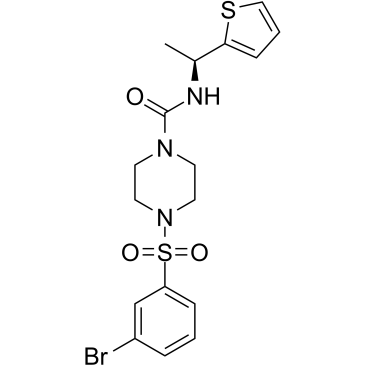
Cas No.: 2437475-16-4
Sample solution is provided at 25 µL, 10mM.
_1-3.$$$39978408@51.jpg');)
_1-9.$$$38538795@65.jpg');)
_1-9.$$$39112701@51.jpg');)
_1-7.$$$37316672@70.jpg');)
_366-372.$$$36198801@70.jpg');)
.$$$38565142@65.jpg');)
_1867-1883.$$$33248023@67.jpg');)
_eads6055.$$$39977546@45.jpg');)
_eadm9805.$$$40080571@45.jpg');)
_eadj3020.$$$39666821@45.jpg');)
_1-20.$$$39757301@28.jpg');)
_1-24.$$$38898113@28.jpg');)
_273-287.$$$36806353@46.jpg');)
_1-16.$$$37156877@44.jpg');)
_1-19.$$$37460805@44.jpg');)
_1291-1307.$$$34518654@46.jpg');)
T6167923 es un inhibidor muy específico de la vía de señalización que depende del factor de diferenciación mieloide 88, el MyD88[1]. Se une justo al dominio TIR del MyD88. Así impide que esta proteína se forme dímeros propios. Y luego, baja toda esta señal inflamatoria que necesita el MyD88 para activarse[1, 2]. Este compuesto vale mucho para estudiar el choque tóxico, también otras inflamaciones ligadas al MyD88[3, 4].
En ensayos con células, se deja reposar las células mononucleares de sangre periférica con T6167923, entre 2 y 10 μM, durante media hora. Luego las activas con enterotoxina B estafilocócica durante 16 horas. Se frena bastante la salida de citoquinas inflamatorias como el TNF-α, IFN-γ, IL-6 y IL-1β. Sus valores de IC50 quedan justo en ese rango de 2 a 10μM[1]. Si juntas células HaCaT con T6167923 a 3μM y LPS por 36 horas. Las células se mueven mejor, y las heridas sanan más rápido también[5]. Con células BV2 a 2μM durante 24h. Baja la expresión del marcador M1 CD86 que sube poe el grupo hemo[6]. Pero también, se preparan macrófagos peritoneales de ratón con 5, 10 o 20μM del compuesto una hora antes. Luego los infectas con virus de la pseudorábia. Se reducen mucho los niveles de RNA y proteína de la pro-IL-1β que provoca el virus[7].
En pruebas con animales, se inyecta el T6167923 por cavidad abdominal en ratones BALB/c, unos 0.17 o 1 mg por ejemplar. Se da media hora antes de exponerlos a la enterotoxina B y el LPS. Protege a los animales del choque tóxico mortal, y depende mucho de la dosis utilizada. Con 0.17 mg, sobrevive la mitad de los ratones. Con 1 mg, todos se mantienen con vida.[1]. Además, se pone por debajo de la piel en la zona de heridas, a 10mM y 400μL una vez al día durante cinco días. En ratones tratados con LPS, las lesiones cicatrizan antes. La capa córnea se hace más delgada, y el colágeno de la piel queda mejor ordenado también[5].
References:
[1] OLSON M A, LEE M S, KISSNER T L, et al. Discovery of small molecule inhibitors of MyD88-dependent signaling pathways using a computational screen[J]. Scientific Reports, 2015, 5: 14246.
[2] SAQIB U, BAIG M S. Identifying the inhibition of TIR proteins involved in TLR signalling as an anti-inflammatory strategy[J]. SAR and QSAR in Environmental Research, 2018, 29(4): 295-318.
[3] SAIKH K U. MyD88 and beyond: a perspective on MyD88-targeted therapeutic approach for modulation of host immunity[J]. Immunologic Research, 2021, 69(2): 117-128.
[4] DI PADOVA F, QUESNIAUX V F, RYFFEL B. MyD88 as a therapeutic target for inflammatory lung diseases[J]. Expert Opinion on Therapeutic Targets, 2018, 22(5): 401-408.
[5] XU Z, CHENG C, ZHANG Y, et al. Lipopolysaccharide induces skin scarring through the TLR4/MyD88 inflammatory signaling pathway in dermal fibroblasts[J]. Burns, 2023, 49(8): 1997-2006.
[6] WEI X, ZHANG F, CHENG D, et al. Free heme induces neuroinflammation and cognitive impairment by microglial activation via the TLR4/MyD88/NF-κB signaling pathway[J]. Cell Communication and Signaling, 2024, 22: 16.
[7] ZHOU Q, ZHANG L, LIN Q, et al. Pseudorabies virus infection activates the TLR-NF-κB axis and AIM2 inflammasome to enhance inflammatory responses in mice[J]. Journal of Virology, 2023, 97(3): e00003-23.
| Experimentos celulares [1]: | |
Líneas celulares | Células mononuclearse de sangre periférica (PBMCs) |
Método de preparación | Los PBMCs se trataron con el compuesto T6167923 (2-10μM) durante 30 minutos antes de la exposición al SEB. Los cultivos se incubaron durante 16 horas y se recogieron los sobrenadantes del cultivo para medir la producción de citoquinas. Las citoquinas en los sobrenadantes de cultivo se midieron mediante un kit CBA utilizando cuenteas capturadas recubiertas con antiicuerpos específicos para citoquinas y análisis de citometría de flujo. |
Condiciones de reacción | 2-10μM; 30 min |
Áreas de aplicación | T6167923 inhibe la producción de citoquinas proinflamatorias inducidas por SEB, incluyendo TNF-α, IFN-γ, IL-6 e IL-1β, con valores de IC50 que osculan entre 2 y 10μM. |
| Experimentos con animales [2]: | |
Modelos animales | Ratones BALB/c |
Método de preparación | A los ratones BALB/c se les inyectaron (0.17mg y 1mg) cantidades de T6167923 y 30 minutos después se les trató con SEB (1μg; i.e.), seguido de LPS otras 2h después. |
Forma de dosificación | 0.17mg/ratón y 1mg/ratón; i.p. |
Áreas de aplicación | Los ratones que fueron tratados con T6167923 a concentraciones de 0.17mg tuvieron una supervivencia del 50%. Todos los ratones que fueron tartados con T6167923 a 1mg fueron protegidos. En conjunto, los resultados indican que el T6167923 mostró una eficacia terapéutica in vivo dependiente de la dosis contra la intoxicación por SEB. |
References: | |
| Cas No. | 2437475-16-4 | SDF | |
| Canonical SMILES | BrC1=CC(S(=O)(N2CCN(C(N[C@H](C3=CC=CS3)C)=O)CC2)=O)=CC=C1 | ||
| Formula | C17H20BrN3O3S2 | M.Wt | 458.39 |
| Solubility | DMSO: 250 mg/mL (545.39 mM) | Storage | Store at -20°C |
| General tips | Please select the appropriate solvent to prepare the stock solution according to the
solubility of the product in different solvents; once the solution is prepared, please store it in
separate packages to avoid product failure caused by repeated freezing and thawing.Storage method
and period of the stock solution: When stored at -80°C, please use it within 6 months; when stored
at -20°C, please use it within 1 month. To increase solubility, heat the tube to 37°C and then oscillate in an ultrasonic bath for some time. |
||
| Shipping Condition | Evaluation sample solution: shipped with blue ice. All other sizes available: with RT, or with Blue Ice upon request. | ||
| Prepare stock solution | |||

|
1 mg | 5 mg | 10 mg |
| 1 mM | 2.1815 mL | 10.9077 mL | 21.8155 mL |
| 5 mM | 436.3 μL | 2.1815 mL | 4.3631 mL |
| 10 mM | 218.2 μL | 1.0908 mL | 2.1815 mL |
Step 1: Enter information below (Recommended: An additional animal making an allowance for loss during the experiment)
 g
μL
g
μL
Step 2: Enter the in vivo formulation (This is only the calculator, not formulation. Please contact us first if there is no in vivo formulation at the solubility Section.)
Calculation results:
Working concentration: mg/ml;
Method for preparing DMSO master liquid: mg drug pre-dissolved in μL DMSO ( Master liquid concentration mg/mL, Please contact us first if the concentration exceeds the DMSO solubility of the batch of drug. )
Method for preparing in vivo formulation: Take μL DMSO master liquid, next addμL PEG300, mix and clarify, next addμL Tween 80, mix and clarify, next add μL saline, mix and clarify.
Method for preparing in vivo formulation: Take μL DMSO master liquid, next add μL Corn oil, mix and clarify.
Note: 1. Please make sure the liquid is clear before adding the next solvent.
2. Be sure to add the solvent(s) in order. You must ensure that the solution obtained, in the previous addition, is a clear solution before proceeding to add the next solvent. Physical methods such as vortex, ultrasound or hot water bath can be used to aid dissolving.
3. All of the above co-solvents are available for purchase on the GlpBio website.
Quality Control & SDS
- View current batch:
- Purity: >98.00% Appearance: A solid
- COA (Certificate of Analysis)
- SDS (Safety Data Sheet)
- Datasheet
Average Rating: 5 (Based on Reviews and 18 reference(s) in Google Scholar.)