

T6167923 |
Catalog No.GC38516
 One-Click Copy Product Info
|

T6167923 is a highly selective inhibitor of the myeloid differentiation factor 88 (MyD88)-dependent signaling pathway.
Products are for research use only. Not for human use. We do not sell to patients.
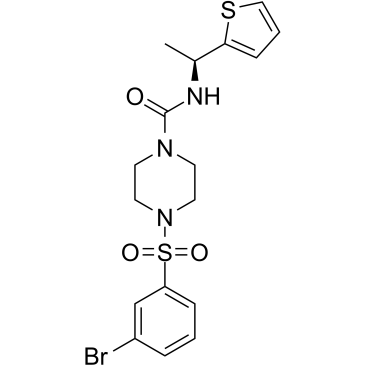
Cas No.: 2437475-16-4
Sample solution is provided at 25 µL, 10mM.
_1-3.$$$39978408@51.jpg');)
_1-9.$$$38538795@65.jpg');)
_1-9.$$$39112701@51.jpg');)
_1-7.$$$37316672@70.jpg');)
_366-372.$$$36198801@70.jpg');)
.$$$38565142@65.jpg');)
_1867-1883.$$$33248023@67.jpg');)
_eads6055.$$$39977546@45.jpg');)
_eadm9805.$$$40080571@45.jpg');)
_eadj3020.$$$39666821@45.jpg');)
_1-20.$$$39757301@28.jpg');)
_1-24.$$$38898113@28.jpg');)
_273-287.$$$36806353@46.jpg');)
_1-16.$$$37156877@44.jpg');)
_1-19.$$$37460805@44.jpg');)
_1291-1307.$$$34518654@46.jpg');)
T6167923 is a highly selective inhibitor of the myeloid differentiation factor 88 (MyD88)-dependent signaling pathway[1]. T6167923 specifically binds to the TIR domain of MyD88, directly inhibiting its homodimer formation and subsequently suppressing MyD88-dependent inflammatory signaling[1, 2]. T6167923 is commonly used in the treatment and research of toxic shock and other MyD88-related inflammatory diseases[3, 4].
In vitro, pre-incubation of peripheral blood mononuclear cells (PBMCs) with T6167923 (2-10μM) for 30min, followed by stimulation with 200ng/mL Staphylococcal enterotoxin B (SEB) for 16h, effectively inhibited SEB-induced production of pro-inflammatory cytokines TNF-α, IFN-γ, IL-6, and IL-1β, with IC50 values ranging from 2 to 10μM[1]. Co-incubation of human immortalized keratinocyte HaCaT cells with T6167923 (3μM) and 1μg/mL lipopolysaccharide (LPS) for 36h significantly promoted cell migration and accelerated wound healing[5]. Treatment of BV2 cells with T6167923 (2μM) for 24h significantly reduced the heme-induced expression of the M1 microglial surface marker CD86[6]. Pre-treatment of mouse peritoneal macrophages with T6167923 (5, 10, 20μM) for 1h, followed by infection with Pseudorabies virus (PRV) for 24h, significantly suppressed PRV-induced mRNA and protein levels of pro-IL-1β[7].
In vivo, intraperitoneal administration of T6167923 (0.17mg/mouse or 1mg/mouse) to BALB/c mice 30min before SEB challenge provided dose-dependent protection against lethal toxic shock induced by a combined challenge of SEB (1μg) and LPS (90μg). The 0.17mg dose group achieved a 50% survival rate, while the 1mg dose group achieved 100% survival[1]. Subcutaneous injection of T6167923 (10mM; 400μL; once daily) for 5 days into the wound area of LPS-treated Balb/c mice accelerated wound healing, reduced stratum corneum thickness, and resulted in thinner and more orderly arranged dermal collagen[5].
References:
[1] OLSON M A, LEE M S, KISSNER T L, et al. Discovery of small molecule inhibitors of MyD88-dependent signaling pathways using a computational screen[J]. Scientific Reports, 2015, 5: 14246.
[2] SAQIB U, BAIG M S. Identifying the inhibition of TIR proteins involved in TLR signalling as an anti-inflammatory strategy[J]. SAR and QSAR in Environmental Research, 2018, 29(4): 295-318.
[3] SAIKH K U. MyD88 and beyond: a perspective on MyD88-targeted therapeutic approach for modulation of host immunity[J]. Immunologic Research, 2021, 69(2): 117-128.
[4] DI PADOVA F, QUESNIAUX V F, RYFFEL B. MyD88 as a therapeutic target for inflammatory lung diseases[J]. Expert Opinion on Therapeutic Targets, 2018, 22(5): 401-408.
[5] XU Z, CHENG C, ZHANG Y, et al. Lipopolysaccharide induces skin scarring through the TLR4/MyD88 inflammatory signaling pathway in dermal fibroblasts[J]. Burns, 2023, 49(8): 1997-2006.
[6] WEI X, ZHANG F, CHENG D, et al. Free heme induces neuroinflammation and cognitive impairment by microglial activation via the TLR4/MyD88/NF-κB signaling pathway[J]. Cell Communication and Signaling, 2024, 22: 16.
[7] ZHOU Q, ZHANG L, LIN Q, et al. Pseudorabies virus infection activates the TLR-NF-κB axis and AIM2 inflammasome to enhance inflammatory responses in mice[J]. Journal of Virology, 2023, 97(3): e00003-23.
| Cell experiment [1]: | |
|
Cell lines |
Peripheral blood mono nuclear cells (PBMCs) |
|
Preparation Method |
PBMCs were treated with compound T6167923 (2-10μM) for 30min prior to SEB exposure. The cultures were incubated for 16h and culture supernatants were collected to measure cytokine production. Cytokines in culture supernatants were measured by a CBA kit using captured beads coated with antibodies specific for cytokines and flow cytometry analysis. |
|
Reaction Conditions |
2-10μM; 30min |
|
Applications |
T6167923 effectively inhibits the production of SEB-induced pro-inflammatory cytokines, including TNF-α, IFN-γ, IL-6, and IL-1β, with IC50 values ranging from 2 to 10μM. |
| Animal experiment [1]: | |
|
Animal models |
BALB/c mice |
|
Preparation Method |
BALB/c mice were injected with (0.17mg and 1mg) amounts of T6167923 and 30min later they were treated with SEB (1μg; i.e.), followed by LPS another 2h later. |
|
Dosage form |
0.17mg/mice and 1mg/mice; i.p. |
|
Applications |
Mice that were treated with T6167923 at concentrations of 0.17mg had 50% survival. All mice that were treated with T6167923 at 1mg were completely protected. Taken together, the results indicate that T6167923 showed dose-dependent in vivo therapeutic efficacy against SEB intoxication. |
|
References: |
|
| Cas No. | 2437475-16-4 | SDF | |
| Canonical SMILES | BrC1=CC(S(=O)(N2CCN(C(N[C@H](C3=CC=CS3)C)=O)CC2)=O)=CC=C1 | ||
| Formula | C17H20BrN3O3S2 | M.Wt | 458.39 |
| Solubility | DMSO: 250 mg/mL (545.39 mM) | Storage | Store at -20°C |
| General tips | Please select the appropriate solvent to prepare the stock solution according to the
solubility of the product in different solvents; once the solution is prepared, please store it in
separate packages to avoid product failure caused by repeated freezing and thawing.Storage method
and period of the stock solution: When stored at -80°C, please use it within 6 months; when stored
at -20°C, please use it within 1 month. To increase solubility, heat the tube to 37°C and then oscillate in an ultrasonic bath for some time. |
||
| Shipping Condition | Evaluation sample solution: shipped with blue ice. All other sizes available: with RT, or with Blue Ice upon request. | ||
| Prepare stock solution | |||

|
1 mg | 5 mg | 10 mg |
| 1 mM | 2.1815 mL | 10.9077 mL | 21.8155 mL |
| 5 mM | 436.3 μL | 2.1815 mL | 4.3631 mL |
| 10 mM | 218.2 μL | 1.0908 mL | 2.1815 mL |
Step 1: Enter information below (Recommended: An additional animal making an allowance for loss during the experiment)
 g
μL
g
μL
Step 2: Enter the in vivo formulation (This is only the calculator, not formulation. Please contact us first if there is no in vivo formulation at the solubility Section.)
Calculation results:
Working concentration: mg/ml;
Method for preparing DMSO master liquid: mg drug pre-dissolved in μL DMSO ( Master liquid concentration mg/mL, Please contact us first if the concentration exceeds the DMSO solubility of the batch of drug. )
Method for preparing in vivo formulation: Take μL DMSO master liquid, next addμL PEG300, mix and clarify, next addμL Tween 80, mix and clarify, next add μL saline, mix and clarify.
Method for preparing in vivo formulation: Take μL DMSO master liquid, next add μL Corn oil, mix and clarify.
Note: 1. Please make sure the liquid is clear before adding the next solvent.
2. Be sure to add the solvent(s) in order. You must ensure that the solution obtained, in the previous addition, is a clear solution before proceeding to add the next solvent. Physical methods such as vortex, ultrasound or hot water bath can be used to aid dissolving.
3. All of the above co-solvents are available for purchase on the GlpBio website.
Quality Control & SDS
- View current batch:
- Purity: >98.00% Appearance: A solid
- COA (Certificate of Analysis)
- SDS (Safety Data Sheet)
- Datasheet
Average Rating: 5 (Based on Reviews and 18 reference(s) in Google Scholar.)