

GSK620 |
Catalog No.GC62312
 One-Click Copy Product Info
|

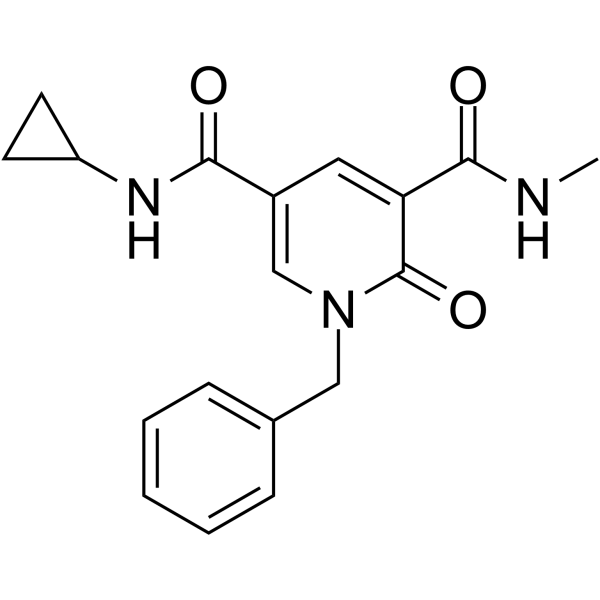
GSK620 es un inhibidor pan-BD2 potente y activo por vía oral con una excelente selectividad amplia, capacidad de desarrollo y farmacocinética oral in vivo.
Products are for research use only. Not for human use. We do not sell to patients.
Cas No.: 2088410-46-0
Sample solution is provided at 25 µL, 10mM.
_1-3.$$$39978408@51.jpg');)
_1-9.$$$38538795@65.jpg');)
_1-9.$$$39112701@51.jpg');)
_1-7.$$$37316672@70.jpg');)
_366-372.$$$36198801@70.jpg');)
.$$$38565142@65.jpg');)
_1867-1883.$$$33248023@67.jpg');)
_eads6055.$$$39977546@45.jpg');)
_eadm9805.$$$40080571@45.jpg');)
_eadj3020.$$$39666821@45.jpg');)
_1-20.$$$39757301@28.jpg');)
_1-24.$$$38898113@28.jpg');)
_273-287.$$$36806353@46.jpg');)
_1-16.$$$37156877@44.jpg');)
_1-19.$$$37460805@44.jpg');)
_1291-1307.$$$34518654@46.jpg');)
GSK620 is an orally active, pan-Bromodomain and Extra-Terminal protein Bromodomain 2 (pan-BET BD2) selective inhibitor. GSK620 is highly selective for the BET-BD2 family of proteins, with more than 200-fold selectivity over all other bromodomains[1].
In vitro, the IC₅₀ values of GSK620 in GSC23 and GSC11 cells were 38.74μM and 35.39μM, respectively. Treatment with GSK620 at 0.5-5μM for 24-48h effectively downregulated Mesenchymal (MES) gene expression in glioblastoma (GBM) models. In GSC11 and GSC23 cells, 1μM GSK620 for 24h reduced chromatin-bound BD2 and its occupancy at MES promoters; 0.5μM inhibited invasion, and 0.5-5μM suppressed colony formation[2].
In vivo, GSK620, administered orally in mice, has a plasma half-life of 1.05h and exhibits brain penetration. Oral GSK620 (30mg/kg; once daily for 8 days) significantly prolonged survival versus vehicle controls and reduced tumor-associated macrophage (TAM) infiltration by IHC in an orthotopic xenograft model[2].
References:
[1] Jonathan T Seal, et al. J Med Chem. 2020 Sep 10;63(17):9093-9126. [2] Massimo Petretich, et al. Curr Opin Chem Biol . 2020 Aug;57:184-193.
[2] Vadla R, Taylor B, Miyake Y, et al. BRD2 bromodomain-mediated regulation of cell state plasticity modulates therapy response in glioblastoma. Neuro Oncol. 2025;27(11):2828-2842.
| Cell experiment [1]: | |
Cell lines | GSC11 and GSC23 cells |
Preparation Method | RNA-seq analysis was performed on GSC11 and GSC23 cells treated with GSK620 (0.5-5µM; 24-48h) to identify differentially expressed genes. |
Reaction Conditions | 0.5-5µM; 24-48h |
Applications | GSK620 treatment downregulated 194 genes in GSC11 and 384 genes in GSC23. Notably, CHI3L2, a key Mesenchymal marker implicated in immune cell infiltration in glioma10, was among the genes commonly downregulated in both lines. And also suppressed transcriptional programs associated with AP-1 and NF-κB signaling pathways. |
| Animal experiment [1]: | |
Animal models | Female BALB/c nude mice |
Preparation Method | Female BALB/c nude mice (4-5 weeks old) were used for intracranial tumor implantation. A total of 1-2×10⁵ cells in a 3-5μL volume was injected stereotactically into the brain (1.0mm anterior and 2.0mm right to the bregma, and 3mm deep from the inner plate of the skull). Tumor growth was monitored using the FMT 2500 fluorescence tomography system. For drug treatment studies, mice received daily oral gavage of vehicle or GSK620 at 30mg/kg. The vehicle formulation consisted of 10% DMSO, 40% PEG, 5% Tween-80, and 45% saline. |
Dosage form | 30mg/kg; 8d; p.o. |
Applications | GSK620-treated mice lived significantly longer than vehicle-treated controls. IHC staining showed reduced infiltration of Tumor-Associated Macrophages (TAMs). |
References: | |
| Cas No. | 2088410-46-0 | SDF | |
| Formula | C18H19N3O3 | M.Wt | 325.36 |
| Solubility | DMSO : 62.5 mg/mL (192.09 mM; Need ultrasonic) | Storage | Store at -20°C |
| General tips | Please select the appropriate solvent to prepare the stock solution according to the
solubility of the product in different solvents; once the solution is prepared, please store it in
separate packages to avoid product failure caused by repeated freezing and thawing.Storage method
and period of the stock solution: When stored at -80°C, please use it within 6 months; when stored
at -20°C, please use it within 1 month. To increase solubility, heat the tube to 37°C and then oscillate in an ultrasonic bath for some time. |
||
| Shipping Condition | Evaluation sample solution: shipped with blue ice. All other sizes available: with RT, or with Blue Ice upon request. | ||
| Prepare stock solution | |||

|
1 mg | 5 mg | 10 mg |
| 1 mM | 3.0735 mL | 15.3676 mL | 30.7352 mL |
| 5 mM | 614.7 μL | 3.0735 mL | 6.147 mL |
| 10 mM | 307.4 μL | 1.5368 mL | 3.0735 mL |
Step 1: Enter information below (Recommended: An additional animal making an allowance for loss during the experiment)
 g
μL
g
μL
Step 2: Enter the in vivo formulation (This is only the calculator, not formulation. Please contact us first if there is no in vivo formulation at the solubility Section.)
Calculation results:
Working concentration: mg/ml;
Method for preparing DMSO master liquid: mg drug pre-dissolved in μL DMSO ( Master liquid concentration mg/mL, Please contact us first if the concentration exceeds the DMSO solubility of the batch of drug. )
Method for preparing in vivo formulation: Take μL DMSO master liquid, next addμL PEG300, mix and clarify, next addμL Tween 80, mix and clarify, next add μL saline, mix and clarify.
Method for preparing in vivo formulation: Take μL DMSO master liquid, next add μL Corn oil, mix and clarify.
Note: 1. Please make sure the liquid is clear before adding the next solvent.
2. Be sure to add the solvent(s) in order. You must ensure that the solution obtained, in the previous addition, is a clear solution before proceeding to add the next solvent. Physical methods such as vortex, ultrasound or hot water bath can be used to aid dissolving.
3. All of the above co-solvents are available for purchase on the GlpBio website.
Quality Control & SDS
- View current batch:
- Purity: >99.50% Appearance: A solid
- COA (Certificate of Analysis)
- SDS (Safety Data Sheet)
- Datasheet
Average Rating: 5 (Based on Reviews and 7 reference(s) in Google Scholar.)