

HPF (Synonyms: Hydroxyphenyl Fluorescein) |
Catalog No.GC43870
 One-Click Copy Product Info
|

El hidroxifenil fluoresceína (HPF) es el reactivo que puede detectar directamente especies de oxígeno altamente reactivas (hROS).
Products are for research use only. Not for human use. We do not sell to patients.
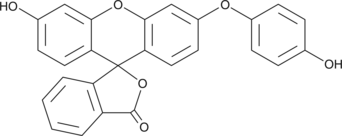
Cas No.: 359010-69-8
Sample solution is provided at 25 µL, 10mM.
The biology of highly reactive oxygen radical species is of great interest in many biomedical research disciplines, including neurodegeneration, aging, cancer, and infectious diseases.[1] There are a number of fluorescent reagents, such as 2,7-dichlorodihydrofluorescein (DCDHF), that can be used to detect free radicals, but they have significant limitations due to their facile oxidation by light and numerous non-radical oxidants such as hydrogen peroxide (H2O2). [2] HPF is a cell-permeable aromatic amino-fluorescein derivative that has little intrinsic fluorescence. [3] It undergoes oxidation only by highly reactive oxygen species (hROS) such as the hydroxyl radical, peroxynitrite, and hROS generated from a peroxidase/H2O2 system. It is inert to hypochlorite ion, nitric oxide, hydrogen peroxide (H2O2), superoxide, and other oxidants. Upon oxidation, HPF is converted to the highly fluorescent molecule fluorescein, with excitation/emission maxima of 490/515 nm, respectively, allowing the simple direct detection of highly reactive biological radicals.
Reference:
[1]. Matés, J.M., Pèrez-Gómez, C., and Nuñez de Castro, I. Antioxidant enzymes and human diseases. Clinical Biochemistry 32(8), 595-603 (1999).
[2]. Hempel, S.L., Buettner, G.R., O'Malley, Y.Q., et al. Dihydrofluorescein diacetate is superior for detecting intracellular oxidants: Comparison with 2',7'-dichlorodihydrofluorescein diacetate, 5(and 6)-carboxy-2',7'-dichlorodihydrofluorescein diacetate, and dihydrorhodamine 123. Free Radical Biology & Medicine 27(1), 146-159 (1999).
[3]. Setsukinai, K.i., Urano, Y., Kakinuma, K., et al. Development of novel fluorescence probes that can reliably detect reactive oxygen species and distinguish specific species. J. Biol. Chem. 278(5), 3170-3175 (2003).
This plan only provides a guide, please modify it to meet your specific needs.
1. Preparation of staining solution
(1) Prepare stock solution: Dissolve HPF in DMSO and prepare a stock solution with a concentration of 1-10mM.
Note:
① HPF can be dissolved in DMSO, but data shows that DMSO is a quencher for hydroxyl radicals, which will interfere with detection and reduce sensitivity. It is recommended to use DMF as a solvent;
② Compared with DMSO, DMF has relatively high cytotoxicity. It is recommended that customers use a lower concentration of HPF under the premise of achieving the ideal fluorescence effect, and verify the sensitivity of the cells to the corresponding dose of solvent before the experiment;
③ Aliquot unused storage solution and store in the dark at -20℃ or -80℃ to avoid repeated freezing and thawing.
(2) Prepare working solution: Dilute the stock solution with a suitable buffer (such as HHBS or PBS) and prepare a working solution with a concentration of 1-10μM.
Note: Please adjust the concentration of the working fluid according to the actual situation and prepare it now.
2. Cell suspension staining
(1) Suspension cells: Centrifuge at 1000g for 3-5 minutes at 4°C, discard the supernatant, and wash twice with PBS for 5 minutes each time.
(2) Adherent cells: Wash twice with PBS, add trypsin to digest the cells, and centrifuge at 1000g for 3-5 minutes after digestion is completed.
(3) Add HPF working solution to resuspend the cells, and incubate at room temperature in the dark for 5-30 minutes. The optimal incubation time for different cells is different, please explore by yourself according to the specific experimental needs.
(4) After the incubation, centrifuge at 1000g for 5 minutes, remove the supernatant, add PBS and wash 2-3 times, 5 minutes each time.
(5) Resuspend cells in pre-warmed serum-free cell culture medium or PBS and observe by fluorescence microscope or flow cytometry.
3. Cell adhesion staining
(1) Culture adherent cells on sterile coverslips.
(2) Remove the coverslip from the culture medium, suck out the excess culture medium, and place the coverslip in a humid environment.
(3) Add 100 μL of dye working solution from one corner of the coverslip and shake gently to evenly cover all cells with the dye.
(4) Incubate at room temperature in the dark for 5-30 minutes. The optimal incubation time for different cells is different, please explore by yourself according to the specific experimental needs.
(5) After the incubation, discard the dye working solution and use pre-warmed culture solution to wash the coverslip 2 to 3 times.
4. Microscope detection: The maximum excitation/emission wavelength of HPF is 490/515nm.
Precautions:
① BSA and phenol red will affect the fluorescence of HPF. It is recommended to use a buffer system or culture medium that does not contain BSA and phenol red for experiments;
② HPF can be used for solution system or intracellular ROS detection. The recommended starting working concentration is 1-10 μM. Please optimize according to your personal experimental system or reference literature;
③ Fluorescent dyes all have quenching problems. Please try to avoid light to slow down fluorescence quenching;
④ For your safety and health, please wear a lab coat and disposable gloves.
| Cas No. | 359010-69-8 | SDF | |
| Sinónimos | Hydroxyphenyl Fluorescein | ||
| Chemical Name | (2-[6-(4'-hydroxy)phenoxy-3H-xanthene-3-on-9-yl]benzoic acid | ||
| Canonical SMILES | OC(C=C1)=CC=C1OC2=CC3=C(C=C2)C4(C(C=CC=C5)=C5C(O4)=O)C6=CC=C(O)C=C6O3 | ||
| Formula | C26H16O6 | M.Wt | 424.4 |
| Solubility | 20mg/mL in ethanol, or in DMF , or in DMSO | Storage | Store at -20°C, protect from light |
| General tips | Please select the appropriate solvent to prepare the stock solution according to the
solubility of the product in different solvents; once the solution is prepared, please store it in
separate packages to avoid product failure caused by repeated freezing and thawing.Storage method
and period of the stock solution: When stored at -80°C, please use it within 6 months; when stored
at -20°C, please use it within 1 month. To increase solubility, heat the tube to 37°C and then oscillate in an ultrasonic bath for some time. |
||
| Shipping Condition | Evaluation sample solution: shipped with blue ice. All other sizes available: with RT, or with Blue Ice upon request. | ||
| Prepare stock solution | |||

|
1 mg | 5 mg | 10 mg |
| 1 mM | 2.3563 mL | 11.7813 mL | 23.5627 mL |
| 5 mM | 471.3 μL | 2.3563 mL | 4.7125 mL |
| 10 mM | 235.6 μL | 1.1781 mL | 2.3563 mL |
Step 1: Enter information below (Recommended: An additional animal making an allowance for loss during the experiment)
 g
μL
g
μL
Step 2: Enter the in vivo formulation (This is only the calculator, not formulation. Please contact us first if there is no in vivo formulation at the solubility Section.)
Calculation results:
Working concentration: mg/ml;
Method for preparing DMSO master liquid: mg drug pre-dissolved in μL DMSO ( Master liquid concentration mg/mL, Please contact us first if the concentration exceeds the DMSO solubility of the batch of drug. )
Method for preparing in vivo formulation: Take μL DMSO master liquid, next addμL PEG300, mix and clarify, next addμL Tween 80, mix and clarify, next add μL saline, mix and clarify.
Method for preparing in vivo formulation: Take μL DMSO master liquid, next add μL Corn oil, mix and clarify.
Note: 1. Please make sure the liquid is clear before adding the next solvent.
2. Be sure to add the solvent(s) in order. You must ensure that the solution obtained, in the previous addition, is a clear solution before proceeding to add the next solvent. Physical methods such as vortex, ultrasound or hot water bath can be used to aid dissolving.
3. All of the above co-solvents are available for purchase on the GlpBio website.
Quality Control & SDS
- View current batch:
- Purity: >98.00% Appearance: A solution in methyl acetate
- COA (Certificate of Analysis)
- SDS (Safety Data Sheet)
- Datasheet
Average Rating: 5 (Based on Reviews and 25 reference(s) in Google Scholar.)