

Icotinib Hydrochloride |
Catalog No.GC16244
 One-Click Copy Product Info
|

An EGFR inhibitor
Products are for research use only. Not for human use. We do not sell to patients.
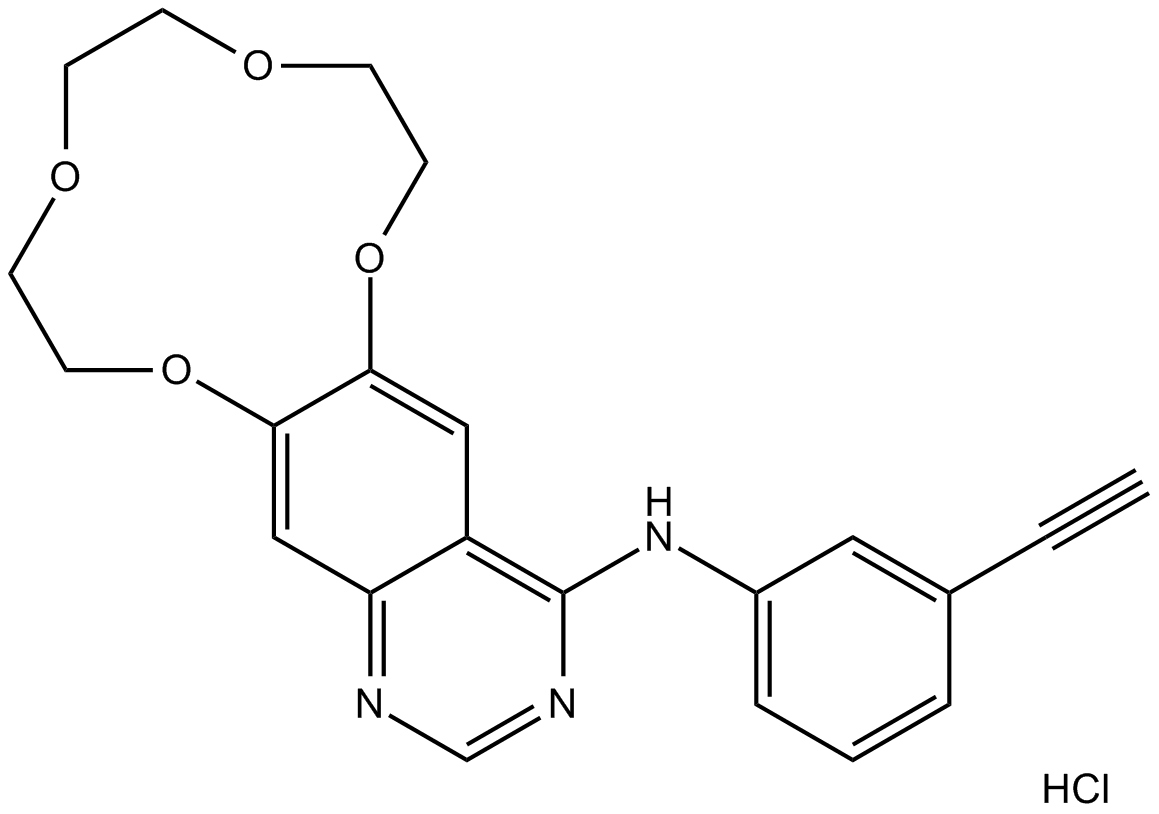
Cas No.: 1204313-51-8
Sample solution is provided at 25 µL, 10mM.
_1-3.$$$39978408@51.jpg');)
_1-9.$$$38538795@65.jpg');)
_1-9.$$$39112701@51.jpg');)
_1-7.$$$37316672@70.jpg');)
_366-372.$$$36198801@70.jpg');)
.$$$38565142@65.jpg');)
_1867-1883.$$$33248023@67.jpg');)
_eads6055.$$$39977546@45.jpg');)
_eadm9805.$$$40080571@45.jpg');)
_eadj3020.$$$39666821@45.jpg');)
_1-20.$$$39757301@28.jpg');)
_1-24.$$$38898113@28.jpg');)
_273-287.$$$36806353@46.jpg');)
_1-16.$$$37156877@44.jpg');)
_1-19.$$$37460805@44.jpg');)
_1291-1307.$$$34518654@46.jpg');)
Icotinib Hydrochloride is a potent and highly selective inhibitor of epidermal growth factor receptor tyrosine kinases (EGFR-TKI) with IC50 value of 5 nM.
EGFR is an oncogenic driver which is expressed on the cell surface of normal cells and cancer cells [1], and patients with somatic mutations, particularly an exon 19 deletion or exon 21 L858R mutation, within the tyrosine kinase domain have activating mutations that lead to unchecked cell proliferation.[2] Overexpression of EGFR caused inappropriate activation of the anti-apoptotic Ras signaling pathway, found in many different types of cancer.[3]
Icotinib is a quinazoline derivative that binds reversibly to the ATP binding site of the EGFR protein, preventing completion of the signal transduction cascade.[4] Icotinib inhibited the intracellular phosphorylation of tyrosine kinase(TK) associated with the epidermal growth factor receptor (EGFR).[5]
Icotinib is indicated for the treatment for EGFR mutation-positive, advanced or metastatic non-small cell lung cancer (NSCLC) as a second-line or third-line treatment, for patients who have failed at least one prior treatment with platinum-based chemotherapy.[6]
References:
1.A Douglas Laird,and Julie M Cherrington. Small molecule tyrosine kinase inhibitors: clinical development of anticancer agents. 2003, 12(1): 51-64.
2.Raymond E, Faivre S, Armand JP: Epidermal growth factor receptor tyrosine kinase as a target for anticancer therapy. Drugs. 2000;60 Suppl 1:15-23.
3.Sordella,R. "Gefitinib-Sensitizing EGFR Mutations in Lung Cancer Activate Anti-Apoptotic Pathways". Science ,2004, 305 (5687): 1163-1167.
4.Bulgaru AM. et al. Erlotinib (Tarceva): a promising drug targeting epidermal growth factor receptor tyrosine kinase. Expert Rev Anticancer Ther. 2003 Jun;3(3):269-79.
5.Dudek AZ.et al. Skin rash and bronchoalveolar histology correlates with clinical benefit in patients treated with gefitinib as a therapy for previously treated advanced or metastatic non-small cell lung cancer. Lung Cancer. 2006, 51(1):89-96.
6.C Delbaldo, S Faivre, E Raymond. Les inhibiteurs des récepteurs de l'Epidermal Growth Factor (EGF) Epidermal growth factor inhibitors. La Revue de Médecine Interne. 2003,24(6): 372–383.
Kinase experiment: | In the in vitro kinase assays, 2.4 ng/μL EGFR protein is mixed with 32 ng/μL Crk in 25 μL kinase reaction buffer containing 1 μM cold ATP and 1 μCi32P-γ-ATP. The mix is incubated with Icotinib at 0, 0.5, 2.5, 12.5 or 62.5 nM on ice for 10 min followed by incubation at 30°C for 20 min. After quenching with SDS sample buffer at 100°C for 4 min, the protein mix is resolved by electrophoresis in a 10% SDS-PAGE gel. The dried gel is then exposed to detect radioactivity. Quantification is performed by software[1]. |
Cell experiment: | Cells (1000/well) are seeded into 96-well plates in RPMI-1640 medium containing 10% FBS and grown in a 5% CO2 incubator at 37°C. After 24 h, cells are treated with Icotinib at 0, 0.78, 1.56, 3.125, 6.25, 12.5 or 25 μM for 96 h. Cell proliferation is calculated by subtracting the mean absorbance value on day 0 from the mean absorbance value on day 4[1]. |
Animal experiment: | Mice: The effect of three doses of Icotinib (30, 60, and 120 mg/kg/dose p.o. qd) on antitumor activity and survival is determined in mice bearing A431, A549, H460 and HCT8 tumor xenografts. Taxol (30 mg/kg/dose i.p. once a week) is employed in these experiments as a positive control group[1]. |
References: [1]. Tan F, et al. Icotinib (BPI-2009H), a novel EGFR tyrosine kinase inhibitor, displays potent efficacy in preclinical studies. Lung Cancer. 2012 May;76(2):177-82. | |
| Cas No. | 1204313-51-8 | SDF | |
| Chemical Name | N-(3-ethynylphenyl)-7,8,10,11,13,14-hexahydro-[1,4,7,10]tetraoxacyclododecino[2,3-g]quinazolin-4-amine hydrochloride | ||
| Canonical SMILES | Cl[H].[H]C1=C2C(N=C([H])N=C2N([H])C3=C([H])C([H])=C([H])C(C#C[H])=C3[H])=C([H])C4=C1OC([H])([H])C([H])([H])OC([H])([H])C([H])([H])OC([H])([H])C([H])([H])O4 | ||
| Formula | C22H22ClN3O4 | M.Wt | 427.88 |
| Solubility | Soluble in DMSO | Storage | Store at -20°C |
| General tips | Please select the appropriate solvent to prepare the stock solution according to the
solubility of the product in different solvents; once the solution is prepared, please store it in
separate packages to avoid product failure caused by repeated freezing and thawing.Storage method
and period of the stock solution: When stored at -80°C, please use it within 6 months; when stored
at -20°C, please use it within 1 month. To increase solubility, heat the tube to 37°C and then oscillate in an ultrasonic bath for some time. |
||
| Shipping Condition | Evaluation sample solution: shipped with blue ice. All other sizes available: with RT, or with Blue Ice upon request. | ||
| Prepare stock solution | |||

|
1 mg | 5 mg | 10 mg |
| 1 mM | 2.3371 mL | 11.6855 mL | 23.371 mL |
| 5 mM | 467.4 μL | 2.3371 mL | 4.6742 mL |
| 10 mM | 233.7 μL | 1.1686 mL | 2.3371 mL |
Step 1: Enter information below (Recommended: An additional animal making an allowance for loss during the experiment)
 g
μL
g
μL
Step 2: Enter the in vivo formulation (This is only the calculator, not formulation. Please contact us first if there is no in vivo formulation at the solubility Section.)
Calculation results:
Working concentration: mg/ml;
Method for preparing DMSO master liquid: mg drug pre-dissolved in μL DMSO ( Master liquid concentration mg/mL, Please contact us first if the concentration exceeds the DMSO solubility of the batch of drug. )
Method for preparing in vivo formulation: Take μL DMSO master liquid, next addμL PEG300, mix and clarify, next addμL Tween 80, mix and clarify, next add μL saline, mix and clarify.
Method for preparing in vivo formulation: Take μL DMSO master liquid, next add μL Corn oil, mix and clarify.
Note: 1. Please make sure the liquid is clear before adding the next solvent.
2. Be sure to add the solvent(s) in order. You must ensure that the solution obtained, in the previous addition, is a clear solution before proceeding to add the next solvent. Physical methods such as vortex, ultrasound or hot water bath can be used to aid dissolving.
3. All of the above co-solvents are available for purchase on the GlpBio website.
Quality Control & SDS
- View current batch:
- Purity: >99.50% Appearance: A solid
- COA (Certificate of Analysis)
- SDS (Safety Data Sheet)
- Datasheet
Average Rating: 5 (Based on Reviews and 30 reference(s) in Google Scholar.)