

INCB-024360 (Synonyms: INCB024360) |
Catalog No.GC17968
 One-Click Copy Product Info
|

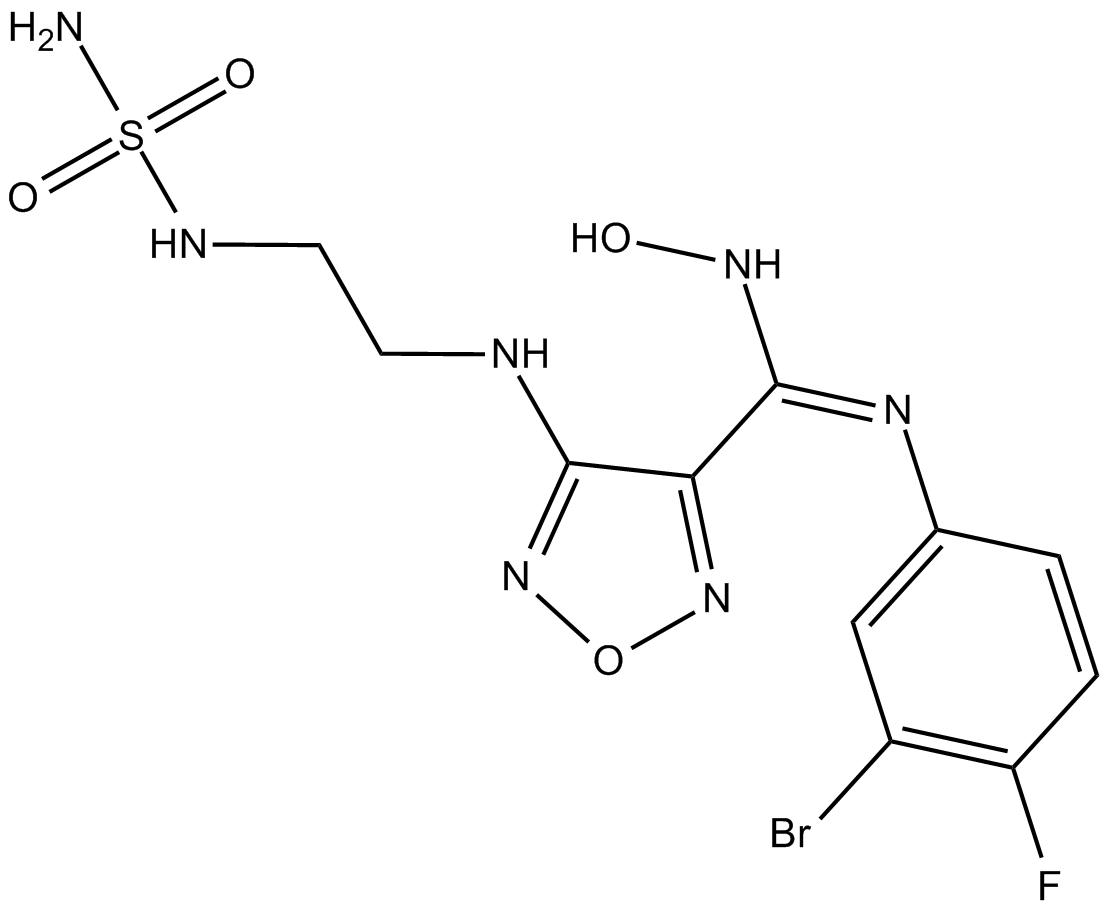
INCB-024360, también conocido como epacadostat, es un inhibidor oral selectivo de IDO1 de molécula pequeña (IC50 = 71.8nM)
Products are for research use only. Not for human use. We do not sell to patients.
Cas No.: 1204669-58-8
Sample solution is provided at 25 µL, 10mM.
_1-3.$$$39978408@51.jpg');)
_1-9.$$$38538795@65.jpg');)
_1-9.$$$39112701@51.jpg');)
_1-7.$$$37316672@70.jpg');)
_366-372.$$$36198801@70.jpg');)
.$$$38565142@65.jpg');)
_1867-1883.$$$33248023@67.jpg');)
_eads6055.$$$39977546@45.jpg');)
_eadm9805.$$$40080571@45.jpg');)
_eadj3020.$$$39666821@45.jpg');)
_1-20.$$$39757301@28.jpg');)
_1-24.$$$38898113@28.jpg');)
_273-287.$$$36806353@46.jpg');)
_1-16.$$$37156877@44.jpg');)
_1-19.$$$37460805@44.jpg');)
_1291-1307.$$$34518654@46.jpg');)
INCB-024360, también conocido como epacadostat, es un inhibidor oral selectivo de IDO1 de molécula pequeña (IC50 = 71.8nM) [1]. INCB-024360 puede inhibir selectivamente la actividad de la enzima IDO1 y bloquear la vía del metabolismo del tritófano a la quinurenina [2]. INCB-024360 se utiliza principalmente para tratar tumores sólidos avanzados o metastásicos [3-4].
En las células SKOV-3, INCB-024360 (10-3-104nM; 24h, 48h, 72h) aumenta la expresión de la proteína IDO1[5]. En las células HT-29, INCB-024360 (10μM; 96h) redujo la viabilidad celular [6]. En las células 4T1, INCB-024360 (1μM; 24h, 48h) sensibliza las metástasis pulmonares a agentes dirigidos a mecanismos de supervivencia de hipoxia/privación de nutrientes[7].
En el modelo de ratones de xenoinjerto de carcinoma de colon, INCB-024360 (100mg/kg; ig; 2h) inhibe efectivamente el metabolismo del triptófano a quinurenina al lograr una alta exposición a los medicamentos en áreas con alta expresión de IDO1, reduciendo significativamente la relación Kyn/Trp, restaurando así la eficacia antitumoral [8].En ratones de tipo salvaje y PD-1-negativos, la coadministración del anticuerpo bloqueador CTLA-4 9D9 y/o el inhibidor de IDO1 INCB-024360 (300mg/kg; ig; 27d) (para imitar los efectos del bloqueo de PD1) indujo sinérgicamente la lesión hepática y la infiltración de células inmunitarias[9]. En ratones WT inducidos por TAC, INCB-024360 (50mg/kg; sc; 4 semanas) inhibe IDO1 y mejora la hipertrofia cardíaca patológica y la remodelación [10]
References:
[1]. Liu X, Shin N, Koblish HK, et al. Selective inhibition of IDO1 effectively regulates mediators of antitumor immunity. Blood, The Journal of the American Society of Hematology. 2010 Apr 29; 115(17): 3520-3230.
[2]. Hao X, Chen Z, Li H, et al. Small-molecule drugs in immunotherapy. Mini Reviews in Medicinal Chemistry. 2023 Jul 1;23(13):1341-1359.
[3]. Alford B, Cox K, Soliman H. IDO1 inhibitors for cancer immunotherapy. Drugs of the Future. 2016 Sep 1; 41(9): 553-559.
[4]. Hellmann MD, Gettinger S, Chow LQ, et al. Phase 1 study of epacadostat in combination with atezolizumab for patients with previously treated advanced nonsmall cell lung cancer. International Journal of Cancer. 2020 Oct 1; 147(7): 1963-1969.
[5]. Rossini S, Ambrosino S, Volpi C, et al. Epacadostat stabilizes the apo-form of IDO1 and signals a pro-tumorigenic pathway in human ovarian cancer cells. Frontiers in Immunology. 2024 Jan 25; 15: 1346686.
[6]. Zhou Y, Tao Q, Luo C, et al. Epacadostat Overcomes Cetuximab Resistance in Colorectal Cancer by Targeting IDO‐Mediated Tryptophan Metabolism. Cancer Science. 2025 Mar 18.
[7]. Shen SC, Dey S, DuHadaway JB, et al. Neovascular pruning by IDO1 inhibitors can potentiate immunogenic cytotoxicity of ischemia-targeted agents to synergistically enhance anti-PD-1 responsiveness. Journal for Immunotherapy of Cancer. 2025 May 30; 13(5): e011398.
[8]. Poncelet L, Ait-Belkacem R, Marillier R, et al. Target exposure and pharmacodynamics study of the indoleamine 2, 3-dioxygenase-1 (IDO-1) inhibitor epacadostat in the CT26 mouse tumor model. Journal of Pharmaceutical and Biomedical Analysis. 2019 Jun 5; 170: 220-227.
[9]. Affolter T, Llewellyn HP, Bartlett DW, et al. Inhibition of immune checkpoints PD-1, CTLA-4, and IDO1 coordinately induces immune-mediated liver injury in mice. PLoS One. 2019 May 21; 14(5): e0217276.
[10]. Wang Y, Song J, Yu K, et al. Indoleamine 2, 3-dioxygenase 1 deletion-mediated kynurenine insufficiency inhibits pathological cardiac hypertrophy. Hypertension. 2023 Oct; 80(10): 2099-2111.
| Experimentos celulares [1]: | |
Líneas celulares | Células SKOV-3 |
Método de preparación | La viabilidad celular de las células SKOV-3 expuestas a INCB-024360 se analizó mediante el ensayo MTT. Las células se sembraron a la concentración final de 5 x 10³ células/100µL/pocillo en una placa de 96 pozos, y se trataron con INCB-024360 durante 24, 48 y 72 horas. Las células tratadas con vehículos se utilizaron como control. En cada momento, se eliminó el estímulo y se proporcionó a las células 110µL/poso de medio completo que contenía MTT a la concentración final de 0.45mg/mL. Después de 4 horas a 37℃, 100µL/pocillo del tampón de solubilización (SDS 10% en HCl 0.01M) y las células se incubaron durante la noche a 37℃. Al día siguiente, la viabilidad celular se determinó mediendo la absorbancia a 570nm, utilizando un espectrofotómetro UV/visible. |
Condiciones de reacción | 10-3-104nM; 24h, 48h, 72h |
Áreas de aplicación | INCB-024360 aumenta la expresión de la proteína IDO1 en las células SKOV-3. |
| Experimentos con animales [2]: | |
Modelos animales | Modelo de ratones de xenoinjerto de carcinoma de colon |
Método de preparación | La línea celular CT26 del caecinoma de colon se injertó por vía subcutánea en ratones BALB/c (Charles River Laboratories, France). los ratones fueron aleatoriazados y el tratamiento se inició cuando los tumores tenían un tamaño promedio de 70-120mm3. Los ratones fueron tratados por gavage oral con el inhibidor de IDO1, INCB-024360 a 100mg/kg, y luego sacrificados 2 horas después. |
Forma de dosificación | 100mg/kg; ig; 2h |
Áreas de aplicación | INCB-024360 inhibe eficazmente el metabolismo del triptófano a la quinurenina al lograr una alta exposición a los medicamentos en áreas con alta expresión de IDO1, reduciendo significativamente la relación Kyn/Trp, restaurando así la actividad inmune y mejorando la eficacia antitumoral. |
References: | |
| Cas No. | 1204669-58-8 | SDF | |
| Sinónimos | INCB024360 | ||
| Chemical Name | (E)-N'-(3-bromo-4-fluorophenyl)-N-hydroxy-4-((2-(sulfamoylamino)ethyl)amino)-1,2,5-oxadiazole-3-carboximidamide | ||
| Canonical SMILES | BrC1=C(F)C=CC(/N=C(NO)\C2=NON=C2NCCNS(N)(=O)=O)=C1 | ||
| Formula | C11H13BrFN7O4S | M.Wt | 438.23 |
| Solubility | ≥ 17.1mg/mL in DMSO | Storage | Store at -20°C |
| General tips | Please select the appropriate solvent to prepare the stock solution according to the
solubility of the product in different solvents; once the solution is prepared, please store it in
separate packages to avoid product failure caused by repeated freezing and thawing.Storage method
and period of the stock solution: When stored at -80°C, please use it within 6 months; when stored
at -20°C, please use it within 1 month. To increase solubility, heat the tube to 37°C and then oscillate in an ultrasonic bath for some time. |
||
| Shipping Condition | Evaluation sample solution: shipped with blue ice. All other sizes available: with RT, or with Blue Ice upon request. | ||
| Prepare stock solution | |||

|
1 mg | 5 mg | 10 mg |
| 1 mM | 2.2819 mL | 11.4095 mL | 22.8191 mL |
| 5 mM | 456.4 μL | 2.2819 mL | 4.5638 mL |
| 10 mM | 228.2 μL | 1.141 mL | 2.2819 mL |
Step 1: Enter information below (Recommended: An additional animal making an allowance for loss during the experiment)
 g
μL
g
μL
Step 2: Enter the in vivo formulation (This is only the calculator, not formulation. Please contact us first if there is no in vivo formulation at the solubility Section.)
Calculation results:
Working concentration: mg/ml;
Method for preparing DMSO master liquid: mg drug pre-dissolved in μL DMSO ( Master liquid concentration mg/mL, Please contact us first if the concentration exceeds the DMSO solubility of the batch of drug. )
Method for preparing in vivo formulation: Take μL DMSO master liquid, next addμL PEG300, mix and clarify, next addμL Tween 80, mix and clarify, next add μL saline, mix and clarify.
Method for preparing in vivo formulation: Take μL DMSO master liquid, next add μL Corn oil, mix and clarify.
Note: 1. Please make sure the liquid is clear before adding the next solvent.
2. Be sure to add the solvent(s) in order. You must ensure that the solution obtained, in the previous addition, is a clear solution before proceeding to add the next solvent. Physical methods such as vortex, ultrasound or hot water bath can be used to aid dissolving.
3. All of the above co-solvents are available for purchase on the GlpBio website.
Quality Control & SDS
- View current batch:
- Purity: >99.50% Appearance: A solid
- COA (Certificate of Analysis)
- SDS (Safety Data Sheet)
- Datasheet
Average Rating: 5 (Based on Reviews and 26 reference(s) in Google Scholar.)