

K145 |
Catalog No.GC12581
 One-Click Copy Product Info
|

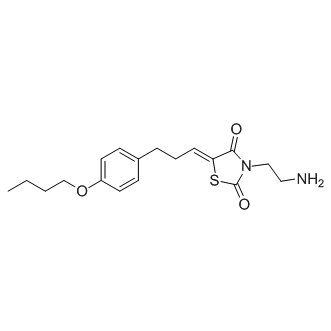
El compuesto K145 inhibe de forma específica la esfingosina quinasa 2, abreviada SphK2. Cuenta con un IC50 de 4.3μM y una constante Ki igual a 6.4μM. Por cierto, esta molécula presenta propiedades antitumorales.
Products are for research use only. Not for human use. We do not sell to patients.
Cas No.: 1309444-75-4
Sample solution is provided at 25 µL, 10mM.
_1-3.$$$39978408@51.jpg');)
_1-9.$$$38538795@65.jpg');)
_1-9.$$$39112701@51.jpg');)
_1-7.$$$37316672@70.jpg');)
_366-372.$$$36198801@70.jpg');)
.$$$38565142@65.jpg');)
_1867-1883.$$$33248023@67.jpg');)
_eads6055.$$$39977546@45.jpg');)
_eadm9805.$$$40080571@45.jpg');)
_eadj3020.$$$39666821@45.jpg');)
_1-20.$$$39757301@28.jpg');)
_1-24.$$$38898113@28.jpg');)
_273-287.$$$36806353@46.jpg');)
_1-16.$$$37156877@44.jpg');)
_1-19.$$$37460805@44.jpg');)
_1291-1307.$$$34518654@46.jpg');)
El compuesto K145 inhibe de forma específica la esfingosina quinasa 2, abreviada SphK2. Cuenta con un IC50 de 4.3μM y una constante Ki igual a 6.4μM. Por cierto, esta molécula presenta propiedades antitumorales[1, 2]. Se una de manera competitiva a la K145 SphK2 para bloquear su funcionamiento. Eso sí, no altera la actividad de su enzima homóloga, la SphK1[3]. Además, logra frenar la proliferación de células del plasmocitoma solitario, conocido como SP[4].
En ensayos realizados fuera de organismos vivos, se preparan líneas celulares de cáncer de mama (MCF-7, MDA-MB-231 y LM2-4). Al preincubarlas con K145 (2μM) se limita la migración celular activada por el factor de crecimeinto epidérmico EGF. En las células LM2-4, también desciende la cantidad de sphingosine-1-phosphate, abreviada S1P[5].
Para experimento con aniamles vivos, existen dos protocolos diferenciados con esta sustancia. Primero, se inyecta K145 por vía intraperitoneal durante diez días en ratones ob/ob y db/db, con dosis de 5 y 10mg/kg. El tratamiento aminora la acumulación de grasas en el hígado. En los ejemplares db/db, baja la glucosa sanguínea en ayunas. En los ratones ob/ob, modifica los niveles de mRNA de genes implicados en el metabolismo lipídico hepático[6]. Segundo, se suministra diariamente K145 (50mg/kg/día) durante 30 días en ratones con xenoinjerto de glioblastoma (GBM). El compuesto ralentiza el avance del tumor y mejora la tasa de supervivencia de los animales de ensayo[7].
References:
[1] Liu K, Guo T L, Hait N C, et al. Biological characterization of 3-(2-amino-ethyl)-5-[3-(4-butoxyl-phenyl)-propylidene]-thiazolidine-2, 4-dione (K145) as a selective sphingosine kinase-2 inhibitor and anticancer agent[J]. PloS one, 2013, 8(2): e56471.
[2] Lewis A C, Wallington-Beddoe C T, Powell J A, et al. Targeting sphingolipid metabolism as an approach for combination therapies in haematological malignancies[J]. Cell Death Discovery, 2018, 4(1): 72.
[3] Worrell B L, Brown A M, Santos W L, et al. In silico characterization of structural distinctions between isoforms of human and mouse sphingosine kinases for accelerating drug discovery[J]. Journal of chemical information and modeling, 2019, 59(5): 2339-2351.
[4] Li J, Li X J, Zhao D, et al. K145, a sphingosine kinase 2 inhibitor, inhibits solitary plasmacytoma cell growth[J]. The FASEB Journal, 2018, 32: 836.14-836.14.
[5] Maiti A, Takabe K, Hait N C. Metastatic triple-negative breast cancer is dependent on SphKs/S1P signaling for growth and survival[J]. Cellular signalling, 2017, 32: 85-92.
[6] Shi Y, Wei Q, Liu Y, et al. The alleviating effect of sphingosine kinases 2 inhibitor K145 on nonalcoholic fatty liver[J]. Biochemical and biophysical research communications, 2021, 580: 1-6.
[7] Fei X, Dou Y, Sun K, et al. TRIM22 promotes the proliferation of glioblastoma cells by activating MAPK signaling and accelerating the degradation of Raf-1[J]. Experimental & molecular medicine, 2023, 55(6): 1203-1217.
| Experimentos celulares [1]: | |
Líneas celulares | Células MCF-7、MDA-MB-231、LM2-4 |
Método de preparación | Las células se mantuvieron en un medio que contenía suero 1-2% durante 18h. Las monocapas se rascaron cuidadosamente con una punta de pipeta de 20-μl o 200-μl. Los desechos celulares se eliminaron posteriormente mediante lavado con PBS, y las células se incubaron en medio con 1-2% de suero. Las células fueron pretratadas con 2μM PF543 (inhibitor de SphK1) y K145 (inhibitor de SphK2 antes del tratameinto del factor de crecimiento epidérmico (EGF) (100ng/ml) durante 8 a 24h. Las células migratorias hacia el área herida fueron fotografiadas bajo un microscopio de contraste de fase. |
Condiciones de reacción | 2µM; 8, 24h |
Áreas de aplicación | La inhibición de SphK2 con el compuesto K145 no solo suprime la migración mediada por EGF de las células MCF-7 y MDA-MB-231, sino que también inhibe la migración mediada por EGF de la línea celular de cáncer de mama metastásico pulmonar LM2-4. |
| Experimentos con animales [2]: | |
Modelos animales | C57BL/6 macho, ratones ob/ob deficientes en leptina, ratones db/db |
Método de preparación | 13 semanas de C57BL/6 macho, ratones ob/ob deficients en leptina y ratones db/db se mantuvieron en una habitación de 12h de ciclo claro-oscuridad con temperatura controlada a 25℃. Se utilizaron seis ratones en cada grupo y recibieron inyección i.p. del inhibidor de SphK2 a una dosis de 5mg/kg y 10mg/kg (disuelto en DMSO) todos los días como grupo experimental. Para el grupo de control, los ratones recibieron una inyección equivalente de DMSO i.p. Después de la inyección durante 10 días, se recogieron sus muestras de sangre e hígado. |
Forma de dosificación | 5, 10mg/kg; 10 días; i.p. |
Áreas de aplicación | K145 mejoró el hígado graso de ratones ob/ob. K145 mejoró la acumulación de lípidos hepáticos y la glucosa en sangre en ayunas de ratones db/db. Los niveles de mRNA hepático para los genes relacionados con el metabolismo de los lípidos fueron regulados por el tratamiento K145 de ratones ob/ob. |
References: | |
| Cas No. | 1309444-75-4 | SDF | |
| Chemical Name | (Z)-3-(2-aminoethyl)-5-(3-(4-butoxyphenyl)propylidene)thiazolidine-2,4-dione | ||
| Canonical SMILES | CCCCOC1=CC=C(C=C1)CC/C([H])=C(S2)/C(N(C2=O)CCN)=O | ||
| Formula | C18H24N2O3S | M.Wt | 348.46 |
| Solubility | Soluble in DMSO | Storage | Store at -20°C |
| General tips | Please select the appropriate solvent to prepare the stock solution according to the
solubility of the product in different solvents; once the solution is prepared, please store it in
separate packages to avoid product failure caused by repeated freezing and thawing.Storage method
and period of the stock solution: When stored at -80°C, please use it within 6 months; when stored
at -20°C, please use it within 1 month. To increase solubility, heat the tube to 37°C and then oscillate in an ultrasonic bath for some time. |
||
| Shipping Condition | Evaluation sample solution: shipped with blue ice. All other sizes available: with RT, or with Blue Ice upon request. | ||
| Prepare stock solution | |||

|
1 mg | 5 mg | 10 mg |
| 1 mM | 2.8698 mL | 14.3488 mL | 28.6977 mL |
| 5 mM | 574 μL | 2.8698 mL | 5.7395 mL |
| 10 mM | 287 μL | 1.4349 mL | 2.8698 mL |
Step 1: Enter information below (Recommended: An additional animal making an allowance for loss during the experiment)
 g
μL
g
μL
Step 2: Enter the in vivo formulation (This is only the calculator, not formulation. Please contact us first if there is no in vivo formulation at the solubility Section.)
Calculation results:
Working concentration: mg/ml;
Method for preparing DMSO master liquid: mg drug pre-dissolved in μL DMSO ( Master liquid concentration mg/mL, Please contact us first if the concentration exceeds the DMSO solubility of the batch of drug. )
Method for preparing in vivo formulation: Take μL DMSO master liquid, next addμL PEG300, mix and clarify, next addμL Tween 80, mix and clarify, next add μL saline, mix and clarify.
Method for preparing in vivo formulation: Take μL DMSO master liquid, next add μL Corn oil, mix and clarify.
Note: 1. Please make sure the liquid is clear before adding the next solvent.
2. Be sure to add the solvent(s) in order. You must ensure that the solution obtained, in the previous addition, is a clear solution before proceeding to add the next solvent. Physical methods such as vortex, ultrasound or hot water bath can be used to aid dissolving.
3. All of the above co-solvents are available for purchase on the GlpBio website.
Quality Control & SDS
- View current batch:
- Purity: >98.00% Appearance: A solid
- COA (Certificate of Analysis)
- SDS (Safety Data Sheet)
- Datasheet
Average Rating: 5 (Based on Reviews and 11 reference(s) in Google Scholar.)