
MCC950 sodium (Synonyms: CRID3 sodium salt ) |
| Catalog No.GC10634 |
MCC950 sodium es un potente y selectivo inhibidor de pequeñas moléculas de NLRP3.
Products are for research use only. Not for human use. We do not sell to patients.
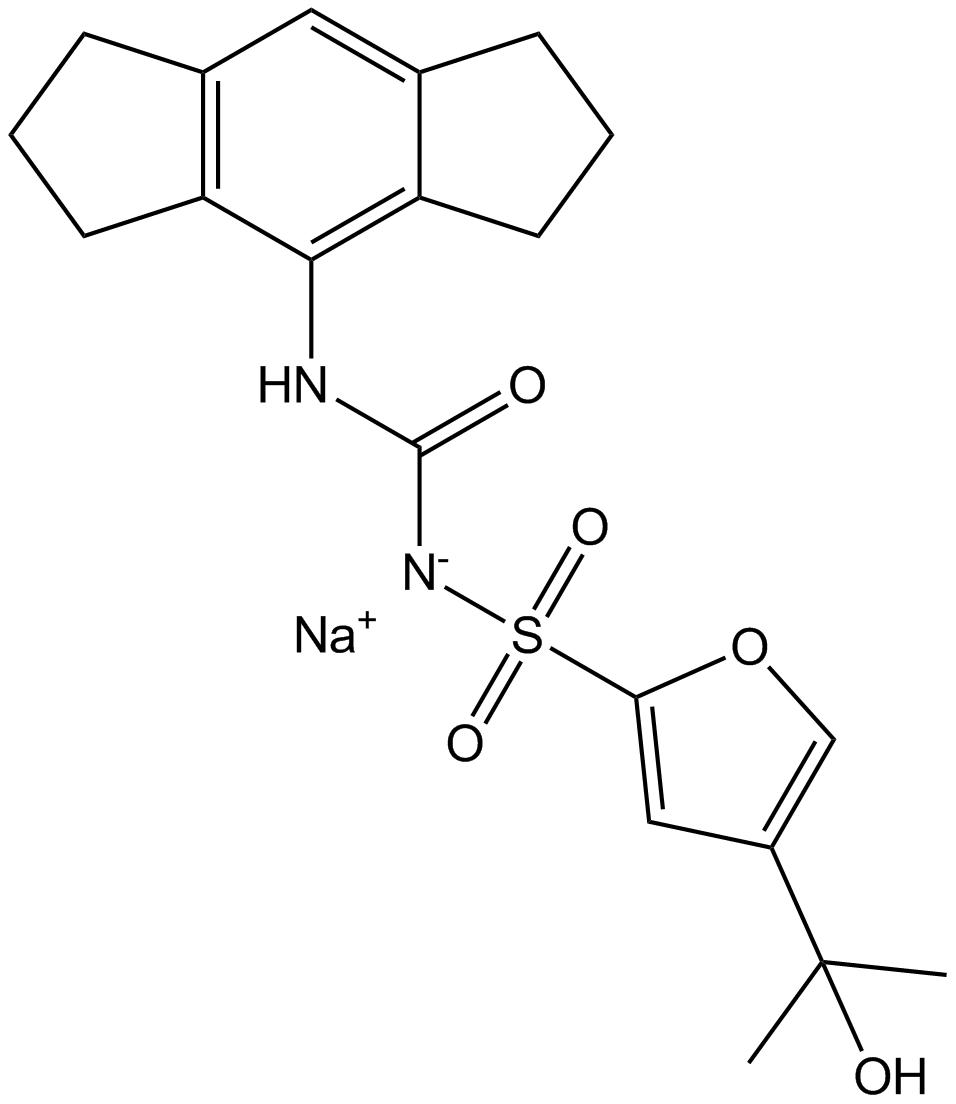
Cas No.: 256373-96-3
Sample solution is provided at 25 µL, 10mM.
- J Ethnopharmacol 340 (2025):119172.PMID:39643022
- Front Pharmacol 16 (2025):1588585.
- Vet Res 53.1 (2022):1-8.PMID:35123552
- J Inflamm Res (2024):6143-6158.PMID:39262652
- Vet Res 53.1 (2022):10.PMID:35123552
- Immun Inflamm Dis 12.12 (2024):e70094.PMID:39679857
- Phytomedicine 94 (2022):153849.
- Vet Res 53.1 (2022):10.
- Behav Brain Res 428 (2022):113879.
- Int J Mol Sci24 21 (2023):15839.
MCC950 sodium es un potente y selectivo inhibidor de pequeñas moléculas de NLRP3. MCC950 bloquea la activación canónica y no canónica de NLRP3 a concentraciones nanomolares. MCC950 inhibe específicamente NLRP3 pero no la activación de AIM2, NLRC4 o NLRP1. MCC950 reduce la producción de Interleucina-1β (IL-1β) in vivo y atenúa la severidad de la encefalomielitis autoinmune experimental (EAE), un modelo de enfermedad de esclerosis múltiple. Además, el tratamiento con MCC950 rescata la letalidad neonatal en un modelo murino de CAPS y es activo en muestras ex vivo de individuos con síndrome de Muckle-Wells. MCC950 es, por tanto, un potencial terapéutico para síndromes asociados a NLRP3, incluyendo enfermedades autoinflamatorias y autoinmunes, y una herramienta para el estudio adicional del inflamasoma NLRP3 en la salud y enfermedad humana.[1]
La concentración inhibitoria media (IC50) de MCC950 en BMDM fue aproximadamente de 7,5 nM, mientras que en HMDM tuvo una capacidad inhibitoria similar (IC50 = 8,1 nM). Las células se preactivaron primero con LPS, luego se pretrataron con MCC950 y finalmente se estimularon con el estímulo NLRP3 ATP. El tratamiento de las células con concentraciones nanomolares de MCC950 inhibió de manera dependiente de la dosis la liberación de IL-1β en BMDM, HMDM y PBMC.[1]
Los ratones fueron pretratados con MCC950 una hora antes de la inyección i.p. de LPS y fueron evaluados dos horas más tarde. El pretratamiento con MCC950 redujo las concentraciones séricas de IL-1β e IL-6, mientras que no disminuyó considerablemente la cantidad de TNF-α, lo que indica que MCC950 es activo in vivo. Además, el tratamiento de ratones db/db con el inhibidor del inflamasoma NLRP3 MCC950 mejoró los comportamientos de ansiedad y depresión, así como la disfunción cognitiva, y revirtió los niveles aumentados de expresión de NLRP3, ASC e IL-1β y la actividad de caspasa-1 en el hipocampo. Además, el tratamiento con MCC950 mejoró significativamente la sensibilidad a la insulina en ratones db/db.[1,2]
References:
[1]. Coll, Rebecca C et al. A small-molecule inhibitor of the NLRP3 inflammasome for the treatment of inflammatory diseases. Nature medicine vol. 21,3 (2015): 248-55.
[2]. Zhai, Yadong et al. Inhibiting the NLRP3 Inflammasome Activation with MCC950 Ameliorates Diabetic Encephalopathy in db/db Mice. Molecules (Basel, Switzerland) vol. 23,3 522. 27 Feb. 2018.

| Experimentos celulares [1]: | |
Líneas celulares | Médula ósea, células HEK293T |
Método de preparación | El MCC950 en forma de sal sódica es altamente soluble en soluciones acuosas. |
Condiciones de reacción | 0,001–10 µM, 30 min |
Áreas de aplicación | La concentración inhibitoria media (IC50) del MCC950 en BMDM fue aproximadamente 7,5 nM, mientras que en HMDM tuvo una capacidad inhibitoria similar (IC50 = 8,1 nM). |
| Experimentos con animales [2]: | |
Modelos animales | Ratones C57BL/6 |
Método de preparación | El MCC950 en forma de sal sódica es altamente soluble en soluciones acuosas. |
Forma de dosificación | 50 mg/kg, inyección intraperitoneal |
Áreas de aplicación | El MCC950 no solo inhibe el NLRP3 in vivo y atenúa la gravedad de la EAE, sino que también rescata un modelo murino de CAPS e inhibe el NLRP3 en células humanas de MWS. |
Referencias: [1]. Coll, Rebecca C et al. Un inhibidor de molécula pequeña del inflamasoma NLRP3 para el tratamiento de enfermedades inflamatorias. Nature medicine vol. 21,3 (2015): 248-55. [2]. Zhai, Yadong et al. Inhibición de la activación del inflamasoma NLRP3 con MCC950 mejora la encefalopatía diabética en ratones db/db. Molecules (Basel, Switzerland) vol. 23,3 522. 27 Feb. 2018. | |
| Cas No. | 256373-96-3 | SDF | |
| Sinónimos | CRID3 sodium salt | ||
| Chemical Name | sodium ((1,2,3,5,6,7-hexahydro-s-indacen-4-yl)carbamoyl)((4-(2-hydroxypropan-2-yl)furan-2-yl)sulfonyl)amide | ||
| Canonical SMILES | O=C(NC1=C2CCCC2=CC3=C1CCC3)[N-]S(=O)(C4=CC(C(O)(C)C)=CO4)=O.[Na+] | ||
| Formula | C20H23N2NaO5S | M.Wt | 426.5 |
| Solubility | ≥ 21.45 mg/mL in DMSO, ≥ 100 mg/mL in Water with gentle warming, ≥ 43 mg/mL in EtOH | Storage | Store at -20°C |
| General tips | Please select the appropriate solvent to prepare the stock solution according to the
solubility of the product in different solvents; once the solution is prepared, please store it in
separate packages to avoid product failure caused by repeated freezing and thawing.Storage method
and period of the stock solution: When stored at -80°C, please use it within 6 months; when stored
at -20°C, please use it within 1 month. To increase solubility, heat the tube to 37°C and then oscillate in an ultrasonic bath for some time. |
||
| Shipping Condition | Evaluation sample solution: shipped with blue ice. All other sizes available: with RT, or with Blue Ice upon request. | ||
| Prepare stock solution | |||
|
1 mg | 5 mg | 10 mg |
| 1 mM | 2.3447 mL | 11.7233 mL | 23.4467 mL |
| 5 mM | 468.9 μL | 2.3447 mL | 4.6893 mL |
| 10 mM | 234.5 μL | 1.1723 mL | 2.3447 mL |
Step 1: Enter information below (Recommended: An additional animal making an allowance for loss during the experiment)
Step 2: Enter the in vivo formulation (This is only the calculator, not formulation. Please contact us first if there is no in vivo formulation at the solubility Section.)
Calculation results:
Working concentration: mg/ml;
Method for preparing DMSO master liquid: mg drug pre-dissolved in μL DMSO ( Master liquid concentration mg/mL, Please contact us first if the concentration exceeds the DMSO solubility of the batch of drug. )
Method for preparing in vivo formulation: Take μL DMSO master liquid, next addμL PEG300, mix and clarify, next addμL Tween 80, mix and clarify, next add μL ddH2O, mix and clarify.
Method for preparing in vivo formulation: Take μL DMSO master liquid, next add μL Corn oil, mix and clarify.
Note: 1. Please make sure the liquid is clear before adding the next solvent.
2. Be sure to add the solvent(s) in order. You must ensure that the solution obtained, in the previous addition, is a clear solution before proceeding to add the next solvent. Physical methods such as vortex, ultrasound or hot water bath can be used to aid dissolving.
3. All of the above co-solvents are available for purchase on the GlpBio website.
Quality Control & SDS
- View current batch:
- Purity: >98.00%
- COA (Certificate Of Analysis)
- SDS (Safety Data Sheet)
- Datasheet
-
Related Biological Data

DBP exposure led NLRP3-mediated pyroptosis via the p38MAPK/NF-κB signaling pathway in HepG2 cells.(G) protein expression in HepG2 cells. DBP: 40 μM, SB203580:5 μM, PDTC: 10 μM, MCC950: 10 μM.
Before DBP stimulation, the p38MAPK (SB203580, 5 μM) (GLPBIO USA), NF-κB (PDTC, 10 μM) and NLRP3 (MCC950, 10 μM) (GLPBIO, USA) inhibitors were introduced to the medium 1 h in advance, respectively.
Sci Total Environ (2023): 165500. PMID: 37442457 IF: 9.8003 -
Related Biological Data

MCC950 attenuated apoptosis in AlCl3-treated Parkin-/- mice hippocampus. (B) Effects of MCC950 on the apoptosis of mice hippocampus by TUNEL staining.
The second-time was treated with normal saline, MitoQ (5 mg/kg body weight, twice weekly) or MCC950 (GlpBio) (10 mg/kg body weight, twice weekly) by intraperitoneal injection in the afternoon of the same day.
Ecotox Environ Safe 264 (2023): 115459. PMID: 37703808 IF: 6.7996 -
Related Biological Data

MCC950 reduced the activation of the NLRP3 inflammasome in LPS-induced RAW 264.7 cells.(a) Effects of MCC950 on NLRP3 expression in LPS-induced RAW 264.7 macrophages as determined by Western blot analysis.
Mice in the IMQ + MCC950 group were intra-gastrically administered with MCC950 (GLPBIO, USA) at a dose of 20 mg/kg/d for 7 consecutive days.
Int Immunopharmacol 124 (2023): 110811. PMID: 37647679 IF: 5.5999 -
Related Biological Data

MCC950 reduces susceptibility to Kainic Acid-induced seizures in mice.B-D: Seizure severity (B): Seizure latency (C): and seizure duration (D).
On the fifth day after electrode implantation, MCC950 (10 mg/kg)(GC10634, GlpBio) was intraperitoneally injected into the mice in the MCC950 groups, whereas those in the CT groups received an equal volume of saline intraperitoneally as a vehicle.
Int Immunopharmacol 126 (2024): 111236. PMID: 38039716 IF: 5.5999 -
Related Biological Data

Refractive status and expression levels of NLRP3 signaling pathway-related factors in the three blank control groups of mice. No statistically significant differences were observed in the refractive status (A) and axial length (B) among the age-matched groups of mice.
To prepare the MCC950 injectable solution, solid MCC950 powder ( GLPBIO) was dissolved in freshly prepared saline solution at a concentration of 50 mg/mL.
Int J Mol Sci 24.21 (2023): 15839. PMID: 37958819 IF: 5.5999 -
Related Biological Data

(A–B) Protein levels of NLRP3, caspase-1, and GSDMD-N.
Mice in the HFPO-TA + MCC950 group received intraperitoneal injections of MCC950 (10 mg/kg, twice/week for 4 weeks; GLPBIO, USA).
Food Chem Toxicol (2023): 113706. PMID: 36871880 IF: 5.5716
Average Rating: 5 (Based on Reviews and 11 reference(s) in Google Scholar.)
GLPBIO products are for RESEARCH USE ONLY. Please make sure your review or question is research based.
Required fields are marked with *