

MCC950 sodium (Synonyms: CRID3 sodium salt ) |
カタログ番号GC10634
 One-Click Copy Product Info
|

MCC950ナトリウム塩(CRID3ナトリウム塩)(MCC950 sodium)は、新規の経口活性型NLRP3インフラマソーム阻害剤(IC50値=7.5nM~8.1nM)である。
Products are for research use only. Not for human use. We do not sell to patients.
Cas No.: 256373-96-3
Sample solution is provided at 25 µL, 10mM.
- J Ethnopharmacol 340 (2025):119172.PMID:39643022
- Front Pharmacol 16 (2025):1588585.
- Int Immunopharmacol 185 (2026):117010.PMID:42284764
- Mol Med Rep 34.2 (2026):230.PMID:42318962
- Vet Res 53.1 (2022):1-8.PMID:35123552
- J Inflamm Res (2024):6143-6158.PMID:39262652
- Vet Res 53.1 (2022):10.PMID:35123552
- Immun Inflamm Dis 12.12 (2024):e70094.PMID:39679857
- Phytomedicine 94 (2022):153849.
- Vet Res 53.1 (2022):10.
- Behav Brain Res 428 (2022):113879.
- Int J Mol Sci24 21 (2023):15839.
MCC950ナトリウム塩(CRID3ナトリウム塩)(MCC950 sodium)は、新規の経口活性型NLRP3インフラマソーム阻害剤(IC50値=7.5nM~8.1nM)である。MCC950ナトリウム塩は、NLRP3のNACHTドメインに結合し、ATP加水分解を阻害することでNLRP3インフラマソームの活性化を抑制し、IL-1βやIL-18などの炎症性サイトカインの放出を減少させる。MCC950ナトリウム塩は、炎症性疾患、心血管疾患、および神経変性疾患に関する研究に利用可能である。
In vitroでは、H9c2細胞を7.5nMのMCC950ナトリウム塩で1時間前処理した後、1µMのドキソルビシンで24時間処理した。MCC950ナトリウム塩は、心筋におけるNLRP3、カスパーゼ-1、ASC、GSDMD、IL-1β、およびIL-18の切断を抑制し、細胞の生存率と形態を改善し、NLRP3を介したパイロトーシスを抑制した。PC12細胞を10µMのMCC950ナトリウム塩で2時間前処理した。MCC950ナトリウム塩は、酸素・グルコース欠乏/再酸素化によって誘発される活性酸素種の生成を抑制し、ミトコンドリア膜電位を維持し、PC12細胞におけるパイロトーシスおよび核濃縮を軽減した。SARS-CoV-2によって誘導されたTHP-1細胞をMCC950ナトリウム塩で処理した。MCC950ナトリウム塩は、IL-1βの分泌およびIL-6の産生を抑制し、SARS-CoV-2のNタンパク質によって促進されるASCのオリゴマー化を抑制した。
In vivoでは、高脂肪食を摂取させたapoE-/-マウスに、MCC950ナトリウム塩を10mg/kgの用量で週3回、12週間にわたり腹腔内投与した。MCC950ナトリウム塩は、大動脈のプラーク面積およびマクロファージ含有量を減少させ、大動脈におけるNLRP3およびカスパーゼ-1のタンパク質発現ならびにASCのオリゴマー化を抑制した。foz/fozマウスに対し、20mg/kgのMCC950ナトリウム塩を週5日、9週間にわたり経口投与した。MCC950ナトリウム塩は、血漿中のALTおよびAST濃度を低下させ、血漿中のIL-1β、MCP-1、IL-6濃度を減少させ、さらに肝臓におけるNLRP3、活性型カスパーゼ-1、およびIL-1βのタンパク質発現を低下させた。LPSで刺激されたC57BL/6マウスに対し、予防的に50mg/kgのMCC950ナトリウム塩を腹腔内投与した。MCC950ナトリウム塩は、血清中のIL-1βおよびIL-6濃度を低下させた。
| 細胞実験 [1]: | |
|
細胞株 |
H9c2細胞(ラット胎児心室心筋細胞株) |
|
調製方法 |
H9c2細胞を、10% FBSを含むDMEM中で、37°C、5% CO2の条件下で培養した。細胞を7.5nMのMCC950ナトリウム塩で1時間前処理した後、1μMのドキソルビシンで24時間処理した。処理後、細胞生存率(CCK-8)、LDH放出量、ATP含有量、IL-1βおよびIL-18のELISA、NLRP3およびカスパーゼ-1の免疫蛍光染色、ならびにNLRP3/ASC/カスパーゼ-1/GSDMD/IL-1β/IL-18の切断に関するqPCRおよびウエスタンブロットを評価した。 |
|
反応条件 |
7.5nM;1時間の前処理 |
|
応用 |
MCC950ナトリウム塩は、H9c2細胞の生存率を高め、細胞形態を改善し、LDHの放出を抑制し、ATP含有量を増加させ、IL-1βおよびIL-18のレベルを低下させ、NLRP3およびカスパーゼ-1の蛍光シグナルを減少させ、さらにドキソルビシンによるNLRP3、ASC、カスパーゼ-1、GSDMD、IL-1βおよびIL-18のタンパク質およびmRNAレベルでの切断を抑制した。 |
| 動物実験 [2]: | |
|
動物モデル |
apoE-/-マウス |
|
調製方法 |
マウスに高脂肪食(コレステロール0.15%+脂肪21%)を12週間与え、高脂肪食の投与と並行して、MCC950ナトリウム塩を10mg/kgの用量で週3回、12週間腹腔内投与した。6週間後、各群から2匹のマウスの大動脈全体をOil Red Oによるen face解析を行った。12週間後、血清分析、Oil Red O染色、大動脈基部のHE/Oil Red O/免疫蛍光/TUNEL染色、RT-qPCRおよびウエスタンブロットのために、静脈血、心臓、および大動脈樹全体を採取した。 |
|
剤形 |
10mg/kg;腹腔内投与;週3回、12週間 |
|
応用 |
MCC950ナトリウム塩は、大動脈全体および大動脈基部のプラーク面積を縮小させ、プラークの脂質含有量を低下させ、大動脈内のマクロファージ含有量およびマクロファージ内のNLRP3発現を減少させ、ASCのオリゴマー化を阻害し、大動脈におけるNLRP3およびカスパーゼ-1の発現を抑制し、大動脈内のIL-1β、 IL-18およびGSDMD-Nタンパク質レベルならびにマクロファージ内のGSDMD-N蛍光を減少させ、大動脈根部のTUNEL陽性細胞数を低下させ、血清中のTNF-α、IL-1β、IL-6およびIL-18レベルを低下させたが、血清中のTG、TC、LDL-C、HDL-C、ox-LDLレベル、体重、あるいは肝臓・腎臓・骨髄への毒性には変化をもたらさなかった。 |
| Cas No. | 256373-96-3 | SDF | |
| 同義語 | CRID3 sodium salt | ||
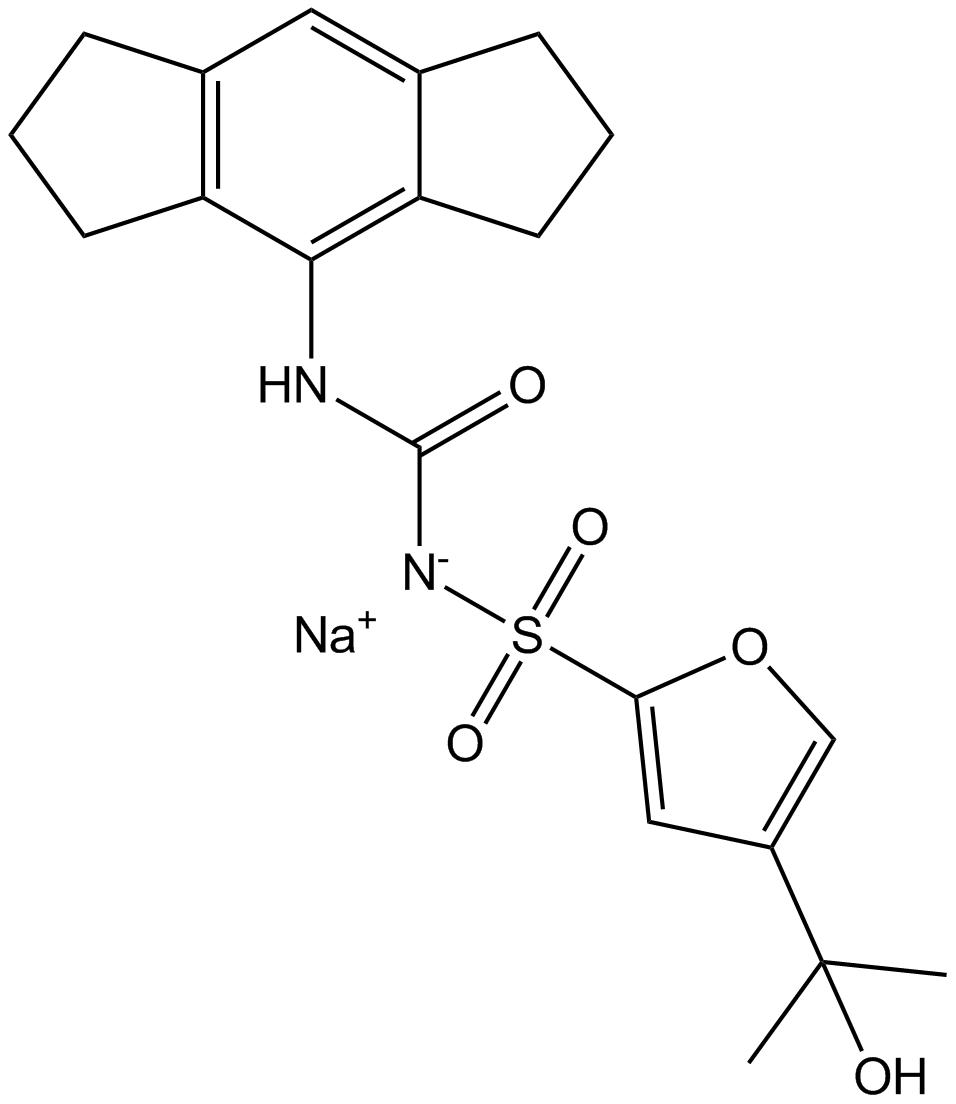
| Chemical Name | sodium ((1,2,3,5,6,7-hexahydro-s-indacen-4-yl)carbamoyl)((4-(2-hydroxypropan-2-yl)furan-2-yl)sulfonyl)amide | ||
| Canonical SMILES | O=C(NC1=C2CCCC2=CC3=C1CCC3)[N-]S(=O)(C4=CC(C(O)(C)C)=CO4)=O.[Na+] | ||
| Formula | C20H23N2NaO5S | M.Wt | 426.5 |
| 溶解度 | ≥ 21.45 mg/mL in DMSO, ≥ 100 mg/mL in Water with gentle warming, ≥ 43 mg/mL in EtOH | Storage | Store at -20°C |
| Shipping Condition | Evaluation sample solution: shipped with blue ice. All other sizes available: with RT, or with Blue Ice upon request. | ||
| Prepare stock solution | |||

|
1 mg | 5 mg | 10 mg |
| 1 mM | 2.3447 mL | 11.7233 mL | 23.4467 mL |
| 5 mM | 468.9 μL | 2.3447 mL | 4.6893 mL |
| 10 mM | 234.5 μL | 1.1723 mL | 2.3447 mL |
Step 1: Enter information below (Recommended: An additional animal making an allowance for loss during the experiment)
 g
μL
g
μL
Step 2: Enter the in vivo formulation (This is only the calculator, not formulation. Please contact us first if there is no in vivo formulation at the solubility Section.)
Calculation results:
Working concentration: mg/ml;
Method for preparing DMSO master liquid: mg drug pre-dissolved in μL DMSO ( Master liquid concentration mg/mL, Please contact us first if the concentration exceeds the DMSO solubility of the batch of drug. )
Method for preparing in vivo formulation: Take μL DMSO master liquid, next addμL PEG300, mix and clarify, next addμL Tween 80, mix and clarify, next add μL saline, mix and clarify.
Method for preparing in vivo formulation: Take μL DMSO master liquid, next add μL Corn oil, mix and clarify.
Note: 1. Please make sure the liquid is clear before adding the next solvent.
2. Be sure to add the solvent(s) in order. You must ensure that the solution obtained, in the previous addition, is a clear solution before proceeding to add the next solvent. Physical methods such as vortex, ultrasound or hot water bath can be used to aid dissolving.
3. All of the above co-solvents are available for purchase on the GlpBio website.
Quality Control & SDS
- View current batch:
- Purity: >98.00% Appearance: A solid
- COA (Certificate of Analysis)
- SDS (Safety Data Sheet)
- Datasheet
-
Related Biological Data

DBP exposure led NLRP3-mediated pyroptosis via the p38MAPK/NF-κB signaling pathway in HepG2 cells.(G) protein expression in HepG2 cells. DBP: 40 μM, SB203580:5 μM, PDTC: 10 μM, MCC950: 10 μM.
Before DBP stimulation, the p38MAPK (SB203580, 5 μM) (GLPBIO USA), NF-κB (PDTC, 10 μM) and NLRP3 (MCC950, 10 μM) (GLPBIO, USA) inhibitors were introduced to the medium 1 h in advance, respectively.
Sci Total Environ (2023): 165500. PMID: 37442457 IF: 9.8003 -
Related Biological Data

MCC950 attenuated apoptosis in AlCl3-treated Parkin-/- mice hippocampus. (B) Effects of MCC950 on the apoptosis of mice hippocampus by TUNEL staining.
The second-time was treated with normal saline, MitoQ (5 mg/kg body weight, twice weekly) or MCC950 (GlpBio) (10 mg/kg body weight, twice weekly) by intraperitoneal injection in the afternoon of the same day.
Ecotox Environ Safe 264 (2023): 115459. PMID: 37703808 IF: 6.7996 -
Related Biological Data

MCC950 reduced the activation of the NLRP3 inflammasome in LPS-induced RAW 264.7 cells.(a) Effects of MCC950 on NLRP3 expression in LPS-induced RAW 264.7 macrophages as determined by Western blot analysis.
Mice in the IMQ + MCC950 group were intra-gastrically administered with MCC950 (GLPBIO, USA) at a dose of 20 mg/kg/d for 7 consecutive days.
Int Immunopharmacol 124 (2023): 110811. PMID: 37647679 IF: 5.5999 -
Related Biological Data

MCC950 reduces susceptibility to Kainic Acid-induced seizures in mice.B-D: Seizure severity (B): Seizure latency (C): and seizure duration (D).
On the fifth day after electrode implantation, MCC950 (10 mg/kg)(GC10634, GlpBio) was intraperitoneally injected into the mice in the MCC950 groups, whereas those in the CT groups received an equal volume of saline intraperitoneally as a vehicle.
Int Immunopharmacol 126 (2024): 111236. PMID: 38039716 IF: 5.5999 -
Related Biological Data

Refractive status and expression levels of NLRP3 signaling pathway-related factors in the three blank control groups of mice. No statistically significant differences were observed in the refractive status (A) and axial length (B) among the age-matched groups of mice.
To prepare the MCC950 injectable solution, solid MCC950 powder ( GLPBIO) was dissolved in freshly prepared saline solution at a concentration of 50 mg/mL.
Int J Mol Sci 24.21 (2023): 15839. PMID: 37958819 IF: 5.5999 -
Related Biological Data

(A–B) Protein levels of NLRP3, caspase-1, and GSDMD-N.
Mice in the HFPO-TA + MCC950 group received intraperitoneal injections of MCC950 (10 mg/kg, twice/week for 4 weeks; GLPBIO, USA).
Food Chem Toxicol (2023): 113706. PMID: 36871880 IF: 5.5716
Average Rating: 5 (Based on Reviews and 11 reference(s) in Google Scholar.)