
Mitoquinone mesylate (Mitoquinone methanesulfonate) |
| Catalog No.GC31292 |
Mitoquinone mesylate (Mitoquinone methanesulfonate) es uno de los antioxidantes más utilizados que se dirigen a las mitocondrias.
Products are for research use only. Not for human use. We do not sell to patients.
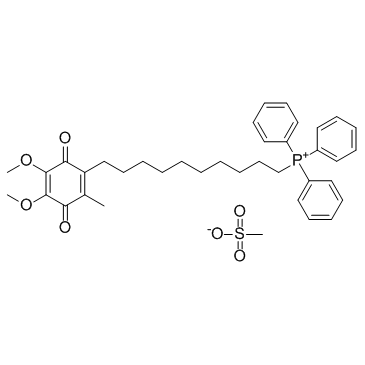
Cas No.: 845959-50-4
Sample solution is provided at 25 µL, 10mM.
Mitoquinone mesylate (Mitoquinone methanesulfonate) es uno de los antioxidantes más utilizados que se dirigen a las mitocondrias. Fue desarrollado para penetrar fácilmente la barrera hematoencefálica (BBB) y las membranas neuronales, donde se concentra en varias centenas dentro de las mitocondrias, mediando la capacidad antioxidante local [1]. Dentro de la cadena de transporte de electrones (ETC), el complejo II, también conocido como succinato deshidrogenasa, reduce el grupo ubiquinona de Mitoquinone mesylate a la forma antioxidante activa ubiquinol, que elimina el exceso de ROS [2].
Mitoquinone mesylate (50 nM) redujo la fragmentación mitocondrial inducida por 6-OHDA, cuando se utilizó en la línea celular SH-SY5Y. Inhibió la proteína de fisión mitocondrial y la translocación de la proteína pro-apoptótica (Bax) en las mitocondrias [3].
El tratamiento con Mitoquinone mesylate inhibió la pérdida de neuronas dopaminérgicas y mejoró el rendimiento conductual, mostrando efectos neuroprotectores en modelos de ratones con enfermedad de Parkinson (PD) [4]. El tratamiento con Mitoquinone mesylate mejoró el control motor fino y redujo los marcadores de daño oxidativo en los músculos en un modelo de ratón con enfermedad de Huntington (HD) [5]. Mitoquinone mesylate redujo la lesión de la materia blanca, mejoró el rendimiento neurológico y disminuyó la latencia del potencial evocado motor en ratones con hemorragia intracerebral (ICH) [6].
References:
[1]. Murphy M P, Smith R A J. Targeting antioxidants to mitochondria by conjugation to lipophilic cations[J]. Annu. Rev. Pharmacol. Toxicol., 2007, 47: 629-656.
[2]. James A M, CochemÉ H M, Smith R A J, et al. Interactions of Mitochondria-targeted and Untargeted Ubiquinones with the Mitochondrial Respiratory Chain and Reactive Oxygen Species: IMPLICATIONS FOR THE USE OF EXOGENOUS UBIQUINONES AS THERAPIES AND EXPERIMENTAL TOOLS*♦[J]. Journal of Biological Chemistry, 2005, 280(22): 21295-21312.
[3]. Solesio M E, Prime T A, Logan A, et al. The mitochondria-targeted anti-oxidant MitoQ reduces aspects of mitochondrial fission in the 6-OHDA cell model of Parkinson's disease[J]. Biochimica et Biophysica Acta (BBA)-Molecular Basis of Disease, 2013, 1832(1): 174-182.
[4]. Pinho B R, Duarte A I, Canas P M, et al. The interplay between redox signalling and proteostasis in neurodegeneration: In vivo effects of a mitochondria-targeted antioxidant in Huntington's disease mice[J]. Free Radical Biology and Medicine, 2020, 146: 372-382.
[5]. Pinho B R, Duarte A I, Canas P M, et al. The interplay between redox signalling and proteostasis in neurodegeneration: In vivo effects of a mitochondria-targeted antioxidant in Huntington's disease mice[J]. Free Radical Biology and Medicine, 2020, 146: 372-382.
[6]. Chen W, Guo C, Jia Z, et al. Inhibition of mitochondrial ROS by MitoQ alleviates white matter injury and improves outcomes after intracerebral haemorrhage in mice[J]. Oxidative medicine and cellular longevity, 2020, 2020.

| Experimentos celulares [1]: | |
Líneas celulares | Células HSC-T6 |
Método de preparación | Mitoquinona mesilato se añadió directamente al medio de cultivo a concentraciones finales de 2 µM, 20 µM, 13 µM, 50 nM o 10 µM, respectivamente, durante 24 h. |
Condiciones de reacción | 2 µM, 20 µM, 13 µM, 50 nM o 10 µM durante 24 horas |
Áreas de aplicación | La microscopía de fluorescencia confocal mostró que el tratamiento con mitoquinona mesilato revirtió las mitocondrias fragmentadas en HSCs activas a un estado alargado. El análisis por inmunoblot mostró una disminución significativa de Fis1 y Drp1 después del tratamiento con mitoquinona mesilato. |
| Experimentos con animales [2]: | |
Modelos animales | Ratas Wistar macho |
Método de preparación | Para el estudio farmacocinético, grupos de ratas (n = 4-5) recibieron una dosis intravenosa (IV) (5 mg/kg) a través de la cánula o una dosis oral (25 mg/kg) por sonda gástrica. |
Forma de dosificación | Inyección intravenosa, 5 mg/kg; oral, 25 mg/kg. |
Áreas de aplicación | Después de la administración oral, la mitoquinona mesilato fue rápidamente absorbida, alcanzando una concentración plasmática de aproximadamente 25 ng/mL después de 1 h. Posteriormente, la concentración de mitoquinona mesilato fluctuó, alcanzando un máximo (Cmax) de 31.2 ± 6.9 ng/mL a las 4.0 h. Tras la administración intravenosa, la concentración plasmática de mitoquinona mesilato mostró un declive exponencial con una fase de distribución rápida seguida de una fase de eliminación más lenta. |
Referencias: [1]: Zhou Y, Long D, Zhao Y, et al. Oxidative stress-mediated mitochondrial fission promotes hepatic stellate cell activation via stimulating oxidative phosphorylation[J]. Cell death & disease, 2022, 13(8): 1-15. [2]: Li Y, Zhang H, Fawcett J P, et al. Quantitation and metabolism of mitoquinone, a mitochondria© argeted antioxidant, in rat by liquid chromatography/tandem mass spectrometry[J]. Rapid Communications in Mass Spectrometry: An International Journal Devoted to the Rapid Dissemination of Up© o© he©Minute Research in Mass Spectrometry, 2007, 21(13): 1958-1964. | |
| Cas No. | 845959-50-4 | SDF | |
| Canonical SMILES | [O-]S(=O)(C)=O.O=C(C(CCCCCCCCCC[P+](C1=CC=CC=C1)(C2=CC=CC=C2)C3=CC=CC=C3)=C4C)C(OC)=C(OC)C4=O | ||
| Formula | C38H47O7PS | M.Wt | 678.81 |
| Solubility | DMSO : 50 mg/mL (73.66 mM);Water : < 0.1 mg/mL (insoluble) | Storage | Store at -20°C |
| General tips | Please select the appropriate solvent to prepare the stock solution according to the
solubility of the product in different solvents; once the solution is prepared, please store it in
separate packages to avoid product failure caused by repeated freezing and thawing.Storage method
and period of the stock solution: When stored at -80°C, please use it within 6 months; when stored
at -20°C, please use it within 1 month. To increase solubility, heat the tube to 37°C and then oscillate in an ultrasonic bath for some time. |
||
| Shipping Condition | Evaluation sample solution: shipped with blue ice. All other sizes available: with RT, or with Blue Ice upon request. | ||
| Prepare stock solution | |||
|
1 mg | 5 mg | 10 mg |
| 1 mM | 1.4732 mL | 7.3658 mL | 14.7317 mL |
| 5 mM | 294.6 μL | 1.4732 mL | 2.9463 mL |
| 10 mM | 147.3 μL | 736.6 μL | 1.4732 mL |
Step 1: Enter information below (Recommended: An additional animal making an allowance for loss during the experiment)
Step 2: Enter the in vivo formulation (This is only the calculator, not formulation. Please contact us first if there is no in vivo formulation at the solubility Section.)
Calculation results:
Working concentration: mg/ml;
Method for preparing DMSO master liquid: mg drug pre-dissolved in μL DMSO ( Master liquid concentration mg/mL, Please contact us first if the concentration exceeds the DMSO solubility of the batch of drug. )
Method for preparing in vivo formulation: Take μL DMSO master liquid, next addμL PEG300, mix and clarify, next addμL Tween 80, mix and clarify, next add μL ddH2O, mix and clarify.
Method for preparing in vivo formulation: Take μL DMSO master liquid, next add μL Corn oil, mix and clarify.
Note: 1. Please make sure the liquid is clear before adding the next solvent.
2. Be sure to add the solvent(s) in order. You must ensure that the solution obtained, in the previous addition, is a clear solution before proceeding to add the next solvent. Physical methods such as vortex, ultrasound or hot water bath can be used to aid dissolving.
3. All of the above co-solvents are available for purchase on the GlpBio website.
Quality Control & SDS
- View current batch:
- Purity: >98.00%
- COA (Certificate Of Analysis)
- SDS (Safety Data Sheet)
- Datasheet
-
Related Biological Data

MitoQ attenuated NLRP3-inflammasome activation and apoptosis in AlCl3-treated Parkin-/- mice hippocampus. (C) Effects of MitoQ on the apoptosis of mice hippocampus by TUNEL staining. The histogram represents the ratio of TUNEL-positive cells.
The second-time was treated with normal saline, MitoQ (5mg/kg body weight, twice weekly,GLPBIO, USA) or MCC950 by intraperitoneal injection in the afternoon of the same day.
Ecotox Environ Safe, 2023, 264: 115459. PMID: 37703808 IF: 6.7996 -
Related Biological Data

MitoQ alleviated mtROS overproduction, activation of NLRP3-inflammasome and W/β signaling, fibrosis and structural and functional damage in the T-2 animal model. (F, G) Protein levels of NLRP3, pro-IL-1β, and caspase-1 p20 in mice kidneys.
MitoQ (100μM, GLPBIO, USA), MCC950 (10μM), or ICG-001 (10μM) were added to the culture medium for 4h before exposing to T-2 media.
J Agr Food Chem (2022). PMID: 36239691 IF: 5.8954 -
Related Biological Data

(J) TUNEL staining of apoptosis.
The MitoQ (GLPBIO, USA) was intraperitoneally administered to mice in HFPO-TA + MitoQ group (5mg/kg, twice/week for 4 weeks).
Food Chem Toxicol (2023): 113706. PMID: 36871880 IF: 5.5716 -
Related Biological Data

ApoE4 exacerbates oxidative stress after oxyHb or SAH. (N-R) Western blots bands (N) of CD16, CD86, Arg-1 and CD206 in APOE4-PBS and APOE4-mitoQ, densitometric quantification of CD16 (O), CD86 (P), Arg-1 (Q) and CD206 (R).
Mitoquinone (GLPBIO, USA) was prepared by dissolving 5mg in dimethylsulfoxide (DMSO).
Neuroscience, 2023. PMID: 37290684 IF: 3.708
Average Rating: 5 (Based on Reviews and 37 reference(s) in Google Scholar.)
GLPBIO products are for RESEARCH USE ONLY. Please make sure your review or question is research based.
Required fields are marked with *