

Eact |
Catalog No.GC18142
 One-Click Copy Product Info
|

Eact es un activador selectivo y potente de TMEM16A, activa directamente los canales TRPV1 en los nociceptores sensoriales y produce picor, nocicepciÓn aguda e hipersensibilidad térmica.
Products are for research use only. Not for human use. We do not sell to patients.
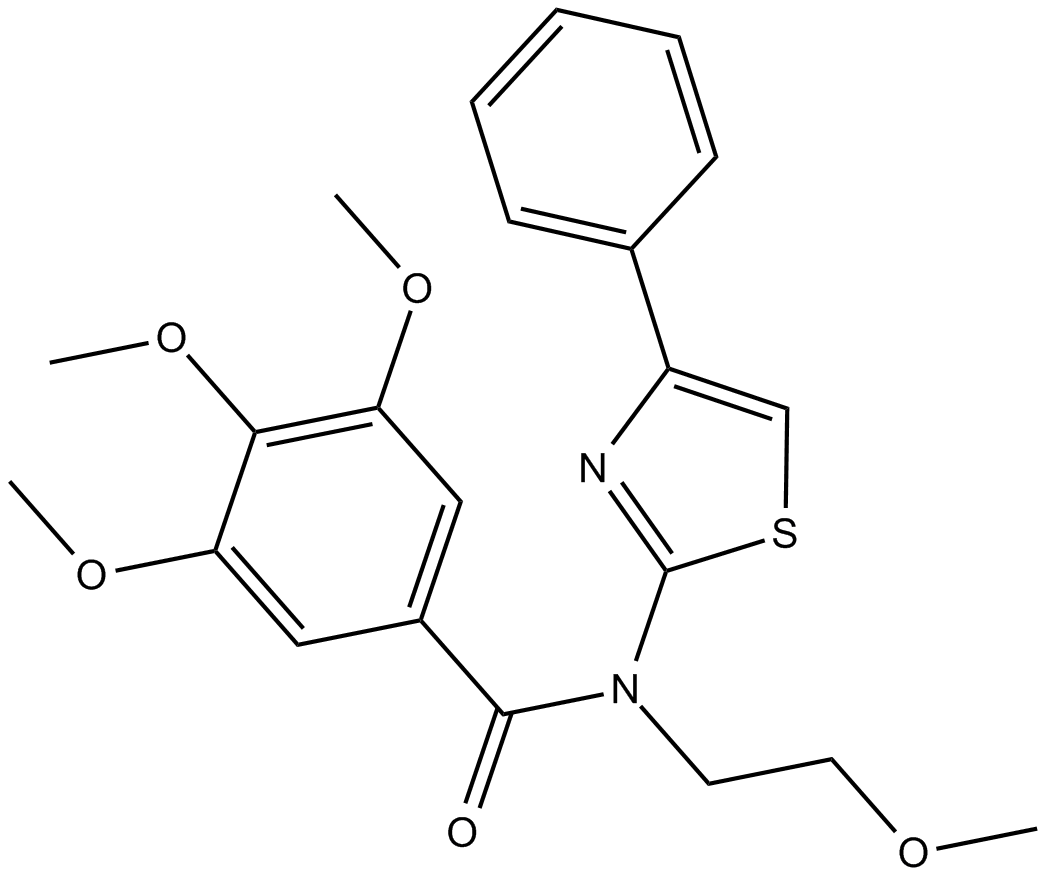
Cas No.: 461000-66-8
Sample solution is provided at 25 µL, 10mM.
_1-3.$$$39978408@51.jpg');)
_1-9.$$$38538795@65.jpg');)
_1-9.$$$39112701@51.jpg');)
_1-7.$$$37316672@70.jpg');)
_366-372.$$$36198801@70.jpg');)
.$$$38565142@65.jpg');)
_1867-1883.$$$33248023@67.jpg');)
_eads6055.$$$39977546@45.jpg');)
_eadm9805.$$$40080571@45.jpg');)
_eadj3020.$$$39666821@45.jpg');)
_1-20.$$$39757301@28.jpg');)
_1-24.$$$38898113@28.jpg');)
_273-287.$$$36806353@46.jpg');)
_1-16.$$$37156877@44.jpg');)
_1-19.$$$37460805@44.jpg');)
_1291-1307.$$$34518654@46.jpg');)
Eact is a highly specific and potent activator of TMEM16A, which activates TMEM16A when the calcium ion concentration increases [1]. At no Ca²⁺ conditions, Eact significantly enhances the Cl- current, and increases the amplitude and frequency of isolated guinea pig ileum contraction [2]. Eact has been widely used to regulate the contraction of coronary artery smooth muscle and to control membrane potential[3].
In vivo, Eact treatment at a single dose (20μl; 4.67mM) via injecting into the paw of a mouse can induce a strong and persistent hyperalgesia to heat for 60 minutes[4]. Thirty minutes before the epilepsy test, a single dose of Eact (10mg/kg) was administered through the gastric intubation, which significantly reduced the severity of acoustically evoked seizures and decreased the frequency of wild running seizures (WRS) in rats[5].
References:
[1] Kunzelmann K, Ousingsawat J, Cabrita I, et al. TMEM16A in cystic fibrosis: activating or inhibiting?[J]. Frontiers in pharmacology, 2019, 10: 3.
[2] Hao A, Guo S, Shi S, et al. Emerging modulators of TMEM16A and their therapeutic potential[J]. The Journal of Membrane Biology, 2021, 254(4): 353-365.
[3] Dick G, Tune J. Smooth Muscle Contraction Is Regulated by Chloride Channels: Functional Evidence for TMEM16A in Porcine Coronary Arteries[J]. The FASEB Journal, 2021, 35.
[4] Liu S, Feng J, Luo J, et al. Eact, a small molecule activator of TMEM16A, activates TRPV1 and elicits pain‐and itch‐related behaviours[J]. British journal of pharmacology, 2016, 173(7): 1208-1218.
[5] Thomas M, Simms M, N’Gouemo P. Activation of calcium-activated chloride channels suppresses inherited seizure susceptibility in genetically epilepsy-prone rats[J]. Biomedicines, 2022, 10(2): 449.
| Animal experiment [1]: | |
Animal models | Genetically epilepsy-prone (GEPR-3s) rats |
Preparation Method | GEPR-3s rats (eight-week-old) were housed in a temperature/humidity-controlled room on a 12h/12h light/dark cycle with free access to food and water. Eact (10mg/kg) and T16Ainh-A01 (10mg/kg) were dissolved in dimethyl sulfonic acid (1%) and sterile water using sonication (80kHz; 100% power); the solutions were filtered and administered 30min before seizure testing. The vehicle, Eact, and T16Ainh-A01 were given p.o. by gastric intubation. To induce seizures, an acoustic stimulus that consisted of pure tones at a 100-105 decibels sound pressure level was presented until either seizure was elicited, or 60s passed with no seizure activity. |
Dosage form | 10mg/kg for once; p.o. |
Applications | Eact treatment significantly reduced the severity of sound-induced epileptic seizures and decreased the frequency of wild running seizures (WRS) in rats. |
References: | |
| Cas No. | 461000-66-8 | SDF | |
| Chemical Name | 3,4,5-trimethoxy-N-(2-methoxyethyl)-N-(4-phenylthiazol-2-yl)benzamide | ||
| Canonical SMILES | COCCN(C1=NC(C2=CC=CC=C2)=CS1)C(C3=CC(OC)=C(OC)C(OC)=C3)=O | ||
| Formula | C22H24N2O5S | M.Wt | 428.5 |
| Solubility | <42.85mg/ml in DMSO | Storage | Store at -20°C |
| General tips | Please select the appropriate solvent to prepare the stock solution according to the
solubility of the product in different solvents; once the solution is prepared, please store it in
separate packages to avoid product failure caused by repeated freezing and thawing.Storage method
and period of the stock solution: When stored at -80°C, please use it within 6 months; when stored
at -20°C, please use it within 1 month. To increase solubility, heat the tube to 37°C and then oscillate in an ultrasonic bath for some time. |
||
| Shipping Condition | Evaluation sample solution: shipped with blue ice. All other sizes available: with RT, or with Blue Ice upon request. | ||
| Prepare stock solution | |||

|
1 mg | 5 mg | 10 mg |
| 1 mM | 2.3337 mL | 11.6686 mL | 23.3372 mL |
| 5 mM | 466.7 μL | 2.3337 mL | 4.6674 mL |
| 10 mM | 233.4 μL | 1.1669 mL | 2.3337 mL |
Step 1: Enter information below (Recommended: An additional animal making an allowance for loss during the experiment)
 g
μL
g
μL
Step 2: Enter the in vivo formulation (This is only the calculator, not formulation. Please contact us first if there is no in vivo formulation at the solubility Section.)
Calculation results:
Working concentration: mg/ml;
Method for preparing DMSO master liquid: mg drug pre-dissolved in μL DMSO ( Master liquid concentration mg/mL, Please contact us first if the concentration exceeds the DMSO solubility of the batch of drug. )
Method for preparing in vivo formulation: Take μL DMSO master liquid, next addμL PEG300, mix and clarify, next addμL Tween 80, mix and clarify, next add μL saline, mix and clarify.
Method for preparing in vivo formulation: Take μL DMSO master liquid, next add μL Corn oil, mix and clarify.
Note: 1. Please make sure the liquid is clear before adding the next solvent.
2. Be sure to add the solvent(s) in order. You must ensure that the solution obtained, in the previous addition, is a clear solution before proceeding to add the next solvent. Physical methods such as vortex, ultrasound or hot water bath can be used to aid dissolving.
3. All of the above co-solvents are available for purchase on the GlpBio website.
Quality Control & SDS
- View current batch:
- Purity: >98.00% Appearance: A solid
- COA (Certificate of Analysis)
- SDS (Safety Data Sheet)
- Datasheet
Average Rating: 5 (Based on Reviews and 28 reference(s) in Google Scholar.)