

Phytic acid |
Catalog No.GN10554
 One-Click Copy Product Info
|

Phytic acid es un antinutriente que se encuentra naturalmente en las semillas de legumbres
Products are for research use only. Not for human use. We do not sell to patients.
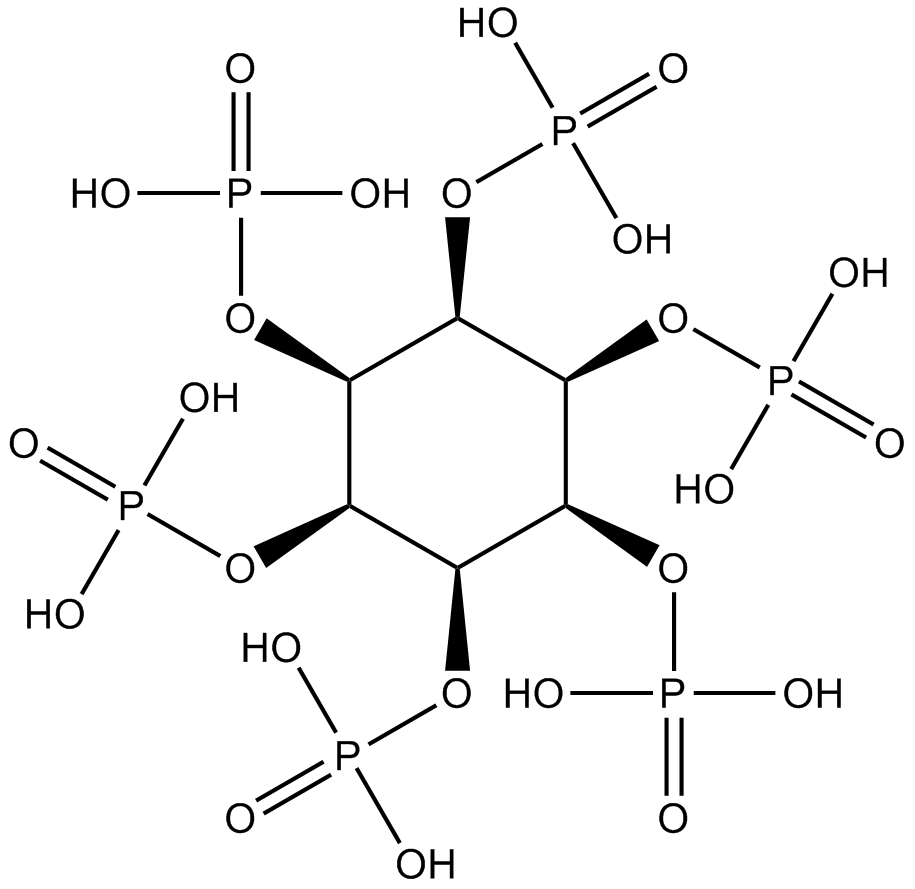
Cas No.: 83-86-3
Sample solution is provided at 25 µL, 10mM.
_1-3.$$$39978408@51.jpg');)
_1-9.$$$38538795@65.jpg');)
_1-9.$$$39112701@51.jpg');)
_1-7.$$$37316672@70.jpg');)
_366-372.$$$36198801@70.jpg');)
.$$$38565142@65.jpg');)
_1867-1883.$$$33248023@67.jpg');)
_eads6055.$$$39977546@45.jpg');)
_eadm9805.$$$40080571@45.jpg');)
_eadj3020.$$$39666821@45.jpg');)
_1-20.$$$39757301@28.jpg');)
_1-24.$$$38898113@28.jpg');)
_273-287.$$$36806353@46.jpg');)
_1-16.$$$37156877@44.jpg');)
_1-19.$$$37460805@44.jpg');)
_1291-1307.$$$34518654@46.jpg');)
Phytic acid es un antinutriente que se encuentra naturalmente en las semillas de legumbres [1]. Phytic acid y sus productos de degradación pueden eliminar los radicales libres y reducir el estrés oxidativo [2]. Phytic acid de iones metálicos (como el hierro) puede reducir las reacciones oxidativas catalizadas por metales [3]. Phytic acid exhibe propiedades anticancerígenas y antioxidantes [4].
En las células MC65, la tasa de supervivencia celular mejoró significativamente después del tratamiento con Phytic acid (100μM; 4d) [5]. En las células HepG2, el tratamiento con Phytic acid (0.1-4mM; 24-48h) inhibió el crecimiento celular [6].
En el modelo de ratones de UC inducidos por sulfato de dextrano sódico (DSS), el tratamiento con Phytic acid (0.25g/kg; ig; 14d) mejoró la pérdida de peso, acortó la longitud del colon, mejoró las puntuaciones clínicas y redujo la liberación de factores proinflamatorios (Il-1β, Il-6 y TNF-α) [7]. En un modelo de ratones con dieta alta en grasa, Phytic acid (0.25-2mg/mL; po; 13 semanas) inhibió significativamente la obesidad y alivió la esteatosis hepática [8].
References:
[1]. Oatway L, Vasanthan T, Helm J H. Phytic acid[J]. Food Reviews International, 2001, 17(4): 419-431.
[2]. Graf E, Empson K L, Eaton J W. Phytic acid. A natural antioxidant[J]. Journal of Biological Chemistry, 1987, 262(24): 11647-11650.
[3]. Lee B J, Hendricks D G. Metal‐catalyzed oxidation of ascorbate, deoxyribose and linoleic acid as affected by phytic acid in a model system[J]. Journal of Food Science, 1997, 62(5): 935-984.
[4]. Bloot A P M, Kalschne D L, Amaral J A S, et al. A review of phytic acid sources, obtention, and applications[J]. Food Reviews International, 2023, 39(1): 73-92.
[5]. Anekonda T S, Wadsworth T L, Sabin R, et al. Phytic acid as a potential treatment for Alzheimer's pathology: evidence from animal and in vitro models[J]. Journal of Alzheimer’s disease, 2011, 23(1): 21-35.
[6]. Al-Fatlawi A A, Al-Fatlawi A A, Irshad M, et al. Rice bran phytic acid induced apoptosis through regulation of Bcl-2/Bax and p53 genes in HepG2 human hepatocellular carcinoma cells[J]. Asian Pacific Journal of Cancer Prevention, 2014, 15(8): 3731-3736.
[7]. Hou X, Sang Y, Dong L. The improved effect and its mechanism of phytic acid on DSS-induced UC mice[J]. Life sciences, 2022, 311: 121139.
[8]. Ran X, Hu G, He F, et al. Phytic acid improves hepatic steatosis, inflammation, and oxidative stress in high-fat diet (HFD)-fed mice by modulating the gut–liver axis[J]. Journal of Agricultural and Food Chemistry, 2022, 70(36): 11401-11411.
| Experimentos celulares [1]: | |
Líneas celulares | Células MC65 |
Método de preparación | La viabilidad celular se determinó utilizando un ensayo MTS y un ensayo de iones de calcio. A una confluencia del 90 %, las células se recogieron de matrazones de TC utilizando tripsina/EDTA al 0,05 %, se lavaron dos veces con PBS y se sembraron a 15 × 103 células/pocillo en placas de 96 pocillos en medio OPTIMem que contenía (Tet+) o (Tet-) tetraciclina (1 μg/mL) y excipientes, o Phytic acid (100 μM). Las células cultivadas en condiciones de Tet- generalmente murieron después de aproximadamente 3-4 días de cultivo, acompañadas de la expresión de oligómeros A endógenos, mientras que las células cultivadas bajo condiciones de Tet+ permanecieron viables durante este período. Los pozos que contienen medio de crecimiento sin células servían como controles de fondo, y los pozos que contenían vehículos servían como controles positivos. Cada tratamiento se replicaba en 3 a 6 pozos, y la duración del tratamiento para cada experimento fue de 72 horas. La absorbancia se midió a una longitud de onda de 490 nm utilizando un lector de microplacas Spectra Max PLUS. La viabilidad celular bajo diferentes tratamientos se determinó en relación con la viabilidad celular bajo el tratamiento Tet +. Los experimentos se repitieron al menos tres veces. |
Condiciones de reacción | 100 μM; 4d |
Áreas de aplicación | La tasa de supervivencia celular mejoró significativamente después del tratamiento con Phytic acid. |
| Experimentos con animales [2]: | |
Modelos animales | Modelo de ratones UC inducidos por sulfato de dextrano sódico (DSS) |
Método de preparación | Los ratones C57BL/6 se dividieron aleatoriamente en cuatro grupos de cinco ratones cada uno. Los grupos específicos fueron los siguientes: sin grupo de tratamiento (grupo NT), grupo de alimentación de ácido fítico (grupo de Phytic acid), grupo de modelado DSS (grupo DSS) y grupo de tratamiento con Phytic acid (grupo de Phytic acid + DSS). Los ratones de los grupos de Phytic acid y Phytic acid + DSS fueron vavados con Phytic acid (0,25 g/kg/día) durante 21 días. Después de recibir Phytic acid durante 14 días, los ratones en los grupos DSS y ácido fítico + DSS recibieron solución acuosa DSS al 2,5% durante 7 días para desarrollar el modelo de ratón de UC. Los pesos corporales de todos los ratones se registraron desde el día 1 de la alimentación de DSS. Después de completar el período de inducción de DSS, todos los ratones fueron sacrificados y se recogieron muestras de colon para estudios posteriores. |
Forma de dosificación | 0,25 g/kg; ig; 14d |
Áreas de aplicación | El tratamiento con Phytic acid mejoró la pérdida de peso, acortó la longitud del colon, mejoró las puntuaciones clínicas y redujo la liberación de factores proinflamatorios (Il-1β, Il-6 y TNF-α). |
References: | |
| Cas No. | 83-86-3 | SDF | |
| Chemical Name | (2,3,4,5,6-pentaphosphonooxycyclohexyl) dihydrogen phosphate | ||
| Canonical SMILES | C1(C(C(C(C(C1OP(=O)(O)O)OP(=O)(O)O)OP(=O)(O)O)OP(=O)(O)O)OP(=O)(O)O)OP(=O)(O)O | ||
| Formula | C6H18O24P6 | M.Wt | 660.04 |
| Solubility | Water : ≥ 250 mg/mL | Storage | Store at -20°C |
| General tips | Please select the appropriate solvent to prepare the stock solution according to the
solubility of the product in different solvents; once the solution is prepared, please store it in
separate packages to avoid product failure caused by repeated freezing and thawing.Storage method
and period of the stock solution: When stored at -80°C, please use it within 6 months; when stored
at -20°C, please use it within 1 month. To increase solubility, heat the tube to 37°C and then oscillate in an ultrasonic bath for some time. |
||
| Shipping Condition | Evaluation sample solution: shipped with blue ice. All other sizes available: with RT, or with Blue Ice upon request. | ||
| Prepare stock solution | |||

|
1 mg | 5 mg | 10 mg |
| 1 mM | 1.5151 mL | 7.5753 mL | 15.1506 mL |
| 5 mM | 303 μL | 1.5151 mL | 3.0301 mL |
| 10 mM | 151.5 μL | 757.5 μL | 1.5151 mL |
Step 1: Enter information below (Recommended: An additional animal making an allowance for loss during the experiment)
 g
μL
g
μL
Step 2: Enter the in vivo formulation (This is only the calculator, not formulation. Please contact us first if there is no in vivo formulation at the solubility Section.)
Calculation results:
Working concentration: mg/ml;
Method for preparing DMSO master liquid: mg drug pre-dissolved in μL DMSO ( Master liquid concentration mg/mL, Please contact us first if the concentration exceeds the DMSO solubility of the batch of drug. )
Method for preparing in vivo formulation: Take μL DMSO master liquid, next addμL PEG300, mix and clarify, next addμL Tween 80, mix and clarify, next add μL saline, mix and clarify.
Method for preparing in vivo formulation: Take μL DMSO master liquid, next add μL Corn oil, mix and clarify.
Note: 1. Please make sure the liquid is clear before adding the next solvent.
2. Be sure to add the solvent(s) in order. You must ensure that the solution obtained, in the previous addition, is a clear solution before proceeding to add the next solvent. Physical methods such as vortex, ultrasound or hot water bath can be used to aid dissolving.
3. All of the above co-solvents are available for purchase on the GlpBio website.
Quality Control & SDS
- View current batch:
- Purity: >98.00% Appearance: A solid
- COA (Certificate of Analysis)
- SDS (Safety Data Sheet)
- Datasheet
Average Rating: 5 (Based on Reviews and 30 reference(s) in Google Scholar.)