

Phytic acid |
Catalog No.GN10554
 One-Click Copy Product Info
|

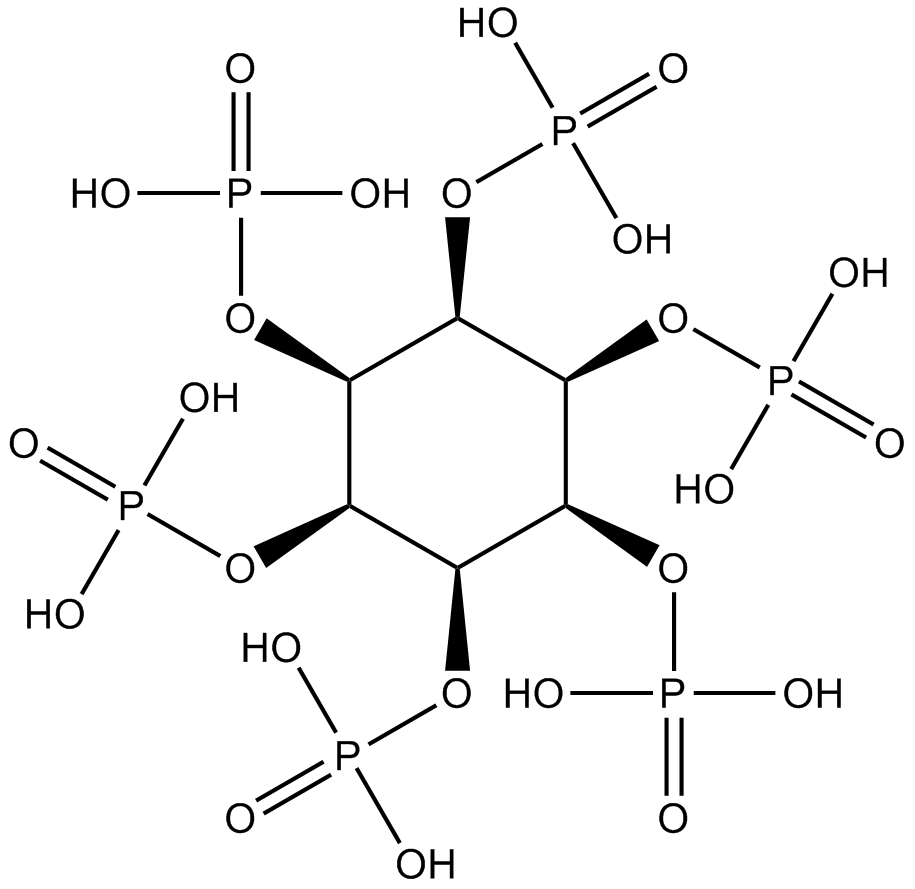
Phytic acid est un actinutritif naturellement présent dans les graines de légumineuses.
Products are for research use only. Not for human use. We do not sell to patients.
Cas No.: 83-86-3
Sample solution is provided at 25 µL, 10mM.
_1-3.$$$39978408@51.jpg');)
_1-9.$$$38538795@65.jpg');)
_1-9.$$$39112701@51.jpg');)
_1-7.$$$37316672@70.jpg');)
_366-372.$$$36198801@70.jpg');)
.$$$38565142@65.jpg');)
_1867-1883.$$$33248023@67.jpg');)
_eads6055.$$$39977546@45.jpg');)
_eadm9805.$$$40080571@45.jpg');)
_eadj3020.$$$39666821@45.jpg');)
_1-20.$$$39757301@28.jpg');)
_1-24.$$$38898113@28.jpg');)
_273-287.$$$36806353@46.jpg');)
_1-16.$$$37156877@44.jpg');)
_1-19.$$$37460805@44.jpg');)
_1291-1307.$$$34518654@46.jpg');)
Phytic acid est un actinutritif naturellement présent dans les graines de légumineuses[1]. Phytic acid et ses produits de dégradation peuvent piéger les radicaux libres et réduire le stress oxydatif[2]. La chélation des ions métalliques (comme le fer) par Phytic acid peut réduire les réactions oxydatives catalysées par les métaux [3]. Phytic acid exhibe des propriétés anticancéreuses et antioxydantes[4].
Dans les cellules MC65, le taux de survie cellulaires s'est amélioré signficativement après un traitement avec Phytic acid (100μM; 4d)[5]. Dans lles cellules HepG2, un traitement avec Phytic acid (0.1-4mM; 24-48h) a inhibé la croissance cellulaire[6].
Dans un modèle de rat atteint de rectocolite ulcéreuse (RCU) induite par le sulfate de dextrane sodique (DSS), un traitement avec Phytic acid (0.25g/kg; ig; 14j) a amélioré la perte de poids, raccourci la longueur du côlon, amélioré les scores cliniques et réduit la libération de facteurs pro-inflammatoires (Il-1β, Il-6, et TNF-α) [7]. Dans un modèle de rats soumis à un régime hyperlipidique, Phytic acid (0.25-2mg/mL; po; 13 semaines) a significativement inhibé l'obésité et atténué la stéatose hépatique[8].
References:
[1]. Oatway L, Vasanthan T, Helm J H. Phytic acid[J]. Food Reviews International, 2001, 17(4): 419-431.
[2]. Graf E, Empson K L, Eaton J W. Phytic acid. A natural antioxidant[J]. Journal of Biological Chemistry, 1987, 262(24): 11647-11650.
[3]. Lee B J, Hendricks D G. Metal‐catalyzed oxidation of ascorbate, deoxyribose and linoleic acid as affected by phytic acid in a model system[J]. Journal of Food Science, 1997, 62(5): 935-984.
[4]. Bloot A P M, Kalschne D L, Amaral J A S, et al. A review of phytic acid sources, obtention, and applications[J]. Food Reviews International, 2023, 39(1): 73-92.
[5]. Anekonda T S, Wadsworth T L, Sabin R, et al. Phytic acid as a potential treatment for Alzheimer's pathology: evidence from animal and in vitro models[J]. Journal of Alzheimer’s disease, 2011, 23(1): 21-35.
[6]. Al-Fatlawi A A, Al-Fatlawi A A, Irshad M, et al. Rice bran phytic acid induced apoptosis through regulation of Bcl-2/Bax and p53 genes in HepG2 human hepatocellular carcinoma cells[J]. Asian Pacific Journal of Cancer Prevention, 2014, 15(8): 3731-3736.
[7]. Hou X, Sang Y, Dong L. The improved effect and its mechanism of phytic acid on DSS-induced UC mice[J]. Life sciences, 2022, 311: 121139.
[8]. Ran X, Hu G, He F, et al. Phytic acid improves hepatic steatosis, inflammation, and oxidative stress in high-fat diet (HFD)-fed mice by modulating the gut–liver axis[J]. Journal of Agricultural and Food Chemistry, 2022, 70(36): 11401-11411.
| Expériences cellulaires [1]: | |
Lignées cellulaires | Cellules MC65 |
Méthode de préparation | La viabilité cellulaire a été déterminée à l'aide d'un test MTS et d'un test d'ions calcium. Lorsque la confluence atteignait 90%, les cellules ont été récoltées à partir de flacons de cultures TC à l'aide de trypsine/EDTA à 0,05%, lavées deux fois avec PBS, puis ensemencées à raison de 15 × 103 cellules/puits dans les plaques à 96 puits, dans un milieu OPTIMem contenant de la tétracycline (Tet+) ou de la tétracycline (Tet-) (1μg/mL) ainsi que des excipients, ou de l'acide phytique (100µM). Les cellules cultivées dans les conditions Tet- mouraient typiquement après environ 3-4 jours de culture, avec une expression d'oligomères A endogènes, tandis que les cellules cultivées dans les conditions Tet+ restaient viables pendant cette période. Les puits contenant le milieu de croissance sans cellules ont servi de témoin de fond, et les puits contenant le véhicule ont servi de témoin positif. Chaque traitement a été répété dans 3-6 puits, et la durée de traitement de chaque expérience était 72 heures. L'absorbance a été mesurée à la longueur d'onde de 490nm à l'aide d'un lecteur de microplaques Spectra Max PLUS. La viabilité cellulaire sous différents traitements a été déterminée par rapport à la viabilité cellulaire sous traitement Tet +. Les expériences ont été répétées au moins trois fois. |
Conditions de Réaction | 100μM; 4j |
Domaines d'application | Le taux de survie cellulaire amélioré signficativement après un traitement avec Phytic acid. |
| Expériences animales [2]: | |
Modèles animaux | Modèle de rats UC induit par le sulfate de dextrane sodique (DSS) |
Méthode de préparation | Les rats C57BL/6 ont été aléatoirement divisés en quatre groupes de cinq rats chacun. Les groupes spécifiques étaient les suivants : groupe sans traitement (groupe NT), groupe alimenté avec Phytic acid (groupe de Phytic acid), groupe de modélisation DSS (groupe DSS) et groupe de traitement avec Phytic acid (groupe avec Phytic acid + DSS). Les rats des groupes avec Phytic acid et Phytic acid + DSS ont été gavés avec Phytic acid (0.25g/kg/jour) pendant 21 jours. Après avoir reçu Phytic acid pendant 14 jours, les rats des groupes DSS et Phytic acid + DSS ont reçu une solution aqueuse de DSS à 2,5% pendant 7 jours pour développer le modèle de rat de la rectocolite ulcéreuse (UC). Les poids corporels de tous les rats ont été enregistrés à partir du jour 1 de l'alimentation en DSS. A la fin de la période d'induction par DSS, tous les rats ont été euthanasiés et des échantillons de côlon ont été collectés pour les études ultérieures. |
Forme de dosage | 0.25g/kg; ig; 14j |
Domaines d'application | Le traitement avec Phytic acid a amélioré la perte de poids, raccourci la longueur du côlon, amélioré les scores cliniques et réduit la libération de facteurs pro-inflammatoires (Il-1β, Il-6, et TNF-α). |
References: | |
| Cas No. | 83-86-3 | SDF | |
| Chemical Name | (2,3,4,5,6-pentaphosphonooxycyclohexyl) dihydrogen phosphate | ||
| Canonical SMILES | C1(C(C(C(C(C1OP(=O)(O)O)OP(=O)(O)O)OP(=O)(O)O)OP(=O)(O)O)OP(=O)(O)O)OP(=O)(O)O | ||
| Formula | C6H18O24P6 | M.Wt | 660.04 |
| Solubility | Water : ≥ 250 mg/mL | Storage | Store at -20°C |
| General tips | Please select the appropriate solvent to prepare the stock solution according to the
solubility of the product in different solvents; once the solution is prepared, please store it in
separate packages to avoid product failure caused by repeated freezing and thawing.Storage method
and period of the stock solution: When stored at -80°C, please use it within 6 months; when stored
at -20°C, please use it within 1 month. To increase solubility, heat the tube to 37°C and then oscillate in an ultrasonic bath for some time. |
||
| Shipping Condition | Evaluation sample solution: shipped with blue ice. All other sizes available: with RT, or with Blue Ice upon request. | ||
| Prepare stock solution | |||

|
1 mg | 5 mg | 10 mg |
| 1 mM | 1.5151 mL | 7.5753 mL | 15.1506 mL |
| 5 mM | 303 μL | 1.5151 mL | 3.0301 mL |
| 10 mM | 151.5 μL | 757.5 μL | 1.5151 mL |
Step 1: Enter information below (Recommended: An additional animal making an allowance for loss during the experiment)
 g
μL
g
μL
Step 2: Enter the in vivo formulation (This is only the calculator, not formulation. Please contact us first if there is no in vivo formulation at the solubility Section.)
Calculation results:
Working concentration: mg/ml;
Method for preparing DMSO master liquid: mg drug pre-dissolved in μL DMSO ( Master liquid concentration mg/mL, Please contact us first if the concentration exceeds the DMSO solubility of the batch of drug. )
Method for preparing in vivo formulation: Take μL DMSO master liquid, next addμL PEG300, mix and clarify, next addμL Tween 80, mix and clarify, next add μL saline, mix and clarify.
Method for preparing in vivo formulation: Take μL DMSO master liquid, next add μL Corn oil, mix and clarify.
Note: 1. Please make sure the liquid is clear before adding the next solvent.
2. Be sure to add the solvent(s) in order. You must ensure that the solution obtained, in the previous addition, is a clear solution before proceeding to add the next solvent. Physical methods such as vortex, ultrasound or hot water bath can be used to aid dissolving.
3. All of the above co-solvents are available for purchase on the GlpBio website.
Quality Control & SDS
- View current batch:
- Purity: >98.00% Appearance: A solid
- COA (Certificate of Analysis)
- SDS (Safety Data Sheet)
- Datasheet
Average Rating: 5 (Based on Reviews and 30 reference(s) in Google Scholar.)