

Savolitinib (Synonyms: AZD6094, HMPL-504, Volitinib) |
Catalog No.GC19321
 One-Click Copy Product Info
|

Savolitinib es un inhibidor potente y selectivo de la proteína c-Met, apto para administrarse por vía oral. Sus valores de IC50s son de 5nM y 3nM para su forma fosforilada p-Met.
Products are for research use only. Not for human use. We do not sell to patients.
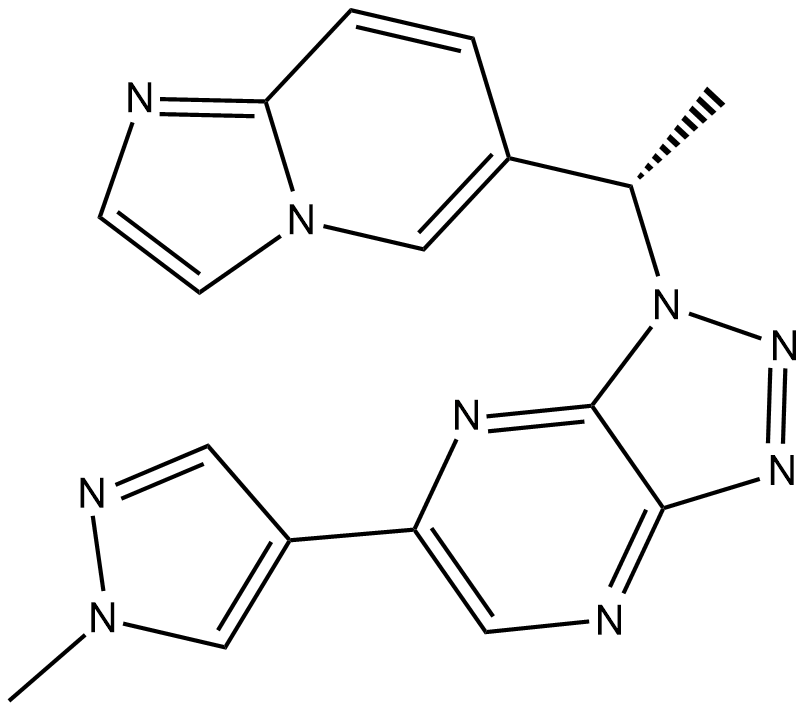
Cas No.: 1313725-88-0
Sample solution is provided at 25 µL, 10mM.
_1-3.$$$39978408@51.jpg');)
_1-9.$$$38538795@65.jpg');)
_1-9.$$$39112701@51.jpg');)
_1-7.$$$37316672@70.jpg');)
_366-372.$$$36198801@70.jpg');)
.$$$38565142@65.jpg');)
_1867-1883.$$$33248023@67.jpg');)
_eads6055.$$$39977546@45.jpg');)
_eadm9805.$$$40080571@45.jpg');)
_eadj3020.$$$39666821@45.jpg');)
_1-20.$$$39757301@28.jpg');)
_1-24.$$$38898113@28.jpg');)
_273-287.$$$36806353@46.jpg');)
_1-16.$$$37156877@44.jpg');)
_1-19.$$$37460805@44.jpg');)
_1291-1307.$$$34518654@46.jpg');)
Savolitinib es un inhibidor potente y selectivo de la proteína c-Met, apto para administrarse por vía oral. Sus valores de IC50s son de 5nM y 3nM para su forma fosforilada p-Met[1,2]. Se emplea de forma habitual en investigaciones sobre el cáncer.
Esta molécula frena la multiplicación de las líneas celulares SNU‐5, SNU‐638, Hs746T, SNU‐620, GTL16 e IM95m. Todas ellas presentan alteraciones en la señalización de c-Met. Sus correspondientes EC50 son 0.6, 0.8, 1.3, 3.5, 5.6 y 14.7nM[2].
Se suministró Savolitinib por vía oral durante 28 días, con dosis diarias entre 0.25-30mg/kg. El tratamiento redujo de forma notable el avance de tumores en modelos de xneoinjerto con células H1993 y EBC-1[3]. En tres modelso de cáncer gástrico PDX con amplificación de c-Met, la administración oral de 1, 10mg/kg/día, durante catorce a veintiún días, bajó el peso de los tumores[2]. En el modelo de xenoinjerto subcutáneo con células U87MG, las dosis orales de 1, 2.5 y 10.0mg/kg aplicadas durante 21 días frenaron el desarrollo tumoral de manera proporcional a la dosis recibida[1]. Por última, una dosis oral de 15mg/kg durante 15 días limitó el desarrollo tumoral en un modelo de cáncer de pulmón en microcítico PDX con mutación de EGFR. El grado de inhibición del desarrollo tumoral alcanzó alrededor del 84%[4].
References:
[1]. Jia, Hong, et al. "Discovery of (S)-1-(1-(Imidazo [1, 2-a] pyridin-6-yl) ethyl)-6-(1-methyl-1 H-pyrazol-4-yl)-1 H-[1, 2, 3] triazolo [4, 5-b] pyrazine (Volitinib) as a Highly Potent and Selective Mesenchymal–Epithelial Transition Factor (c-Met) Inhibitor in Clinical Development for Treatment of Cancer." Journal of medicinal chemistry 57.18 (2014): 7577-7589.
[2]. Gavine, Paul R., et al. "Volitinib, a potent and highly selective c-Met inhibitor, effectively blocks c-Met signaling and growth in c-MET amplified gastric cancer patient-derived tumor xenograft models." Molecular oncology 9.1 (2015): 323-333.
[3]. Henry, Ryan E., et al. "Acquired savolitinib resistance in non-small cell lung cancer arises via multiple mechanisms that converge on MET-independent mTOR and MYC activation." Oncotarget 7.36 (2016): 57651.
[4]. Jones, Rhys DO, et al. "Pharmacokinetic/pharmacodynamic analysis of savolitinib plus osimertinib in an EGFR mutation–positive, MET-amplified non–small cell lung cancer model." Molecular Cancer Therapeutics 22.5 (2023): 679-690.
| Experimentos con animales [1]: | |
Modelos animales | Xenoinjertos tumoreales H1993 y EBC-1 |
Método de preparación | Para xenoinjertos H1993 y EBC-1: las ratones Balb/c nu/nu hembras de 6-7 semanas de edad se mantuvieron en un entorno controlado y específico libre de patógenos a 20-25°C, 40-70% de humedad y un fotoperíodo de 12 horas de luz a oscuridad. Cada ratón fue inyectado por vía subcutánea en el flanco lateral suspendidas en un metrigel 1:1 de 0.2mL y se aleatorizó según el volumen del tumor; la dosificación comenzó cuando los tumores alcanzaron los 120-275mm3. Savolitinib se formuló en CMC-Na 0.5% (pH = 2.1) y se dosificó por vía oral una vez al día en las concentraciones indicadas para todos los estudios. |
Forma de dosificación | 0.25-30mg/kg/día; oral; 28 días |
Áreas de aplicación | El tratamiento con Savolitinib condujo a disminuciones marcadas en el crecimeinto tumoral en relación con los controles de vehículos en ambos modelos, con Savolitinib logrando una respuesta máxima a dosis tan bajas como 0.3mg/kg y 2.5mg/kg en tumores H1993 y EBC-1, respectivamente. |
References: | |
| Cas No. | 1313725-88-0 | SDF | |
| Sinónimos | AZD6094, HMPL-504, Volitinib | ||
| Canonical SMILES | CN1N=CC(C2=CN=C3C(N([C@H](C4=CN5C(C=C4)=NC=C5)C)N=N3)=N2)=C1 | ||
| Formula | C17H15N9 | M.Wt | 345.36 |
| Solubility | DMSO : ≥ 34 mg/mL (98.45 mM);Water : < 0.1 mg/mL (insoluble) | Storage | Store at -20°C |
| General tips | Please select the appropriate solvent to prepare the stock solution according to the
solubility of the product in different solvents; once the solution is prepared, please store it in
separate packages to avoid product failure caused by repeated freezing and thawing.Storage method
and period of the stock solution: When stored at -80°C, please use it within 6 months; when stored
at -20°C, please use it within 1 month. To increase solubility, heat the tube to 37°C and then oscillate in an ultrasonic bath for some time. |
||
| Shipping Condition | Evaluation sample solution: shipped with blue ice. All other sizes available: with RT, or with Blue Ice upon request. | ||
| Prepare stock solution | |||

|
1 mg | 5 mg | 10 mg |
| 1 mM | 2.8955 mL | 14.4776 mL | 28.9553 mL |
| 5 mM | 579.1 μL | 2.8955 mL | 5.7911 mL |
| 10 mM | 289.6 μL | 1.4478 mL | 2.8955 mL |
Step 1: Enter information below (Recommended: An additional animal making an allowance for loss during the experiment)
 g
μL
g
μL
Step 2: Enter the in vivo formulation (This is only the calculator, not formulation. Please contact us first if there is no in vivo formulation at the solubility Section.)
Calculation results:
Working concentration: mg/ml;
Method for preparing DMSO master liquid: mg drug pre-dissolved in μL DMSO ( Master liquid concentration mg/mL, Please contact us first if the concentration exceeds the DMSO solubility of the batch of drug. )
Method for preparing in vivo formulation: Take μL DMSO master liquid, next addμL PEG300, mix and clarify, next addμL Tween 80, mix and clarify, next add μL saline, mix and clarify.
Method for preparing in vivo formulation: Take μL DMSO master liquid, next add μL Corn oil, mix and clarify.
Note: 1. Please make sure the liquid is clear before adding the next solvent.
2. Be sure to add the solvent(s) in order. You must ensure that the solution obtained, in the previous addition, is a clear solution before proceeding to add the next solvent. Physical methods such as vortex, ultrasound or hot water bath can be used to aid dissolving.
3. All of the above co-solvents are available for purchase on the GlpBio website.
Quality Control & SDS
- View current batch:
- Purity: >99.50% Appearance: A solid
- COA (Certificate of Analysis)
- SDS (Safety Data Sheet)
- Datasheet
Average Rating: 5 (Based on Reviews and 1 reference(s) in Google Scholar.)