

SC 79 |
Catalog No.GC11645
 One-Click Copy Product Info
|

SC 79 es un activador de la fosforilación osmótica de Akt en el cerebro y un inhibidor de la translocación del dominio AKT-PH.
Products are for research use only. Not for human use. We do not sell to patients.
Cas No.: 305834-79-1
Sample solution is provided at 25 µL, 10mM.
SC 79 es un activador de la fosforilación osmótica de Akt en el cerebro y un inhibidor de la translocación del dominio AKT-PH[1].
SC 79 aumenta la fosforilación de los tres isotipos de Akt y potencia la activación de Akt en diversos tipos de células[1]. El tratamiento de células con reducción de BRAT1 con el activador de Akt SC 79 puede mejorar su proliferación y reducir la concentración de ROS mitocondrial[4]. En células SH-SY5Y y neuronas dopaminérgicas primarias de ratón, el pretratamiento con SC 79 inhibió en gran medida la reducción de viabilidad celular, apoptosis y necrosis inducidas por peróxido de hidrógeno (H2O2). SC 79 activó Akt en las células neuronales, lo cual fue necesario para su neuroprotección contra H2O2[5]. En osteoblastos primarios de ratón y células osteoblásticas MC3T3-E1, el pretratamiento con SC 79 atenuó significativamente la muerte celular inducida por Dex. Además, la apertura del poro de transición de permeabilidad mitocondrial (mPTP), la liberación de citocromo C y la activación de la apoptosis inducidas por Dex se aliviaron drásticamente con el pretratamiento con SC 79 en las células mencionadas[6]. El papel protector de SC 79 contra la H/R de hepatocitos o la lesión I/R hepática está relacionado con la activación de la fosforilación de Akt, lo que resulta en la disminución de proteínas pro-apoptóticas Bim, Bax y Bad, y el aumento de las proteínas anti-apoptóticas Bcl-2 y Bcl-xL inducidas por la H/R celular y la lesión I/R hepática[7].
SC 79 aumenta la actividad de Akt durante la muerte celular neuronal en un modelo de ratón in vivo de isquemia; SC 79 atenúa la muerte neuronal inducida por el ictus[1]. SC 79 protege a los hepatocitos de la apoptosis inducida por el anticuerpo agonista anti-Fas CH11 (para humanos) o Jo2 (para ratones) y prolonga significativamente la supervivencia de ratones con una dosis letal de Jo2[2]. El activador de Akt SC 79 protege a los hepatocitos de la apoptosis inducida por TNF-α y protege a los ratones de la lesión hepática y el daño mediado por TNF-α inducidos por d-galactosamina (d-Gal)/lipopolisacárido (LPS). SC 79 no solo potencia la señalización de supervivencia del factor nuclear-κB (NF-κB) en respuesta a la estimulación de TNF-α, sino que también aumenta la expresión de las proteínas inhibidoras de FLICE celular L y S (FLIPL/S), lo que consecuentemente inhibe la activación de procaspasa-8[2].
References:
[1]: Jo H, Mondal S, et,al. Small molecule-induced cytosolic activation of protein kinase Akt rescues ischemia-elicited neuronal death. Proc Natl Acad Sci U S A. 2012 Jun 26;109(26):10581-6. doi: 10.1073/pnas.1202810109. Epub 2012 Jun 11. PMID: 22689977; PMCID: PMC3387065.
[2]: Liu W, Jing ZT, et,al. A Novel AKT Activator, SC79, Prevents Acute Hepatic Failure Induced by Fas-Mediated Apoptosis of Hepatocytes. Am J Pathol. 2018 May;188(5):1171-1182. doi: 10.1016/j.ajpath.2018.01.013. PMID: 29673487.
[3]: Jing ZT, Liu W, et,al. AKT activator SC79 protects hepatocytes from TNF-α-mediated apoptosis and alleviates d-Gal/LPS-induced liver injury. Am J Physiol Gastrointest Liver Physiol. 2019 Mar 1;316(3):G387-G396. doi: 10.1152/ajpgi.00350.2018. Epub 2019 Jan 10. PMID: 30629471.
[4]: So EY, Ouchi T. BRAT1 deficiency causes increased glucose metabolism and mitochondrial malfunction. BMC Cancer. 2014 Jul 29;14:548. doi: 10.1186/1471-2407-14-548. PMID: 25070371; PMCID: PMC4129107.
[5]: Xu Y, Gao YW, et,al. SC79 protects dopaminergic neurons from oxidative stress. Oncotarget. 2017 Dec 20;9(16):12639-12648. doi: 10.18632/oncotarget.23538. PMID: 29560097; PMCID: PMC5849161.
[6]: Li ST, Chen NN, et,al. SC79 rescues osteoblasts from dexamethasone though activating Akt-Nrf2 signaling. Biochem Biophys Res Commun. 2016 Oct 7;479(1):54-60. doi: 10.1016/j.bbrc.2016.09.027. Epub 2016 Sep 7. PMID: 27614310.
[7]: Zhou H, Yu Y,et,al. Protective Effects the Akt Activator SC79 in Hepatic Ischemia-Reperfusion Injury. Med Sci Monit. 2018 Jun 24;24:4346-4354. doi: 10.12659/MSM.911178. PMID: 29936516; PMCID: PMC6049012.
| Experimentos celulares [2]: | |
Líneas celulares | Células HsSultan y NB4. |
Método de preparación | Se añadió SC 79 (8 μg/mL) al medio de células HsSultan o NB4 y se incubó durante la noche (16-20 h). |
Condiciones de reacción | 8 μg/mL de SC 79 durante 16-20 h. |
Áreas de aplicación | SC 79 aumenta la fosforilación de los tres isotipos de Akt y potencia la activación de Akt en una variedad de tipos celulares. |
| Experimentos con animales [3]: | |
Modelos animales | Ratones MCAO. |
Método de preparación | SC 79 se administró por inyección intraperitoneal a una concentración de 0.04 mg/g de peso corporal. |
Forma de dosificación | 0.04 mg/g de SC 79. |
Áreas de aplicación | SC 79 potencia la actividad de Akt durante la muerte celular neuronal en un modelo de ratón in vivo de isquemia, SC 79 atenúa la muerte neuronal inducida por el ictus. |
| Experimento con quinasas [1]: | |
Método de preparación | Las células Hela fueron privadas de suero durante 1 hora, tratadas con IGF o SC 79 (4 μg/mL) durante 30 minutos, lisadas en un tampón de lisis, suplementado con inhibidores de proteasa y analizadas para fosfo-Akt mediante Western blotting. |
Condiciones de reacción | SC 79 (4 μg/mL) durante 30 minutos. |
Áreas de aplicación | SC 79, que inhibe la translocación de la membrana plasmática de PH AkT-GFP pero aumenta la fosforilación y activación de Akt en los citosoles. |
Referencias: [1]. Jo H, Mondal S, et al. Activación citosólica inducida por pequeñas moléculas de la quinasa de proteínas Akt rescata la muerte neuronal provocada por isquemia. Proc Natl Acad Sci U S A. 2012 Jun 26;109(26):10581-6. doi: 10.1073/pnas.1202810109. Epub 2012 Jun 11. PMID: 22689977; PMCID: PMC3387065. | |
| Cas No. | 305834-79-1 | SDF | |
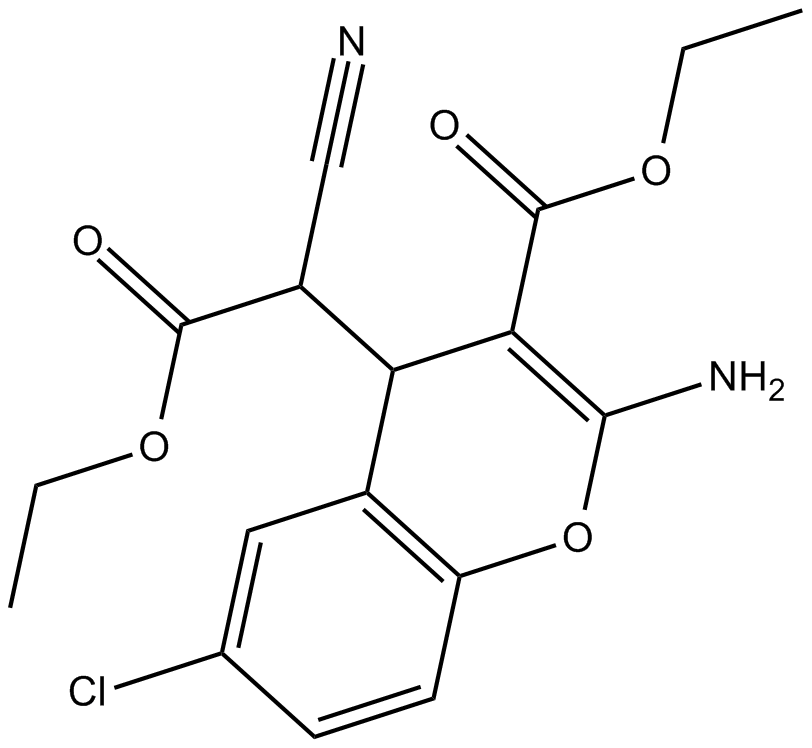
| Chemical Name | ethyl 2-amino-6-chloro-4-(1-cyano-2-ethoxy-2-oxoethyl)-4H-chromene-3-carboxylate | ||
| Canonical SMILES | CCOC(C(C(C(C(OCC)=O)=C1N)C2=C(O1)C=CC(Cl)=C2)C#N)=O | ||
| Formula | C17H17ClN2O5 | M.Wt | 364.78 |
| Solubility | ≥ 36.5mg/mL in DMSO | Storage | Store at -20°C,unstable in solution, ready to use. |
| General tips | Please select the appropriate solvent to prepare the stock solution according to the
solubility of the product in different solvents; once the solution is prepared, please store it in
separate packages to avoid product failure caused by repeated freezing and thawing.Storage method
and period of the stock solution: When stored at -80°C, please use it within 6 months; when stored
at -20°C, please use it within 1 month. To increase solubility, heat the tube to 37°C and then oscillate in an ultrasonic bath for some time. |
||
| Shipping Condition | Evaluation sample solution: shipped with blue ice. All other sizes available: with RT, or with Blue Ice upon request. | ||
| Prepare stock solution | |||

|
1 mg | 5 mg | 10 mg |
| 1 mM | 2.7414 mL | 13.7069 mL | 27.4138 mL |
| 5 mM | 548.3 μL | 2.7414 mL | 5.4828 mL |
| 10 mM | 274.1 μL | 1.3707 mL | 2.7414 mL |
Step 1: Enter information below (Recommended: An additional animal making an allowance for loss during the experiment)
 g
μL
g
μL
Step 2: Enter the in vivo formulation (This is only the calculator, not formulation. Please contact us first if there is no in vivo formulation at the solubility Section.)
Calculation results:
Working concentration: mg/ml;
Method for preparing DMSO master liquid: mg drug pre-dissolved in μL DMSO ( Master liquid concentration mg/mL, Please contact us first if the concentration exceeds the DMSO solubility of the batch of drug. )
Method for preparing in vivo formulation: Take μL DMSO master liquid, next addμL PEG300, mix and clarify, next addμL Tween 80, mix and clarify, next add μL saline, mix and clarify.
Method for preparing in vivo formulation: Take μL DMSO master liquid, next add μL Corn oil, mix and clarify.
Note: 1. Please make sure the liquid is clear before adding the next solvent.
2. Be sure to add the solvent(s) in order. You must ensure that the solution obtained, in the previous addition, is a clear solution before proceeding to add the next solvent. Physical methods such as vortex, ultrasound or hot water bath can be used to aid dissolving.
3. All of the above co-solvents are available for purchase on the GlpBio website.
Quality Control & SDS
- View current batch:
- Purity: >98.00% Appearance: A solid
- COA (Certificate of Analysis)
- SDS (Safety Data Sheet)
- Datasheet
-
Related Biological Data

Activation of PFK1 and PFKFB3 is due to phosphorylation of AKT and AMPK. (F) Representative images of ARS and ALP staining in MC3T3-E1 cells after treatment with SC79 and PFK15.
MK-2206 dihydrochloride (GC16304) and SC79 (GC11645) were obtained from GLPBIO.
Clin Transl Med 13.9 (2023): e1369. PMID: 37649137 IF: 10.6002 -
Related Biological Data

SC79 partially rescued the inhibitory effect of proliferation and migration caused by the knockdown of HRL-SC. a, b Western blot analysis showed that SC79 increased expression of p-AKT.
The medium was replaced with the medium containing 5 μg/mL of SC79 (10 μM, GlpBio) in AKT activation experiments.
Stem Cell Res Ther 13.1 (2022): 1-16. PMID: 35765088 IF: 7.4996 -
Related Biological Data

Melatonin inhibits the AKT/mTOR signaling to reduce autophagy and the expression of fibrotic proteins in HSFs. (E) Treatment with SC79 to activate the AKT/mTOR signaling rescued the melatonin-decreased AKT/mTOR signaling and fibrotic protein expression in HSFs.
HSFs were treated with vehicle (DMSO) or 200 μM melatonin and/or 10 μM SC79 (Glpbio) for 24 h.
Bba-Mol Basis Dis (2023): 166887. PMID: 37739092 IF: 6.2001 -
Related Biological Data

CST1 enhances SERPINB2 expression via AKT signaling pathway in bronchial epithelial cells. (C) SC-79 has a positive effect on SERPINB2 expression (n = 2).
BEAS-2B cells were stimulated with or without cytokines IL-4, IL-13, and IL-17A,17 stimulated with or without house dust mite, treated with or without E64d, induced with SC-79 (4 μg/mL, AKT activator; GlpBio) or MK2206USA).
Allergy Asthma Immun 15.3 (2023): 374. PMID: 37075800 IF: 4.4 -
Related Biological Data

Rescue experiments were conducted to verify the mechanism of TOP2A regulating OC cell behavior. (a-c) after SC79 treatment of cells in the SH-TOP2A group, WB results suggested that the levels of p-AKT/AKT and p-mTOR/mTOR were increased.
Lyophilized SC79 (GC11645, Glpbio), an activator of AKT, was resuspended in 500 μL of DMSO at 20 μg/μL, followed by storage at −20°C for later use.
Cancer Biol Ther 25.1 (2024): 2325126. PMID: 38445610 IF: 3.5999
Average Rating: 5 (Based on Reviews and 22 reference(s) in Google Scholar.)