

SC 79 |
カタログ番号GC11645
 One-Click Copy Product Info
|

SC 79は特異的で、血液脳関門透過性のAktアゴニストである。
Products are for research use only. Not for human use. We do not sell to patients.
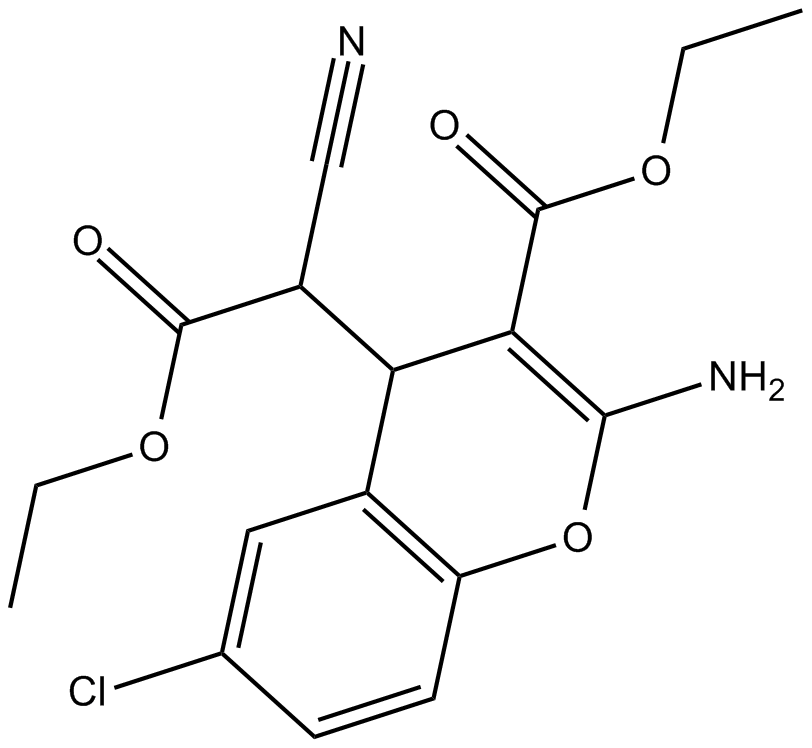
Cas No.: 305834-79-1
Sample solution is provided at 25 µL, 10mM.
SC 79は特異的で、血液脳関門透過性のAktアゴニストである[1]。SC 79はAktのPHドメインに特異的に結合し、細胞質Aktを活性化し、同時に細胞膜へのAktの転座を阻害する[2]。SC 79は、神経保護、虚血再潅流損傷とアポトーシスの分野で研究の有用性を示し、脳卒中と肝臓損傷の動物モデルでは保護作用を示している[3,4]。
In vitro(体外)実験で、SC 79(4μg/mL)でHepG2細胞を30分間前処理し、その後はTNF-α(0-16ng/mL)と24時間共同処理したところ、細胞の生存率が著しく上昇し、TUNEL陽性アポトーシス細胞が減少した[5]。SC 79(1-10μg/mL)でARPE-19細胞を1時間処理したところ、Aktのリン酸化(p-Akt Ser473)の活性化が用量依存的に誘発された[6]。
In vivo(体内)実験で、SC 79(10mg/kg)をC57BL/6マウスに0.5時間腹腔内注射して前処理し、その後はD-ガラクトサミン(400mg/kg)とリポ多糖(LPS、60μg/kg)を投与し、急性肝損傷を誘発したところ、マウスで肝臓カスパーゼ-3/7の活性が著しく低下した[5]。SC 79(10mg/kg)をC57BL/6マウスに0.5時間腹腔内注射して前処理し、その後は致死量の抗Fas Jo2を投与して急性肝不全を誘発したところ、マウスの12時間の生存率が0%から35%に上昇し、2か月の観察期が終わるまで追加の死亡は観察されなかった[7]。
| 細胞実験 [1]: | |
|
細胞株 |
ARPE-19細胞 |
|
調製方法 |
適用濃度のSC 79(0.1-10μg/mL)でARPE-19細胞を1時間処理し、p-Akt (Ser-473)とAkt1の発現をウェスタンブロット法でテストした。 |
|
反応条件 |
0.1、1、5と10μg/mL;1時間 |
|
応用 |
SC 79で処理したところ、Aktのリン酸化(p-Akt Ser-473)の活性化が用量依存的に誘発された。 |
| 動物実験 [2]: | |
|
動物モデル |
C57BL/6マウス |
|
調製方法 |
C57BL/6マウスをSC 79(10mg/kg;腹腔内注射)で0.5時間前処理し、その後はD-ガラクトサミン(400mg/kg)とLPS(60μg/kg)を投与した。D-Gal/LPS注射の12時間後に、caspase-3/7アッセイキットを使い、肝臓caspase-3/7の活性を測定した。 |
|
剤形 |
10mg/kg;腹腔内注射 |
|
応用 |
SC 79の前処理により、マウスで、肝臓内caspase-3/7の活性が著しく低下した。 |
| Cas No. | 305834-79-1 | SDF | |
| Chemical Name | ethyl 2-amino-6-chloro-4-(1-cyano-2-ethoxy-2-oxoethyl)-4H-chromene-3-carboxylate | ||
| Canonical SMILES | CCOC(C(C(C(C(OCC)=O)=C1N)C2=C(O1)C=CC(Cl)=C2)C#N)=O | ||
| Formula | C17H17ClN2O5 | M.Wt | 364.78 |
| 溶解度 | ≥ 36.5mg/mL in DMSO | Storage | Store at -20°C,unstable in solution, ready to use. |
| General tips | Please select the appropriate solvent to prepare the stock solution according to the
solubility of the product in different solvents; once the solution is prepared, please store it in
separate packages to avoid product failure caused by repeated freezing and thawing.Storage method
and period of the stock solution: When stored at -80°C, please use it within 6 months; when stored
at -20°C, please use it within 1 month. To increase solubility, heat the tube to 37°C and then oscillate in an ultrasonic bath for some time. |
||
| Shipping Condition | Evaluation sample solution: shipped with blue ice. All other sizes available: with RT, or with Blue Ice upon request. | ||
| Prepare stock solution | |||

|
1 mg | 5 mg | 10 mg |
| 1 mM | 2.7414 mL | 13.7069 mL | 27.4138 mL |
| 5 mM | 548.3 μL | 2.7414 mL | 5.4828 mL |
| 10 mM | 274.1 μL | 1.3707 mL | 2.7414 mL |
Step 1: Enter information below (Recommended: An additional animal making an allowance for loss during the experiment)
 g
μL
g
μL
Step 2: Enter the in vivo formulation (This is only the calculator, not formulation. Please contact us first if there is no in vivo formulation at the solubility Section.)
Calculation results:
Working concentration: mg/ml;
Method for preparing DMSO master liquid: mg drug pre-dissolved in μL DMSO ( Master liquid concentration mg/mL, Please contact us first if the concentration exceeds the DMSO solubility of the batch of drug. )
Method for preparing in vivo formulation: Take μL DMSO master liquid, next addμL PEG300, mix and clarify, next addμL Tween 80, mix and clarify, next add μL saline, mix and clarify.
Method for preparing in vivo formulation: Take μL DMSO master liquid, next add μL Corn oil, mix and clarify.
Note: 1. Please make sure the liquid is clear before adding the next solvent.
2. Be sure to add the solvent(s) in order. You must ensure that the solution obtained, in the previous addition, is a clear solution before proceeding to add the next solvent. Physical methods such as vortex, ultrasound or hot water bath can be used to aid dissolving.
3. All of the above co-solvents are available for purchase on the GlpBio website.
Quality Control & SDS
- View current batch:
- Purity: >98.00% Appearance: A solid
- COA (Certificate of Analysis)
- SDS (Safety Data Sheet)
- Datasheet
-
Related Biological Data

Activation of PFK1 and PFKFB3 is due to phosphorylation of AKT and AMPK. (F) Representative images of ARS and ALP staining in MC3T3-E1 cells after treatment with SC79 and PFK15.
MK-2206 dihydrochloride (GC16304) and SC79 (GC11645) were obtained from GLPBIO.
Clin Transl Med 13.9 (2023): e1369. PMID: 37649137 IF: 10.6002 -
Related Biological Data

SC79 partially rescued the inhibitory effect of proliferation and migration caused by the knockdown of HRL-SC. a, b Western blot analysis showed that SC79 increased expression of p-AKT.
The medium was replaced with the medium containing 5 μg/mL of SC79 (10 μM, GlpBio) in AKT activation experiments.
Stem Cell Res Ther 13.1 (2022): 1-16. PMID: 35765088 IF: 7.4996 -
Related Biological Data

Melatonin inhibits the AKT/mTOR signaling to reduce autophagy and the expression of fibrotic proteins in HSFs. (E) Treatment with SC79 to activate the AKT/mTOR signaling rescued the melatonin-decreased AKT/mTOR signaling and fibrotic protein expression in HSFs.
HSFs were treated with vehicle (DMSO) or 200 μM melatonin and/or 10 μM SC79 (Glpbio) for 24 h.
Bba-Mol Basis Dis (2023): 166887. PMID: 37739092 IF: 6.2001 -
Related Biological Data

CST1 enhances SERPINB2 expression via AKT signaling pathway in bronchial epithelial cells. (C) SC-79 has a positive effect on SERPINB2 expression (n = 2).
BEAS-2B cells were stimulated with or without cytokines IL-4, IL-13, and IL-17A,17 stimulated with or without house dust mite, treated with or without E64d, induced with SC-79 (4 μg/mL, AKT activator; GlpBio) or MK2206USA).
Allergy Asthma Immun 15.3 (2023): 374. PMID: 37075800 IF: 4.4 -
Related Biological Data

Rescue experiments were conducted to verify the mechanism of TOP2A regulating OC cell behavior. (a-c) after SC79 treatment of cells in the SH-TOP2A group, WB results suggested that the levels of p-AKT/AKT and p-mTOR/mTOR were increased.
Lyophilized SC79 (GC11645, Glpbio), an activator of AKT, was resuspended in 500 μL of DMSO at 20 μg/μL, followed by storage at −20°C for later use.
Cancer Biol Ther 25.1 (2024): 2325126. PMID: 38445610 IF: 3.5999
Average Rating: 5 (Based on Reviews and 22 reference(s) in Google Scholar.)