

SC 79 |
Katalog-Nr.GC11645
 One-Click Copy Product Info
|

SC 79 ist ein Aktivator der osmotischen Akt-Phosphorylierung im Gehirn und ein Inhibitor der AKT-PH-Domänentranslokation.
Products are for research use only. Not for human use. We do not sell to patients.
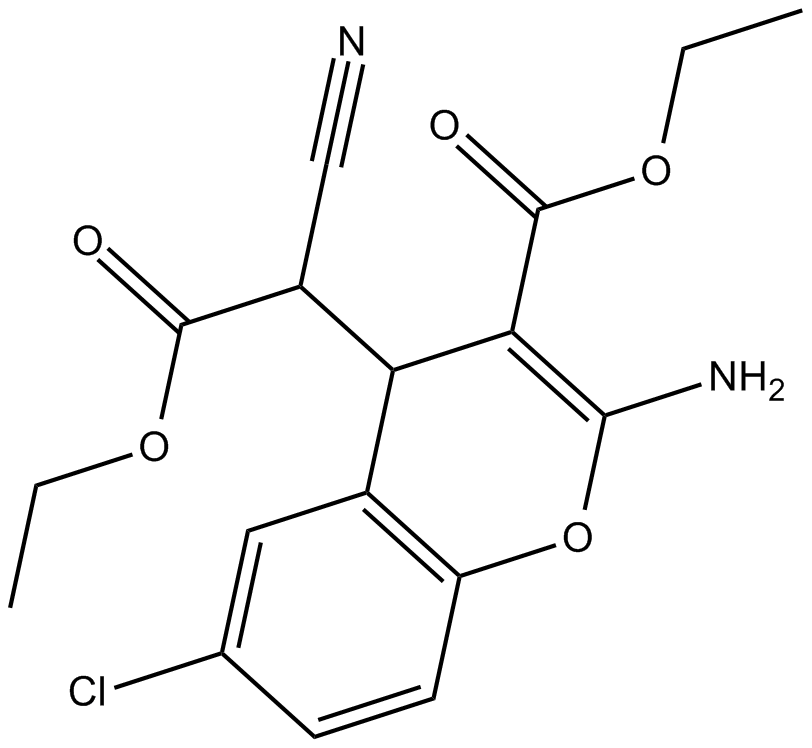
Cas No.: 305834-79-1
Sample solution is provided at 25 µL, 10mM.
SC 79 ist ein Aktivator der osmotischen Akt-Phosphorylierung im Gehirn und ein Inhibitor der AKT-PH-Domänentranslokation[1].
SC 79 versträrkt die Phosphorylierung aller drei Akt-Isotypen und die Akt-Aktivierung in einer Vielzahl von Zelltypen[1]. Die Behandlung von BRAT1-Knockdown-Zellen mit dem Akt-Aktivator SC 79 kann ihre Proliferation verbessern und die mitochondriale ROS-Konzentration reduzieren[4]. Sowohl in SH-SY5Y-Zellen als auch in primären dopaminergen Neuronen von Mäusen hemmte die Vorbehandlung mit SC 79 die durch Wasserstoffperoxid (H2O2)- induzierte Verringerung der Zelllebensfähigkeit, Apoptose und Nekrose weitgehend. SC 79 aktivierte Akt in den neuronalen Zellen, was für dessen Neuroprotektion gegen H2O2 erforderlich war[5]. In primären murinen Osteoblasten und osteoblastischen MC3T3-E1-Zellen schwächte die Vorbehandlung mit SC 79 den durch Dex-induzierten Zelltod signifikant ab. Darüber hinaus wurden die durch Dex-induzierte Öffnung der mitochondrialen Permeabilitätstransitionspore (mPTP), die Freisetzung von Cytochrome C und die Aktivierung der Apoptose durch eine Vorbehandlung in den oben genannten Zellen drastisch gemildert [6]. Die schützende Rolle von SC 79 gegen H/R von Hepatozyten oder hepatische I/R-Verletzungen hängt mt der Aktivierung der Phosphorylierung von Akt zusammen, was zu einer Abnahme des pro-apoptotischen Proteins von Bim, Bax, und Bad und einer Zunahme des anti-apoptotischen Proteins Bcl-2 und Bcl-xL führt, die durch Zell-H/R und hepatische I/R-Verletzungen induziert wird [7].
SC 79 erhöht die Akt-Aktivität während des neuronalen Zelltods in einem in-vivo-Mausmodell der Ischämie. SC 79 mildert den durch Schlaganfall verursachten Neurontod [1]. SC 79 schützt Hepatozyten vor Apoptose, die durch den agonistischen Anti-Fas-Antikörper CH11 (für Menschen) oder Jo2 (für Mäuse) ausgelöst wird, und verlängert signifikant das Überleben von Mäusen, denen eine tödliche Dosis JO2 verabreicht wurde [2]. Der Akt-Aktivator SC 79 schützt Hepatozyten vor TNF-α-induzierter Apoptose und Mäuse vor durch d-Galaktosamin (d-Gal)/Lipopolysaccharide (LPS)-induzieten TNF-α-vermittelten Leberschäden und -schädigungen. SC 79 verstärkt nicht nur die überlebensfördernde Signalisierung des nuklearen Faktors-κB (NF-κB) als Reaktion auf TNF-α-Stimulation, sondern erhöht auch die Expression des zellulären FLICE (FADD-ähnliches IL-1β-konvertierendes Enzym)-inhibitorischem Protein L und S (FLIPL/S), was folglich die Aktivierung von Prokaspase-8 hemmt [2].
References:
[1]: Jo H, Mondal S, et,al. Small molecule-induced cytosolic activation of protein kinase Akt rescues ischemia-elicited neuronal death. Proc Natl Acad Sci U S A. 2012 Jun 26;109(26):10581-6. doi: 10.1073/pnas.1202810109. Epub 2012 Jun 11. PMID: 22689977; PMCID: PMC3387065.
[2]: Liu W, Jing ZT, et,al. A Novel AKT Activator, SC79, Prevents Acute Hepatic Failure Induced by Fas-Mediated Apoptosis of Hepatocytes. Am J Pathol. 2018 May;188(5):1171-1182. doi: 10.1016/j.ajpath.2018.01.013. PMID: 29673487.
[3]: Jing ZT, Liu W, et,al. AKT activator SC79 protects hepatocytes from TNF-α-mediated apoptosis and alleviates d-Gal/LPS-induced liver injury. Am J Physiol Gastrointest Liver Physiol. 2019 Mar 1;316(3):G387-G396. doi: 10.1152/ajpgi.00350.2018. Epub 2019 Jan 10. PMID: 30629471.
[4]: So EY, Ouchi T. BRAT1 deficiency causes increased glucose metabolism and mitochondrial malfunction. BMC Cancer. 2014 Jul 29;14:548. doi: 10.1186/1471-2407-14-548. PMID: 25070371; PMCID: PMC4129107.
[5]: Xu Y, Gao YW, et,al. SC79 protects dopaminergic neurons from oxidative stress. Oncotarget. 2017 Dec 20;9(16):12639-12648. doi: 10.18632/oncotarget.23538. PMID: 29560097; PMCID: PMC5849161.
[6]: Li ST, Chen NN, et,al. SC79 rescues osteoblasts from dexamethasone though activating Akt-Nrf2 signaling. Biochem Biophys Res Commun. 2016 Oct 7;479(1):54-60. doi: 10.1016/j.bbrc.2016.09.027. Epub 2016 Sep 7. PMID: 27614310.
[7]: Zhou H, Yu Y,et,al. Protective Effects the Akt Activator SC79 in Hepatic Ischemia-Reperfusion Injury. Med Sci Monit. 2018 Jun 24;24:4346-4354. doi: 10.12659/MSM.911178. PMID: 29936516; PMCID: PMC6049012.
| Kinase-Experiment [1]: | |
Vorbereitungsmethode | Hela-Zellen wurden 1 Stunde lang serumverhungert, 30 Minuten lang mit IGF oder SC 79 (4 μg/mL) behandelt, in mit Proteaseinhibitoren ergänztem Lyse-Puffer lysiert und per Western Blot auf Phospho-Akt analysiert. |
Reaktionsbedingungen | SC 79 (4 μg/mL) für 30 Minuten |
Anwendungen | SC 79 hemmt die Translokation von PH AkT-GFP in die Plasmamembrane, verstärkt jedoch die Phosphorylierung und Aktivierung von Akt in den Zytosolen. |
| Zellexperiment [1]: | |
Zelllinien | HsSultan- und NB4-Zellen |
Vorbereitungsmethode | SC 79(8 ug/mL) wurde zu HsSultan- und NB4-Zellmedium hinzugefügt und über Nacht (16-20 Stunden) inkubiert. |
Reaktionsbedingungen | 8 ug/mL SC 79 für 16-20 h |
Anwendungen | SC 79 versträrkt die Phosphorylierung aller drei Akt-Isotypen und die Akt-Aktivierung in einer Vielzahl von Zelltypen. |
| Tierversuch [1]: | |
Tiermodelle | MCAO-Mäuse |
Vorbereitungsmethode | SC 79 wurde durch intraperitoneale Injektion in einer Konzentration von 0,04mg/g Körpergewicht verabreicht. |
Dosierungsform | 0,04mg/g SC 79 |
Anwendungen | SC 79 erhöht die Akt-Aktivität während des neuronalen Zelltods in einem in-vivo-Mausmodell der Ischämie. SC 79 mildert den durch Schlaganfall verursachten Neurontod . |
References: | |
| Cas No. | 305834-79-1 | SDF | |
| Chemical Name | ethyl 2-amino-6-chloro-4-(1-cyano-2-ethoxy-2-oxoethyl)-4H-chromene-3-carboxylate | ||
| Canonical SMILES | CCOC(C(C(C(C(OCC)=O)=C1N)C2=C(O1)C=CC(Cl)=C2)C#N)=O | ||
| Formula | C17H17ClN2O5 | M.Wt | 364.78 |
| Löslichkeit | ≥ 36.5mg/mL in DMSO | Storage | Store at -20°C,unstable in solution, ready to use. |
| General tips | Please select the appropriate solvent to prepare the stock solution according to the
solubility of the product in different solvents; once the solution is prepared, please store it in
separate packages to avoid product failure caused by repeated freezing and thawing.Storage method
and period of the stock solution: When stored at -80°C, please use it within 6 months; when stored
at -20°C, please use it within 1 month. To increase solubility, heat the tube to 37°C and then oscillate in an ultrasonic bath for some time. |
||
| Shipping Condition | Evaluation sample solution: shipped with blue ice. All other sizes available: with RT, or with Blue Ice upon request. | ||
| Prepare stock solution | |||

|
1 mg | 5 mg | 10 mg |
| 1 mM | 2.7414 mL | 13.7069 mL | 27.4138 mL |
| 5 mM | 548.3 μL | 2.7414 mL | 5.4828 mL |
| 10 mM | 274.1 μL | 1.3707 mL | 2.7414 mL |
Step 1: Enter information below (Recommended: An additional animal making an allowance for loss during the experiment)
 g
μL
g
μL
Step 2: Enter the in vivo formulation (This is only the calculator, not formulation. Please contact us first if there is no in vivo formulation at the solubility Section.)
Calculation results:
Working concentration: mg/ml;
Method for preparing DMSO master liquid: mg drug pre-dissolved in μL DMSO ( Master liquid concentration mg/mL, Please contact us first if the concentration exceeds the DMSO solubility of the batch of drug. )
Method for preparing in vivo formulation: Take μL DMSO master liquid, next addμL PEG300, mix and clarify, next addμL Tween 80, mix and clarify, next add μL saline, mix and clarify.
Method for preparing in vivo formulation: Take μL DMSO master liquid, next add μL Corn oil, mix and clarify.
Note: 1. Please make sure the liquid is clear before adding the next solvent.
2. Be sure to add the solvent(s) in order. You must ensure that the solution obtained, in the previous addition, is a clear solution before proceeding to add the next solvent. Physical methods such as vortex, ultrasound or hot water bath can be used to aid dissolving.
3. All of the above co-solvents are available for purchase on the GlpBio website.
Quality Control & SDS
- View current batch:
- Purity: >98.00% Appearance: A solid
- COA (Certificate of Analysis)
- SDS (Safety Data Sheet)
- Datasheet
-
Related Biological Data

Activation of PFK1 and PFKFB3 is due to phosphorylation of AKT and AMPK. (F) Representative images of ARS and ALP staining in MC3T3-E1 cells after treatment with SC79 and PFK15.
MK-2206 dihydrochloride (GC16304) and SC79 (GC11645) were obtained from GLPBIO.
Clin Transl Med 13.9 (2023): e1369. PMID: 37649137 IF: 10.6002 -
Related Biological Data

SC79 partially rescued the inhibitory effect of proliferation and migration caused by the knockdown of HRL-SC. a, b Western blot analysis showed that SC79 increased expression of p-AKT.
The medium was replaced with the medium containing 5 μg/mL of SC79 (10 μM, GlpBio) in AKT activation experiments.
Stem Cell Res Ther 13.1 (2022): 1-16. PMID: 35765088 IF: 7.4996 -
Related Biological Data

Melatonin inhibits the AKT/mTOR signaling to reduce autophagy and the expression of fibrotic proteins in HSFs. (E) Treatment with SC79 to activate the AKT/mTOR signaling rescued the melatonin-decreased AKT/mTOR signaling and fibrotic protein expression in HSFs.
HSFs were treated with vehicle (DMSO) or 200 μM melatonin and/or 10 μM SC79 (Glpbio) for 24 h.
Bba-Mol Basis Dis (2023): 166887. PMID: 37739092 IF: 6.2001 -
Related Biological Data

CST1 enhances SERPINB2 expression via AKT signaling pathway in bronchial epithelial cells. (C) SC-79 has a positive effect on SERPINB2 expression (n = 2).
BEAS-2B cells were stimulated with or without cytokines IL-4, IL-13, and IL-17A,17 stimulated with or without house dust mite, treated with or without E64d, induced with SC-79 (4 μg/mL, AKT activator; GlpBio) or MK2206USA).
Allergy Asthma Immun 15.3 (2023): 374. PMID: 37075800 IF: 4.4 -
Related Biological Data

Rescue experiments were conducted to verify the mechanism of TOP2A regulating OC cell behavior. (a-c) after SC79 treatment of cells in the SH-TOP2A group, WB results suggested that the levels of p-AKT/AKT and p-mTOR/mTOR were increased.
Lyophilized SC79 (GC11645, Glpbio), an activator of AKT, was resuspended in 500 μL of DMSO at 20 μg/μL, followed by storage at −20°C for later use.
Cancer Biol Ther 25.1 (2024): 2325126. PMID: 38445610 IF: 3.5999
Average Rating: 5 (Based on Reviews and 22 reference(s) in Google Scholar.)