

Senkyunolide I |
Catalog No.GN10801
 One-Click Copy Product Info
|

Senkyunolide I is a natural phthalide existing in L. chuanxiong and A. sinensis with good blood-brain barrier permeability, which has the potential to become a cardio-cerebral vascular drug candidate.
Products are for research use only. Not for human use. We do not sell to patients.
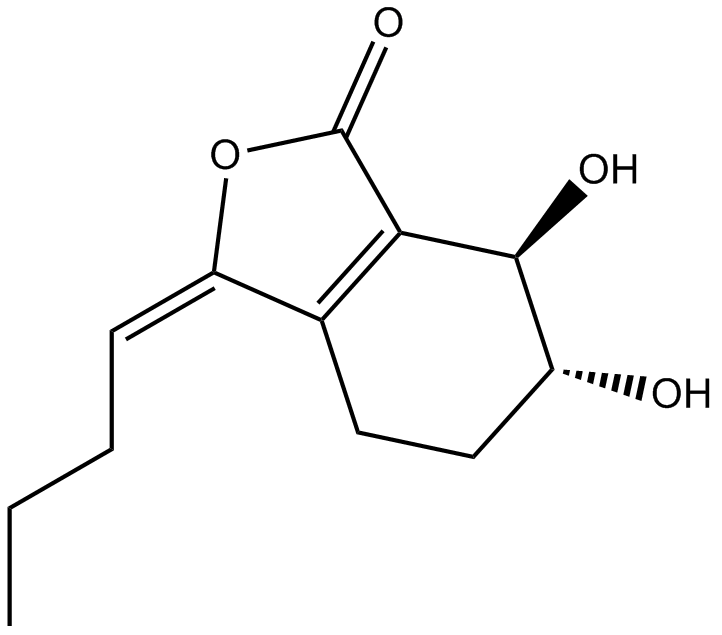
Cas No.: 94596-28-8
Sample solution is provided at 25 µL, 10mM.
_1-3.$$$39978408@51.jpg');)
_1-9.$$$38538795@65.jpg');)
_1-9.$$$39112701@51.jpg');)
_1-7.$$$37316672@70.jpg');)
_366-372.$$$36198801@70.jpg');)
.$$$38565142@65.jpg');)
_1867-1883.$$$33248023@67.jpg');)
_eads6055.$$$39977546@45.jpg');)
_eadm9805.$$$40080571@45.jpg');)
_eadj3020.$$$39666821@45.jpg');)
_1-20.$$$39757301@28.jpg');)
_1-24.$$$38898113@28.jpg');)
_273-287.$$$36806353@46.jpg');)
_1-16.$$$37156877@44.jpg');)
_1-19.$$$37460805@44.jpg');)
_1291-1307.$$$34518654@46.jpg');)
Senkyunolide I is a natural phthalide existing in L. chuanxiong and A. sinensis with good blood-brain barrier permeability, which has the potential to become a cardio-cerebral vascular drug candidate [1]. Its pharmacological effects include analgesic, anti-inflammatory, antioxidant, anti-thrombotic, anti-tumor effects, alleviating ischemia-reperfusion injury, etc [1].
Senkyunolide I (400μM; 2h) significantly attenuated glutamate-induced cytotoxicity, increased the cell viability of Neuro2a cells [2]. Senkyunolide I (20, 50, 100μM; 24h) suppressed the fibrotic markers (α-Sma, Col1a1, and Timp1) in the TGF-β1-stimulated hepatic stellate cells in a dose-dependent manner [3]. Senkyunolide I (200, 400μM; 24h) promoted neural stem/progenitor cells proliferative capacity [4].
Senkyunolide I (36mg/kg; 4 weeks; qow; i.p.) attenuated the ROS and apoptosis in the aortic tissue in the TAAD (thoracic aortic aneurysm and aortic dissection) model C57BL/6J mice [5]. Senkyunolide I (72mg/kg; i.p.) reduced TNF-α, IL-1β levels in sepsis-associated encephalopathy model Sprague-Dawley rats [6].
References:
[1] Huang Y, Wu Y, Yin H, et al. Senkyunolide I: a review of its phytochemistry, pharmacology, pharmacokinetics, and drug-likeness [J]. Molecules, 2023, 28(8): 3636.
[2] Wang M, Hayashi H, Horinokita I, et al. Neuroprotective effects of Senkyunolide I against glutamate-induced cells death by attenuating JNK/caspase-3 activation and apoptosis [J]. Biomedicine & pharmacotherapy, 2021, 140: 111696.
[3] Zhu M, Ren L, Xiao W, et al. Senkyunolide I suppresses hepatic stellate cell activation and liver fibrosis by reprogramming VDR-dependent fatty acid metabolism [J]. Chinese medicine, 2025, 20(1): 85.
[4] Wang M, Hayashi H, Horinokita I, et al. Role of senkyunolide I in the promotion of neural stem/progenitor cell proliferation via the Akt/β-catenin pathway [J]. Biomedicine & pharmacotherapy, 2023, 168: 115683.
[5] Zhao K, Zhu H, He X, et al. Senkyunolide I ameliorates thoracic aortic aneurysm and dissection in mice via inhibiting the oxidative stress and apoptosis of endothelial cells [J]. Biochimica et biophysica acta Molecular basis of disease, 2023, 1869(7): 166819.
[6] Cao H, Liu T, Xu M. Senkyunolide I improves septicemia-induced brain dysfunction via regulating Nrf2 and astrocyte activity [J]. Biotechnology and applied biochemistry, 2025, 72(5): 1385-1394.
| Cell experiment [1]: | |
Cell lines | Neuro2a cells |
Preparation Method | Cells were seeded at 2×10⁴ cells into 96-well plates and grown for 48h, and then were treated with 150mM glutamate for 24h to obtain the glutamate-induced excitotoxicity cell model. Cells were pre-treated with Senkyunolide I for 2h prior to incubation with glutamate. After 24h, cell viability was measured. |
Reaction Conditions | 400μM; 2h |
Applications | Senkyunolide I significantly attenuated glutamate-induced cytotoxicity, increased the cell viability. |
| Animal experiment [2]: | |
Animal models | Male C57BL/6J mice |
Preparation Method | The mice were administered with water containing 1mg/kg/day BAPN (β-aminopropionitrile) for 4 weeks, followed by a 3-day infusion of angiotensin II (1000ng/kg/min) via mini-osmotic pumps to induce thoracic aortic aneurysm and aortic dissection (TAAD). Intraperitoneal injections of 1 % DMSO or Senkyunolide I (36mg/kg) were administered at days 7, 14, 21, and 28. Detecting apoptosis in the aortic tissue and immunofluorescence of ROS after sacrificing. |
Dosage form | 36mg/kg; 4 weeks; qow; i.p. |
Applications | Senkyunolide I attenuated the ROS and apoptosis in the aortic tissue compared with the model group. |
References: | |
| Cas No. | 94596-28-8 | SDF | |
| Chemical Name | (3Z,6R,7R)-3-butylidene-6,7-dihydroxy-4,5,6,7-tetrahydro-2-benzofuran-1-one | ||
| Canonical SMILES | CCCC=C1C2=C(C(C(CC2)O)O)C(=O)O1 | ||
| Formula | C12H16O4 | M.Wt | 224.25 |
| Solubility | DMSO : 100 mg/mL (445.93 mM; Need ultrasonic) | Storage | 4°C, protect from light |
| General tips | Please select the appropriate solvent to prepare the stock solution according to the
solubility of the product in different solvents; once the solution is prepared, please store it in
separate packages to avoid product failure caused by repeated freezing and thawing.Storage method
and period of the stock solution: When stored at -80°C, please use it within 6 months; when stored
at -20°C, please use it within 1 month. To increase solubility, heat the tube to 37°C and then oscillate in an ultrasonic bath for some time. |
||
| Shipping Condition | Evaluation sample solution: shipped with blue ice. All other sizes available: with RT, or with Blue Ice upon request. | ||
| Prepare stock solution | |||

|
1 mg | 5 mg | 10 mg |
| 1 mM | 4.4593 mL | 22.2965 mL | 44.5931 mL |
| 5 mM | 891.9 μL | 4.4593 mL | 8.9186 mL |
| 10 mM | 445.9 μL | 2.2297 mL | 4.4593 mL |
Step 1: Enter information below (Recommended: An additional animal making an allowance for loss during the experiment)
 g
μL
g
μL
Step 2: Enter the in vivo formulation (This is only the calculator, not formulation. Please contact us first if there is no in vivo formulation at the solubility Section.)
Calculation results:
Working concentration: mg/ml;
Method for preparing DMSO master liquid: mg drug pre-dissolved in μL DMSO ( Master liquid concentration mg/mL, Please contact us first if the concentration exceeds the DMSO solubility of the batch of drug. )
Method for preparing in vivo formulation: Take μL DMSO master liquid, next addμL PEG300, mix and clarify, next addμL Tween 80, mix and clarify, next add μL saline, mix and clarify.
Method for preparing in vivo formulation: Take μL DMSO master liquid, next add μL Corn oil, mix and clarify.
Note: 1. Please make sure the liquid is clear before adding the next solvent.
2. Be sure to add the solvent(s) in order. You must ensure that the solution obtained, in the previous addition, is a clear solution before proceeding to add the next solvent. Physical methods such as vortex, ultrasound or hot water bath can be used to aid dissolving.
3. All of the above co-solvents are available for purchase on the GlpBio website.
Quality Control & SDS
- View current batch:
- Purity: >99.50% Appearance: A solid
- COA (Certificate of Analysis)
- SDS (Safety Data Sheet)
- Datasheet
Average Rating: 5 (Based on Reviews and 30 reference(s) in Google Scholar.)