

ULK-101 |
Catalog No.GC34315
 One-Click Copy Product Info
|

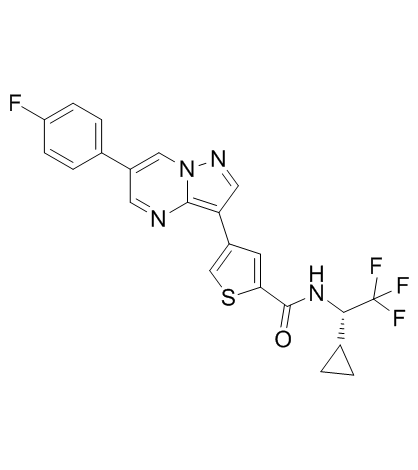
ULK-101 es un inhibidor potente y selectivo de ULK1, con valores IC50 de 1,6 nM y 30 nM para ULK1 y ULK2, respectivamente. ULK-101 suprime la autofagia y sensibiliza las células cancerosas al estrés nutricional.
Products are for research use only. Not for human use. We do not sell to patients.
Cas No.: 2443816-45-1
Sample solution is provided at 25 µL, 10mM.
_1-3.$$$39978408@51.jpg');)
_1-9.$$$38538795@65.jpg');)
_1-9.$$$39112701@51.jpg');)
_1-7.$$$37316672@70.jpg');)
_366-372.$$$36198801@70.jpg');)
.$$$38565142@65.jpg');)
_1867-1883.$$$33248023@67.jpg');)
_eads6055.$$$39977546@45.jpg');)
_eadm9805.$$$40080571@45.jpg');)
_eadj3020.$$$39666821@45.jpg');)
_1-20.$$$39757301@28.jpg');)
_1-24.$$$38898113@28.jpg');)
_273-287.$$$36806353@46.jpg');)
_1-16.$$$37156877@44.jpg');)
_1-19.$$$37460805@44.jpg');)
_1291-1307.$$$34518654@46.jpg');)
ULK-101 is a selective ULK1 inhibitor (IC₅₀=1.6nM) that inhibits ULK2 activity (IC₅₀=30nM). ULK-101 blocks cellular autophagy by inhibiting both autophagy induction and autophagic flux[1-2]. ULK-101 can be used in research related to autophagy mechanisms and cancer, particularly KRAS-mutant lung cancer[3-4].
In vitro, U2OS cells were pretreated with ULK-101 (5μM) for 2.5 hours and then stimulated with AZD8055 (100nM). ULK-101 significantly inhibited the formation of DFCP1-positive puncta and ATG12-positive phagophores. In another experiment, cells were treated with ULK-101 (5μM) for 3 hours, with BafA1 (100nM) added for the final 1.5 hours. This treatment significantly inhibited the accumulation of LC3B-positive vesicles[5]. A549, H1299, and Mv1Lu cells were pretreated with ULK-101 (1μM) for 24 hours and then stimulated with TGFβ1 (250pM). ULK-101 significantly inhibited the trafficking of cell-surface TGFβ receptors to early endosomes, late endosomes, and lysosomes. ULK-101 reduced TGFβ1-induced Smad2/Smad3 phosphorylation, nuclear translocation, expression of epithelial-mesenchymal transition (EMT) markers (N-cadherin, Slug, Snail), stress fiber formation, and cell migration[6].
In vivo, wild-type (WT) mice with house dust mite (HDM)-induced asthma were administered ULK-101 (20mg/kg) via daily intraperitoneal injection for 10 days. ULK-101 administration significantly inhibited the activation of the ULK1/Atg9a signaling pathway and reduced the expression of the NLRP3 inflammasome and its downstream effector molecules, caspase-1 and IL-1β, in lung tissues[7].
References:
[1] Hou W, Xiao C, Zhou R, et al. Inhibiting autophagy selectively prunes dysfunctional tumor vessels and optimizes the tumor immune microenvironment. Theranostics. 2025 Jan 1;15(1):258-276.
[2] Jaeger-Ruckstuhl CA, Lo Y, Fulton E, et al. Signaling via a CD27-TRAF2-SHP-1 axis during naive T cell activation promotes memory-associated gene regulatory networks. Immunity. 2024 Feb 13;57(2):287-302.e12.
[3] Ikeda R, Noshiro D, Morishita H, et al. Phosphorylation of phase-separated p62 bodies by ULK1 activates a redox-independent stress response. EMBO J. 2023 Jul 17;42(14):e113349.
[4] Tian MY, Yang JQ, Hu JC, et al. Semaglutide administration protects cardiomyocytes in db/db mice via energetic improvement and mitochondrial quality control. Acta Pharmacol Sin. 2025 May;46(5):1250-1261.
[5] Martin KR, Celano SL, Solitro AR, et al. A Potent and Selective ULK1 Inhibitor Suppresses Autophagy and Sensitizes Cancer Cells to Nutrient Stress. iScience. 2018 Oct 26;8:74-84.
[6] Trelford CB, Di Guglielmo GM. Autophagy regulates transforming growth factor β signaling and receptor trafficking. Biochim Biophys Acta Mol Cell Res. 2022 Sep;1869(9):119284.
[7] Xu C, Song Y, Liu W, et al. IL-4 activates ULK1/Atg9a/Rab9 in asthma, NLRP3 inflammasomes, and Golgi fragmentation by increasing autophagy flux and mitochondrial oxidative stress. Redox Biol. 2024 May;71:103090.
| Cell experiment [1]: | |
Cell lines | A549 cells (human non-small cell lung cancer cell line), H1299 cells (human non-small cell lung cancer cell line), and Mv1Lu cells (mink lung epithelial cell line) |
Preparation Method | A549 cells were grown in Kaighn’s Modification of Ham’s F‑12 (F‑12K) medium supplemented with 10% fetal bovine serum (FBS). H1299 cells were grown in Roswell Park Memorial Institute (RPMI) medium supplemented with 10% FBS. Mv1Lu cells were grown in Minimum Essential Medium (MEM) supplemented with 10% FBS. All cells were cultured at 37 °C under 5% CO₂, treated with ULK-101(10μM). |
Reaction Conditions | 10μM; 24h. |
Applications | ULK-101 significantly inhibited TGFβ1-induced Smad2/Smad3 phosphorylation, nuclear translocation, and the expression of epithelial–mesenchymal transition (EMT) markers (N‑cadherin, Slug, Snail). ULK-101 attenuated stress‑fiber formation and cell migration. |
| Animal experiment [2]: | |
Animal models | Wild-type (WT) and ULK1 knockout (ULK1⁻/⁻) mice (C57BL/6 background) |
Preparation Method | Mice were intranasally (i.n.) administered house dust mite (HDM) (50µg) on days 0, 7, and 14 for sensitization, and challenged daily with HDM (50µg; i.n.) on days 21-27 to induce asthma. ULK-101 (20mg/kg) was administered during the challenge phase. |
Dosage form | 20mg/kg; i.p.; daily injection for 10 days (from day 17 to day 27). |
Applications | ULK-101 administration significantly inhibited the activation of the ULK1/Atg9a signaling pathway and reduced the expression of NLRP3 inflammasome components and their downstream effectors, caspase-1 and IL-1β, in the lung tissues of HDM-induced asthmatic mice. |
References: | |
| Cas No. | 2443816-45-1 | SDF | |
| Canonical SMILES | FC1=CC=C(C(C=N2)=CN3C2=C(C4=CSC(C(N[C@@H](C5CC5)C(F)(F)F)=O)=C4)C=N3)C=C1 | ||
| Formula | C22H16F4N4OS | M.Wt | 460.45 |
| Solubility | DMSO : 83.33 mg/mL (180.98 mM);Water : < 0.1 mg/mL (insoluble) | Storage | Store at -20°C |
| General tips | Please select the appropriate solvent to prepare the stock solution according to the
solubility of the product in different solvents; once the solution is prepared, please store it in
separate packages to avoid product failure caused by repeated freezing and thawing.Storage method
and period of the stock solution: When stored at -80°C, please use it within 6 months; when stored
at -20°C, please use it within 1 month. To increase solubility, heat the tube to 37°C and then oscillate in an ultrasonic bath for some time. |
||
| Shipping Condition | Evaluation sample solution: shipped with blue ice. All other sizes available: with RT, or with Blue Ice upon request. | ||
| Prepare stock solution | |||

|
1 mg | 5 mg | 10 mg |
| 1 mM | 2.1718 mL | 10.8589 mL | 21.7179 mL |
| 5 mM | 434.4 μL | 2.1718 mL | 4.3436 mL |
| 10 mM | 217.2 μL | 1.0859 mL | 2.1718 mL |
Step 1: Enter information below (Recommended: An additional animal making an allowance for loss during the experiment)
 g
μL
g
μL
Step 2: Enter the in vivo formulation (This is only the calculator, not formulation. Please contact us first if there is no in vivo formulation at the solubility Section.)
Calculation results:
Working concentration: mg/ml;
Method for preparing DMSO master liquid: mg drug pre-dissolved in μL DMSO ( Master liquid concentration mg/mL, Please contact us first if the concentration exceeds the DMSO solubility of the batch of drug. )
Method for preparing in vivo formulation: Take μL DMSO master liquid, next addμL PEG300, mix and clarify, next addμL Tween 80, mix and clarify, next add μL saline, mix and clarify.
Method for preparing in vivo formulation: Take μL DMSO master liquid, next add μL Corn oil, mix and clarify.
Note: 1. Please make sure the liquid is clear before adding the next solvent.
2. Be sure to add the solvent(s) in order. You must ensure that the solution obtained, in the previous addition, is a clear solution before proceeding to add the next solvent. Physical methods such as vortex, ultrasound or hot water bath can be used to aid dissolving.
3. All of the above co-solvents are available for purchase on the GlpBio website.
Quality Control & SDS
- View current batch:
- Purity: >99.50% Appearance: A solid
- COA (Certificate of Analysis)
- SDS (Safety Data Sheet)
- Datasheet
Average Rating: 5 (Based on Reviews and 22 reference(s) in Google Scholar.)