
Guggulsterone |
| رقم الكتالوجGC17658 |
Guggulsterone هو ستيرول نباتي مشتق من صمغ شجرة Commiphora wightiiيمنع Guggulsterone نمو مجموعة متنوعة من الخلايا السرطانية ويحفز موت الخلايا المبرمج من خلال التنظيم السفلي لمنتجات الجينات المضادة للخلايا (IAP1 و xIAP و Bfl-1 / A1 و Bcl-2 و cFLIP و survivin) ، وتعديل بروتينات دورة الخلية (cyclin D1 و c-Myc) ، تفعيل الكاسبيسات و JNK ، تثبيط AktGuggulsterone ، أحد مضادات مستقبلات farnesoid X (FXR) ، يقلل من تنشيط FXR الناجم عن CDCA مع IC50s من 17 و 15 ميكرومتر لـ Z- و E-Guggulsterone ، على التوالي
Products are for research use only. Not for human use. We do not sell to patients.
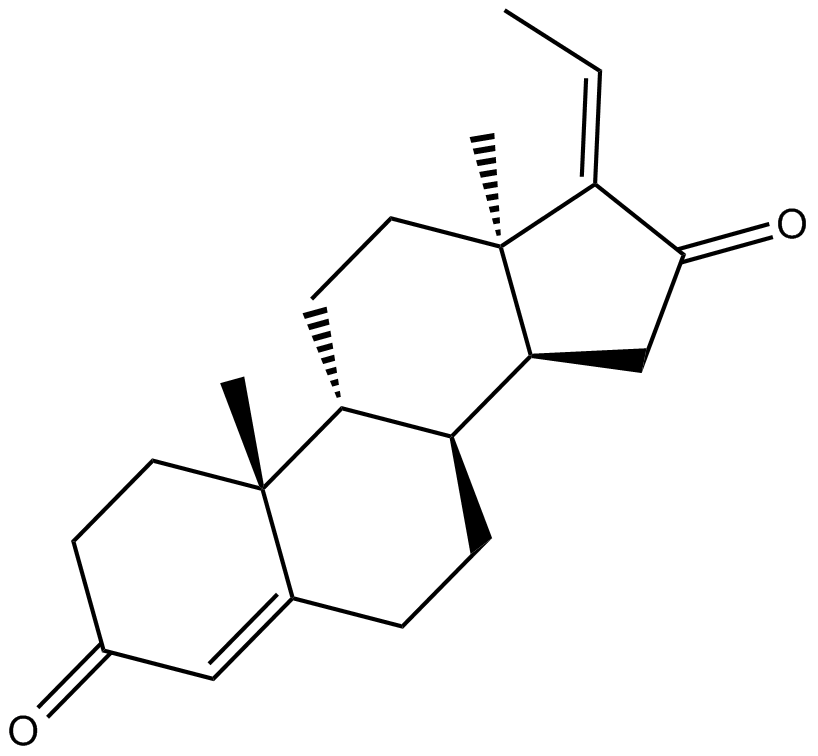
Cas No.: 95975-55-6
Sample solution is provided at 25 µL, 10mM.
Guggulsterone is a plant sterol extracted from the resin of the plant Commiphora wightii. Guggulsterone can inhibit the growth of a wide variety of tumor cells and induce apoptosis through downregulation of antiapoptotic gene products (IAP1, xIAP, Bfl-1/A1, Bcl-2, cFLIP, and survivin), modulation of cell cycle proteins (such as Cyclin D1 and c-Myc), activation of caspases, inhibition of Akt, and activation of JNK[1].
In vitro, Guggulsterone (22.28μM; 8 days) inhibits clone-forming potential of liver cancer cells[2]. Guggulsterone (0, 15, 50 and 75µM; 24h) dose-dependently inhibites SGC-7901 cell proliferation[3].
In vivo, Guggulsterone (5 or 10mg/kg; on days 1, 3, and 5 post-infection; i.p.) decreases mortality in dengue virus (DENV) infected ICR suckling mice[4]. In an in vivo xenograft mouse model, Guggulsterone (20 or 40mg/kg; 14 days; oral administration) significantly reduced tumor growth in a dose-dependent manner[5].
References:
[1] Shishodia S, Azu N, Rosenzweig JA, et al. Guggulsterone for Chemoprevention of Cancer. Curr Pharm Des. 2016;22(3):294-306.
[2] Gupta M, Ghufran SM, Kausar T, et al. Z-Guggulsterone Is a Potential Lead Molecule of Dawa-ul-Kurkum against Hepatocellular Carcinoma. Molecules. 2022 Aug 11;27(16):5104.
[3] Lv R, Zhu M, Chen K, et al. Z-Guggulsterone Induces Apoptosis in Gastric Cancer Cells through the Intrinsic Mitochondria-Dependent Pathway. ScientificWorldJournal. 2021 Jan 4;2021:3152304.
[4] Chen WC, Wei CK, Hossen M, et al. (E)-Guggulsterone Inhibits Dengue Virus Replication by Upregulating Antiviral Interferon Responses through the Induction of Heme Oxygenase-1 Expression. Viruses. 2021 Apr 20;13(4):712.
[5] Wu Y, Zhou T, Qian D, et al. Z-Guggulsterone Induces Cell Cycle Arrest and Apoptosis by Targeting the p53/CCNB1/PLK1 Pathway in Triple-Negative Breast Cancer. ACS Omega. 2023 Jan 3;8(2):2780-2792.
| Cell experiment [1]: | |
Cell lines | Huh7 cells |
Preparation Method | Colony Formation Assay Huh7 cells were seeded into 6-well plates at a density of 800 cells per well and incubated for 24h. After 24h, the cells were treated with 22.28μM Guggulsterone or a vehicle alone. The cells were then incubated for an additional 8 days to allow colonies to form. After incubation, the cells were fixed with 100% methanol at room temperature for 30min, and the plates were air-dried. The colonies were stained with 1% Coomassie blue, washed to remove excess dye, and imaged. The data are presented as percentages of the control group. |
Reaction Conditions | 22.28μM; 8 days |
Applications | Guggulsterone inhibits clone-forming potential of liver cancer cells. |
| Animal experiment [2]: | |
Animal models | Six-day-old ICR suckling mice |
Preparation Method | Six-day-old ICR suckling mice were randomly divided into four groups (five mice per group). Group 1 received 60°C heat-inactivated DENV and saline treatment (iDENV); Group 2 received 2.5 × 10⁵ plaque-forming units (PFU) of DENV and saline treatment (DENV); Group 3 received 2.5 × 10⁵ PFU of DENV and intraperitoneal injection of 5mg/kg Guggulsterone on days 1, 3, and 5 post-infection (DENV + Guggulsterone 5mg/kg); Group 4 received 2.5 × 10⁵ PFU of DENV and 10mg/kg Guggulsterone on days 1, 3, and 5 post-infection (DENV + Guggulsterone 10mg/kg). The body weights and mortality rates of the mice in each group were recorded daily for up to 6 days. To determine the viral titer, six-day-old ICR suckling mice were randomly divided into two groups (five mice per group). Group 1 received 2.5 × 10⁵ PFU of DENV and saline treatment (DENV); Group 2 received 2.5 × 10⁵ PFU of DENV and 10mg/kg Guggulsterone on days 1, 3, and 5 post-infection (DENV + Guggulsterone 10mg/kg). The suckling mice were sacrificed by carbon dioxide euthanasia after 6 days. The brain tissues were collected, weighed, and homogenized in 0.5mL RPMI 1640 medium supplemented with 2% fetal bovine serum, and then centrifuged at 8000rpm for 15min at 4°C. Finally, a plaque assay was performed. |
Dosage form | 5 or 10mg/kg; on days 1, 3, and 5 post-infection; i.p. |
Applications | Guggulsterone decreases mortality in dengue virus (DENV) infected ICR suckling mice. |
References: | |
| Cas No. | 95975-55-6 | SDF | |
| Chemical Name | (8S,9R,10R,13R,14S,E)-17-ethylidene-10,13-dimethyl-7,8,9,10,11,12,13,14,15,17-decahydro-1H-cyclopenta[a]phenanthrene-3,16(2H,6H)-dione | ||
| Canonical SMILES | O=C1C[C@H]([C@@](/C1=C\C)(C)CC2)[C@@H](CC3)[C@@H]2[C@](CC4)(C)C3=CC4=O | ||
| Formula | C21H28O2 | M.Wt | 312.45 |
| الذوبان | DMSO: 62 mg/mL (198.43 mM) | Storage | 4°C, protect from light |
| General tips | Please select the appropriate solvent to prepare the stock solution according to the
solubility of the product in different solvents; once the solution is prepared, please store it in
separate packages to avoid product failure caused by repeated freezing and thawing.Storage method
and period of the stock solution: When stored at -80°C, please use it within 6 months; when stored
at -20°C, please use it within 1 month. To increase solubility, heat the tube to 37°C and then oscillate in an ultrasonic bath for some time. |
||
| Shipping Condition | Evaluation sample solution: shipped with blue ice. All other sizes available: with RT, or with Blue Ice upon request. | ||
| Prepare stock solution | |||
|
1 mg | 5 mg | 10 mg |
| 1 mM | 3.2005 mL | 16.0026 mL | 32.0051 mL |
| 5 mM | 640.1 μL | 3.2005 mL | 6.401 mL |
| 10 mM | 320.1 μL | 1.6003 mL | 3.2005 mL |
Step 1: Enter information below (Recommended: An additional animal making an allowance for loss during the experiment)
Step 2: Enter the in vivo formulation (This is only the calculator, not formulation. Please contact us first if there is no in vivo formulation at the solubility Section.)
Calculation results:
Working concentration: mg/ml;
Method for preparing DMSO master liquid: mg drug pre-dissolved in μL DMSO ( Master liquid concentration mg/mL, Please contact us first if the concentration exceeds the DMSO solubility of the batch of drug. )
Method for preparing in vivo formulation: Take μL DMSO master liquid, next addμL PEG300, mix and clarify, next addμL Tween 80, mix and clarify, next add μL ddH2O, mix and clarify.
Method for preparing in vivo formulation: Take μL DMSO master liquid, next add μL Corn oil, mix and clarify.
Note: 1. Please make sure the liquid is clear before adding the next solvent.
2. Be sure to add the solvent(s) in order. You must ensure that the solution obtained, in the previous addition, is a clear solution before proceeding to add the next solvent. Physical methods such as vortex, ultrasound or hot water bath can be used to aid dissolving.
3. All of the above co-solvents are available for purchase on the GlpBio website.
Quality Control & SDS
- View current batch:
- Purity: >99.50%
- COA (Certificate Of Analysis)
- SDS (Safety Data Sheet)
- Datasheet
Average Rating: 5 (Based on Reviews and 27 reference(s) in Google Scholar.)
GLPBIO products are for RESEARCH USE ONLY. Please make sure your review or question is research based.
Required fields are marked with *


